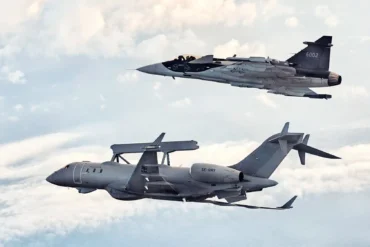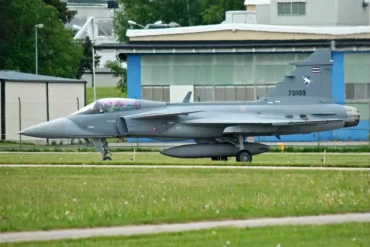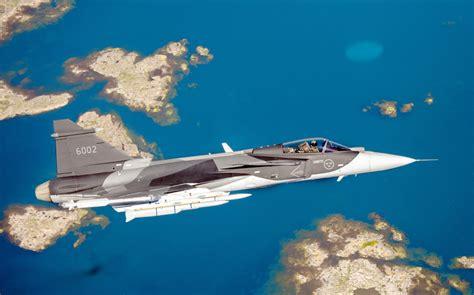
India’s fighter aircraft shortfall has shifted from a long-discussed structural problem into an urgent operational concern, and Saab has stepped forward with a proposal designed to address both numbers and industrial capacity at once. At the Singapore Airshow, the Swedish aerospace group formally offered the Gripen E multirole fighter to the Government of India, pairing the aircraft with an unusually expansive industrial plan that extends well beyond simple assembly. The proposal is framed as a response to the Indian Air Force’s declining squadron strength and its need for a rapidly scalable, technologically modern platform that can be absorbed without overburdening budgets or infrastructure.
Saab’s offer is not positioned as a replacement for India’s existing fighter programs but as a structural reinforcement. The company argues that the Gripen E could be inducted quickly, produced in large numbers, and sustained domestically, providing relief to an air force operating far below its sanctioned strength of 42 squadrons. By emphasizing speed of delivery, software sovereignty, and a distributed industrial ecosystem, Saab is attempting to align its pitch with India’s strategic priorities rather than competing solely on aircraft performance.
The context is unforgiving. Retirements of legacy aircraft, delays in indigenous production, and the rising cost of high-end fighters have created gaps that cannot be closed by incremental upgrades alone. Saab’s proposal seeks to turn that pressure into an opportunity by offering India a fighter program that blends immediate operational utility with long-term industrial leverage.
An Industrial Proposal Designed for Scale and Speed
At the heart of Saab’s pitch is an industrial framework that goes far beyond licensed production. According to the company, the plan would involve more than 300 Indian companies, including tier-1, tier-2, and tier-3 suppliers as well as micro, small, and medium enterprises. Design, production, and sustainment activities would all be embedded within India, creating what Saab describes as a multi-layered aerospace ecosystem rather than a single assembly line.
Initial aircraft would be built in Sweden to accelerate early deliveries, with production shifting to India at a rapid pace. Saab has stated that deliveries could begin as early as the third year after contract signature, followed by a steep ramp-up in output. This timeline is central to the proposal, as it addresses one of the Indian Air Force’s most immediate concerns: how quickly new squadrons can actually be formed and made mission-ready.
Unlike many transfer-of-technology arrangements that leave key intellectual property offshore, Saab emphasizes that the Gripen E’s architecture allows the operator to build, certify, and update its own mission software. For India, this promise of software independence is not a marketing detail but a strategic lever, potentially reducing long-term dependence on foreign upgrade cycles and export approvals.
Where the Gripen E Fits in India’s Fighter Mix
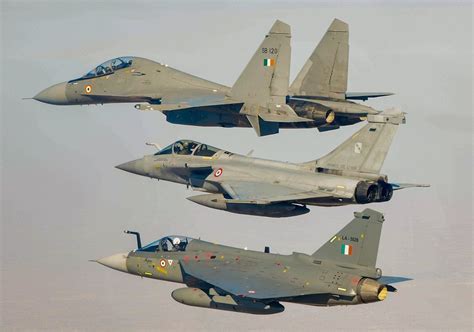
Saab has been careful to frame the Gripen E as a complement, not a competitor, to India’s existing fighters. The Indian Air Force currently operates the Dassault Rafale at the high end and the HAL Tejas at the lighter end, with a complex legacy fleet filling the middle. Saab positions the Gripen E squarely between Rafale and Tejas, both in capability and in cost.
Rafale is optimized for deep strike, heavy payloads, and long-range missions, making it a premium asset that commanders prefer to reserve for critical tasks. Tejas, meanwhile, is intended to rebuild numbers and strengthen domestic production but remains constrained by production rates and subsystem maturity. Saab argues that the Gripen E can be inducted in larger numbers than heavy fighters, increasing the pool of mission-ready aircraft available for daily air defense, patrol, and tactical missions.
This positioning is directly tied to the IAF’s operational reality. With fewer squadrons than planned, high-end assets are often tasked with routine missions, accelerating wear and driving up costs. A medium-weight fighter with high availability and lower operating demands could relieve that pressure while preserving the Rafale fleet for scenarios where its capabilities are truly needed.
Sensors, Software, and Electronic Warfare as Core Strengths
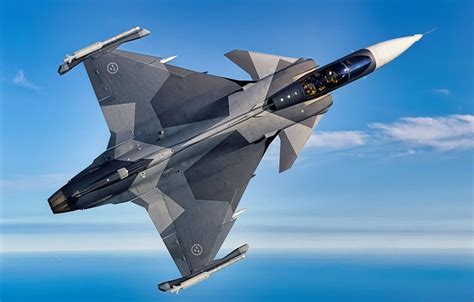
The Gripen E’s design philosophy centers on information dominance rather than brute force. Its sensor suite is built around the Raven ES-05 active electronically scanned array radar, mounted on a swash plate that expands its field of regard. This is paired with an infrared search and track system and an internal electronic warfare suite providing full 360-degree spherical coverage.
What distinguishes the Gripen E in Saab’s narrative is not any single sensor but the way they are fused. The aircraft’s modular avionics architecture separates mission systems from flight-critical software, enabling rapid updates without extensive recertification. Saab states that this allows operators to integrate national systems, electronic warfare logic, and even artificial intelligence functions directly into the avionics core.
For India, this approach contrasts with platforms where upgrades remain tightly coupled to manufacturer-controlled timelines. Saab explicitly highlights that the Indian Air Force would be able to qualify and certify its own software, a capability that could shorten upgrade cycles and reduce the risk of prolonged fleet grounding during modernization.
A Different Basing and Survivability Model
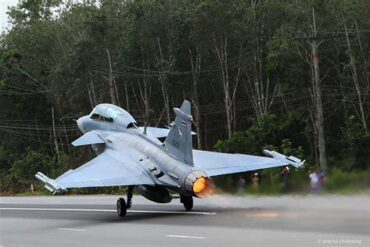
Operational resilience is another pillar of Saab’s argument. The Gripen E is engineered to operate from dispersed and unprepared bases, including roads and short airstrips, reflecting Swedish doctrine developed during the Cold War. This design choice influences everything from landing gear strength to maintenance philosophy.
Saab claims that for air-to-air missions, the Gripen E can be refueled and rearmed in under 15 minutes using a limited ground crew. General combat turnaround times are cited in the 15 to 25 minute range. In a high-intensity conflict, this ability to generate sorties from austere locations could complicate an adversary’s targeting calculus and reduce reliance on large, fixed air bases.
India’s current fighter fleet is largely structured around conventional air base operations. While hardened shelters and dispersal plans exist, Saab argues that the Gripen E introduces a qualitatively different model of survivability, one that emphasizes mobility, rapid turnaround, and operational flexibility under attack.
Technical Profile of the Gripen E
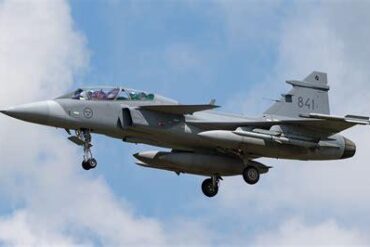
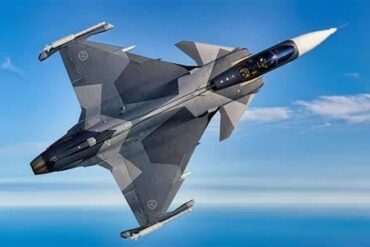
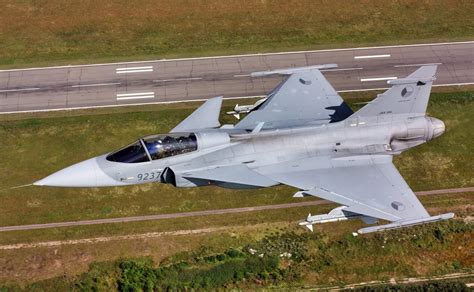
The Gripen E is a single-seat multirole fighter developed as a substantial redesign of earlier Gripen variants. Measuring 15.2 meters in length with an 8.6-meter wingspan, it falls squarely into the medium-weight category. Maximum takeoff weight is approximately 16,500 kilograms, reflecting increased internal fuel capacity compared to earlier models.
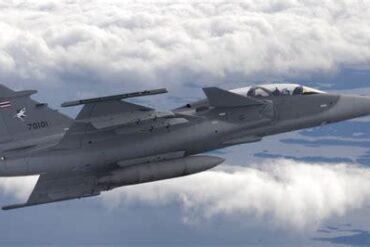
Power is provided by the GE F414G turbofan engine, rated at around 98 kN of thrust, enabling speeds above Mach 2 and maneuvering limits of up to +9 g. The aircraft features ten external hardpoints and supports air-to-air refueling, allowing flexible loadouts across air defense, strike, and reconnaissance missions. A Mauser BK 27 mm internal cannon is fitted as standard.
The design prioritizes endurance and availability rather than raw payload. Saab argues that longer on-station time without external tanks and high sortie generation rates can be as decisive as carrying maximum weapons on a single mission.
Weapons Flexibility and Networked Operations
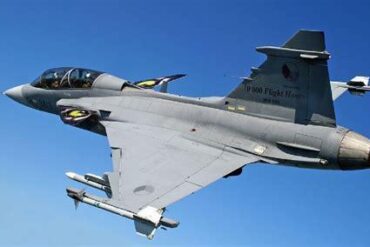
Gripen E is designed to integrate a wide range of international weapons, including Meteor beyond-visual-range missiles and IRIS-T within-visual-range missiles. Its ten hardpoints allow simultaneous carriage of weapons, targeting pods, electronic attack pods, and reconnaissance systems, depending on mission needs.
The integrated electronic warfare system supports radar warning, missile approach warning, electronic countermeasures, and electronic attack, enabling both self-protection and escort missions. Networked operations are central to the concept, with support for Link 16, national data links, and IFF Mode 5. Saab emphasizes that the aircraft’s value increases when operating as part of a networked force rather than as an isolated platform.
The cockpit reflects this philosophy, featuring a wide area display and helmet-mounted sight that present fused sensor data to the pilot. The goal is to reduce workload and speed decision-making, particularly in complex air combat environments.
India’s Broader Fighter Dilemma
The appeal of Saab’s proposal becomes clearer when viewed against India’s broader fighter landscape. Alongside Rafale and Tejas, the Indian Air Force operates Su-30MKI, upgraded MiG-29s, Mirage 2000s, and Jaguars. Many of these platforms require life-extension programs, foreign support, or ad hoc solutions to remain operational.
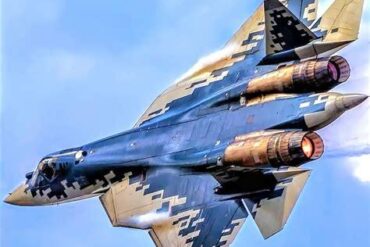
India has sought external assistance to keep Jaguars flying, signed agreements to modernize Russian-origin fighters, and continues to debate its future stealth fighter path, whether through the indigenous AMCA program or foreign options such as the F-35 or Su-57. Each of these decisions carries cost, timeline, and sovereignty implications.
In this environment, Saab presents the Gripen E as a way to address three problems simultaneously: restoring squadron numbers, increasing production capacity, and modernizing capabilities without locking India into rigid foreign control structures. The emphasis on local industry and software autonomy is intended to resonate with long-standing policy goals rather than short-term procurement fixes.
Strategic Implications of a Gripen Line in India
If realized, a Gripen E production line in India would have implications beyond immediate force levels. It would embed a modern fighter ecosystem within the country, potentially supporting upgrades, exports, and future indigenous programs. Saab’s willingness to involve hundreds of companies suggests an attempt to anchor itself deeply within India’s aerospace landscape rather than remain a transactional supplier.
The proposal also reflects a broader shift in fighter competition. Instead of selling only performance metrics, manufacturers are increasingly selling industrial relevance, operational resilience, and adaptability to national doctrines. Saab’s pitch to India fits squarely within this trend.
Whether the Gripen E ultimately secures a place in the Indian Air Force will depend on political decisions, budgetary realities, and strategic alignment. What is clear is that Saab has tailored its offer to India’s specific constraints and ambitions, framing the Gripen E not merely as another fighter jet, but as a tool to rebuild numbers, capability, and industrial depth at the same time.