Flying a Precision Runway Monitor (PRM) approach is one of the most technically demanding procedures in modern instrument flight. These approaches allow for simultaneous independent operations to parallel runways spaced closer than 4,300 feet—requiring precision, sharp situational awareness, and exact adherence to ATC instructions. As we guide you through this high-stakes maneuver, we’ll break down every phase, from setup to breakout protocols, ensuring a full comprehension of what makes a PRM approach uniquely intense and critically important in maximizing airport efficiency in IFR conditions.
Understanding PRM Approaches: Purpose and Conditions
A PRM approach is designed to increase arrival throughput during low-visibility conditions at airports with closely spaced parallel runways. Airports like Chicago O’Hare, Atlanta Hartsfield-Jackson, Detroit Metro, and San Francisco International employ PRM approaches to maintain traffic flow when simultaneous ILS operations would otherwise be restricted.
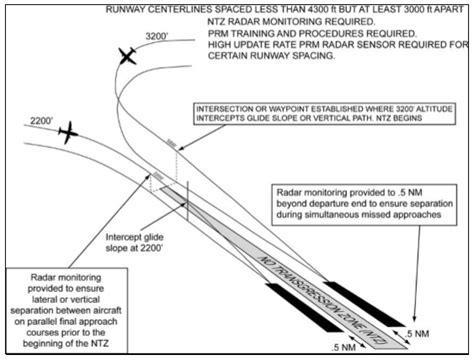
Unlike traditional parallel runway operations, PRM approaches rely on an array of technological and procedural tools, including high-update radar systems, No Transgression Zones (NTZs), and dedicated monitor controllers. These approaches are published as RNAV (GPS), LDA, or ILS PRM procedures, and despite their complexity, they do not require special onboard navigation equipment. The challenge lies not in the airplane’s capabilities, but in the pilot’s performance and preparation.
PRM Approach Chart Elements and Setup
Flying a PRM approach begins with detailed pre-briefing using the approach plate and its associated Attention All Users Page (AAUP). This briefing must address:
- Breakout procedures and expectations
- Communication setups
- Visual approach guidance (if applicable)
- Missed approach and climb-out instructions
One of the most distinctive features of a PRM chart is the dual communication requirement. The primary communication channel (COM 1) is used to communicate with the local tower controller, while COM 2 is passively monitoring the monitor controller frequency. At no time during the approach should pilots transmit on the monitor frequency; its sole function is to provide instant breakout instructions when aircraft proximity triggers intervention protocols.
Communication Discipline and Dual VHF Requirement
Aircraft conducting PRM approaches must be equipped with dual VHF radios. One radio must be tuned to the active tower frequency, where routine communication occurs. The second must continuously monitor the dedicated monitor frequency, ensuring pilots receive breakout instructions in real time without interference.
This dual-receive protocol ensures that if a pilot is transmitting or receiving on tower frequency, the monitor controller can still intervene instantly with instructions to avert a loss of separation. The monitor controller always has priority in the event of a conflict—making discipline in monitoring both channels a cornerstone of PRM execution.
Air Traffic Control Surveillance and the NTZ
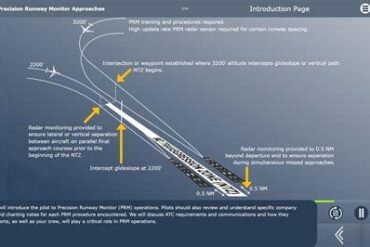
The heart of a PRM approach lies in real-time ATC monitoring. Air traffic controllers rely on high-resolution, high-update radar systems capable of detecting minute course deviations within seconds. These systems project a ten-second future aircraft position, allowing controllers to anticipate intrusions into the No Transgression Zone (NTZ)—a narrow buffer space separating the two approach paths.
Each runway in a PRM approach has:
- A local tower controller managing normal operations
- A monitor controller dedicated to conflict detection and breakout commands
Should any aircraft deviate toward the NTZ or pose an imminent threat to separation, the monitor controller will issue immediate breakout instructions. These events require pilots to respond without hesitation.
Breakout Protocols: Immediate and Manual Response
If ATC issues a breakout—typically in response to another aircraft penetrating the NTZ—pilots must disconnect the autopilot and manually execute the instructed maneuver. Breakout instructions may sound like:
“Traffic Alert! JetBlue 432, turn right immediately heading 220. Climb and maintain 3000.”
Such directives are not optional, and timing is critical. Any delay in execution may result in a serious conflict. All PRM breakouts must be hand flown—automation is not permitted during this maneuver due to the immediacy and dynamic nature of the response.
In situations where a TCAS Resolution Advisory (RA) contradicts the vertical component of ATC’s instruction, the pilot must prioritize the RA for climb or descent, while still complying with the horizontal turn direction provided by ATC.
FAA Training and Operational Authorization
Not all pilots or operators are authorized to fly PRM approaches. Authorization depends on:
- Part 121, 129, and 135 operators: Must complete approved training per Op Specs
- Part 91 transport category operators: Must comply with AIM Section 5-4-44 and view the FAA’s PRM training video
- Part 91 general aviation pilots (non-transport): Must be familiar with AIM guidance
Although not required for every operator, the FAA strongly recommends completing its PRM training video and reviewing associated documentation before attempting a PRM procedure.

Offset Approaches and Simultaneous Offset Instrument Approaches (SOIA)
Some PRM approaches include offset final approach courses, typically between 2.5 to 3 degrees, to provide additional visual separation. These are most commonly found in SOIA procedures used at locations like San Francisco, where geographic or airspace constraints limit runway spacing.
Offset courses place increased responsibility on the pilot for visual acquisition of traffic on the parallel path. PRM charts will include additional notes and visual segment markers, alerting pilots to the point where visual separation must be established.
Safety Implications and Human Factors
The complexity of PRM operations places an intense cognitive load on pilots. Strict adherence to checklist procedures, sterile cockpit discipline, and clear crew coordination are vital. Any lapse in attention or miscommunication during a breakout could quickly escalate into a near-miss or worse.
Simulator training or scenario-based briefings significantly enhance a pilot’s readiness to interpret and react to unplanned breakout scenarios. CRM (Crew Resource Management) principles are especially critical when one pilot is flying and the other is monitoring multiple frequencies.
Conclusion: Precision and Discipline Define PRM Mastery
Flying a PRM approach is not merely a test of instrument proficiency—it’s an orchestration of navigation precision, real-time communication, and high-speed decision-making. Airports that utilize PRM procedures do so to maximize IFR arrival capacity safely, but this benefit can only be realized when pilots are fully briefed, properly trained, and capable of handling high-consequence maneuvers under pressure.
As procedures evolve and traffic continues to grow at hub airports, PRM operations will remain a cornerstone of advanced terminal arrival programs. For professional and general aviation pilots alike, developing competence in PRM execution ensures safety and operational excellence in the most challenging terminal environments.