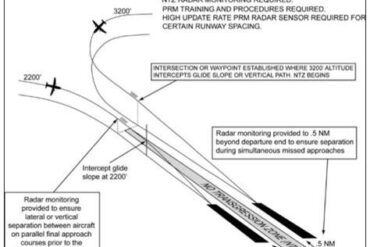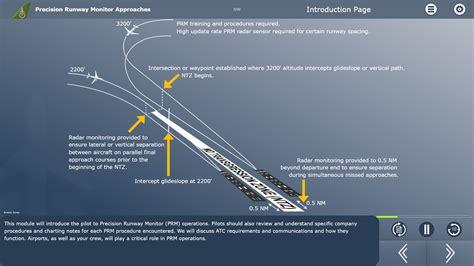
The Precision Runway Monitor (PRM) system allows independent, simultaneous operations on runways that are spaced between 2,500 and 4,300 feet apart. Typically, the approach courses are parallel, but they can be offset by 2.5 to 3.0 degrees based on runway separation. This system offers air traffic controllers precise, high-update secondary surveillance data to monitor the No Transgression Zone (NTZ) during PRM approaches.
Pilots must undergo specific training for PRM approaches, as outlined in company policy or the Aeronautical Information Manual (AIM) for general aviation. During the approach, pilots are required to listen to both the PRM monitor frequency and the Tower frequency, which necessitates dual VHF communication. This setup helps prevent any missed “breakout” instructions. The tower transmits on both frequencies, while aircraft only transmit on the Tower frequency. Each PRM runway is managed by one Tower Controller and one Monitor Controller, who watches for off-course deviations, especially those heading toward the NTZ, which acts as a safety buffer between parallel runways.
If an aircraft strays off its course, the monitor will work to guide it back on track. In cases where a conflict arises, such as an aircraft entering the NTZ, the monitor may issue a “breakout” instruction. This usually involves a turn away from the NTZ and typically a climb, though a descent is rare. Pilots must execute this instruction immediately, meaning all “breakouts” are performed manually. While “breakouts” are infrequent, crews should prepare by reviewing their aircraft’s specific procedures for handling such calls. This includes discussing autopilot, flight director, pitch, roll, and power management before starting the PRM approach.
If a TCAS alert triggers a climb or descent Resolution Advisory (RA) that contradicts the controller’s instruction during a “breakout,” pilots should prioritize the TCAS RA while executing the turn as directed by the controller. For more details, refer to the separate article on Simultaneous Close Parallel PRM Approach.