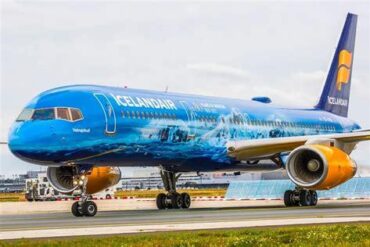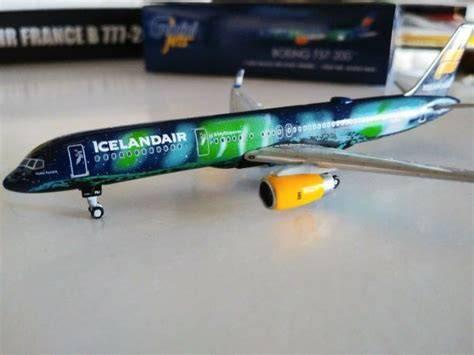
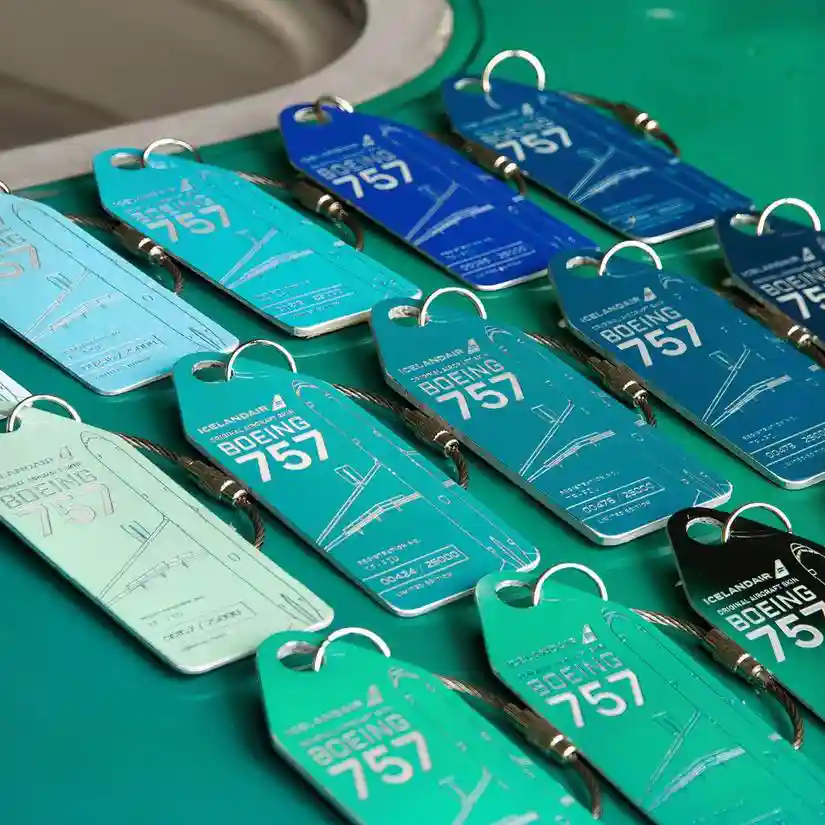
Icelandair’s iconic Boeing 757 TF-FIU, famous for its distinctive Northern Lights livery, has reached the end of its flying career—but its story has taken an unexpected turn. Rather than disappearing completely after being dismantled, pieces of the aircraft are now being transformed into collectible aviation keychains, allowing enthusiasts to own a physical fragment of one of Icelandair’s most recognizable aircraft.
The aircraft, known as Hekla Aurora, was retired in 2025 after more than three decades of aviation service. Its final chapter initially appeared to be a familiar one: storage, dismantling, and recycling. Yet Aviationtag, a German company specializing in aircraft upcycling, recovered sections of the fuselage before the aircraft was destroyed. The result is a limited collection that preserves part of the jet’s extraordinary visual identity.
From Icelandair Icon to Aviation Collectible
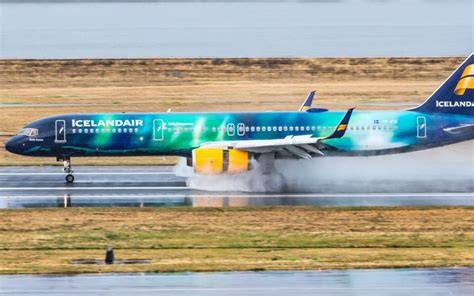
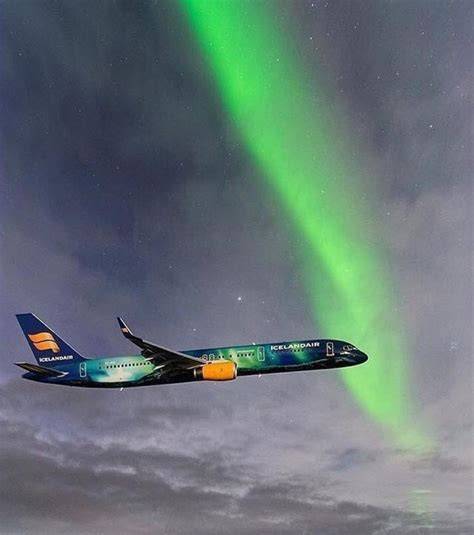
The transformation is particularly meaningful because TF-FIU was not an ordinary Boeing 757. Although the aircraft entered Icelandair service in 2004, it became internationally recognizable after receiving its unique Northern Lights-inspired appearance in 2014. The colorful design represented Iceland’s natural beauty and quickly became a favorite among aviation enthusiasts and photographers.
The aircraft was originally ordered by Iberia on May 25, 1990. Carrying manufacturer’s serial number 26243, it first flew on April 8, 1994, before being delivered to the Spanish carrier on July 29 of that year. It later operated for Air Europa, adding further chapters to a career that eventually brought it to Icelandair.
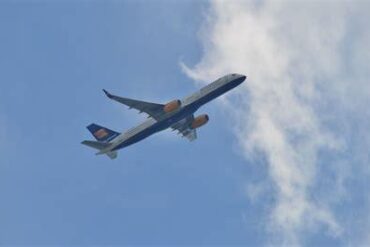
Once at Icelandair, TF-FIU spent years performing the airline’s demanding international operations. By July 31, 2025, the aircraft had accumulated 80,059 flight hours and 29,217 flights, according to ch-aviation data. Its cabin contained 183 seats, including 161 economy seats and 22 business-class seats, meaning thousands of passengers experienced the aircraft long before its unusual second life began.
The Final Flight of TF-FIU
Icelandair gave the aircraft a farewell worthy of its status. On October 12, 2025, TF-FIU departed Keflavík International Airport for Reykjavik Airport before embarking on a two-hour-and-22-minute flight around Iceland. It returned to Reykjavik and later continued flying additional missions, including trips to Rome and Copenhagen.
Its final positioning flight came on November 6, 2025, when the Boeing 757 departed Keflavík for Lleida Airport in Spain. After more than four hours in the air, it landed at 14:11, ending its operational career.
Lleida would become the aircraft’s final destination, but not quite the end of its story. The jet remained there before Aviationtag arrived to rescue sections of its fuselage. Heavy machinery eventually dismantled the remaining aircraft, producing striking footage that showed the once-famous Icelandair jet being reduced to its constituent materials.
Aviationtag Turns the Fuselage Into Keychains
The preservation effort began in earnest in June 2026, when Aviationtag’s team traveled to Lleida. Working in temperatures above 40 degrees Celsius, the team cut hundreds of sections from the Boeing 757’s fuselage. Those pieces were subsequently transported to the outskirts of Cologne, Germany, where they underwent further processing.
Each recovered section was cut into smaller pieces suitable for the finished product and laser engraved with an individual edition number. This approach gives the resulting keychains more significance than a conventional aviation souvenir. Each one represents a small, tangible piece of an aircraft that once crossed the Atlantic wearing one of the most distinctive liveries in commercial aviation.
Aviationtag produced a limited run of 25,000 pieces, with prices beginning at €39.95. For aviation enthusiasts, the appeal lies not only in the collectible itself but also in its provenance. The material once formed part of TF-FIU, meaning every tag connects directly to the physical aircraft.
Why the Northern Lights Livery Matters
The aircraft’s colorful identity is central to the appeal of the collection. Icelandair’s Northern Lights design transformed an otherwise familiar Boeing 757 into an instantly recognizable ambassador for Iceland.
That distinction matters because aircraft liveries normally disappear when an airplane is retired or repainted. With TF-FIU, however, portions of the Northern Lights livery have been preserved in another form. Instead of remaining attached to a dismantled fuselage, fragments can now travel around the world with the people who collect them.
Tobias Richter, Aviationtag’s co-founder, described Hekla Aurora as an aircraft whose livery, history, and emotional connection made it especially important to preserve. That sentiment captures why aviation upcycling can be more meaningful than simple recycling: it retains a connection between the material and the aircraft’s identity.
A Boeing 757 That Refused to Disappear
TF-FIU’s fate illustrates how an aircraft can remain culturally relevant even after its flying days are over. The Boeing 757 itself may now be gone, but its Northern Lights livery, operational history, and physical remains continue through thousands of small collectibles.
For Icelandair fans, Boeing 757 enthusiasts, and aviation memorabilia collectors, the keychains offer something unusual. They are not merely souvenirs bearing an aircraft registration. They contain material recovered from the actual aircraft.
The story of TF-FIU therefore ends in a fittingly unconventional way. A Boeing 757 that once carried passengers across the North Atlantic has been dismantled, but it has not completely disappeared. Pieces of Hekla Aurora are still traveling—only now in the pockets, luggage, and collections of aviation enthusiasts around the world.