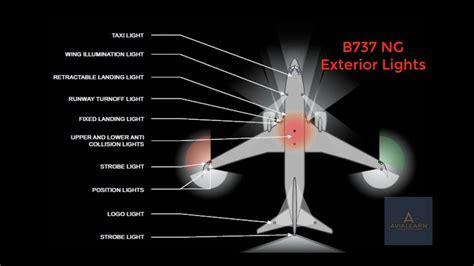
The Boeing 737 has changed dramatically since the first aircraft entered service in the 1960s, but some of its most interesting differences are hidden in places passengers rarely notice. One of those changes involves the landing lights. Older members of the 737 family could extend their landing lights into the airflow when they were needed and retract them into the aircraft afterward, a clever arrangement that reduced aerodynamic drag while preserving powerful illumination for low-altitude operations.
The system made particular sense on an aircraft designed around efficiency and simplicity. A landing light needs to be useful close to the ground, but there is little reason to expose a relatively large lighting assembly to the airflow throughout the entire flight. The solution adopted by Boeing was to keep the lights tucked away for much of the journey and deploy them when required. It was a small mechanical feature, but it demonstrated the engineering priorities of earlier generations of the 737.
As the 737 evolved, however, Boeing eventually abandoned the retractable arrangement. The change was not caused by a fundamental problem with landing lights themselves. Instead, improvements in LED lighting technology, combined with maintenance considerations, component durability and aerodynamic design, made the older system increasingly difficult to justify. Starting in 2015, newer 737 Next Generation aircraft received a fixed LED lighting arrangement, and the same basic approach became part of the 737 MAX.
Why Boeing 737 Landing Lights Were Originally Retractable
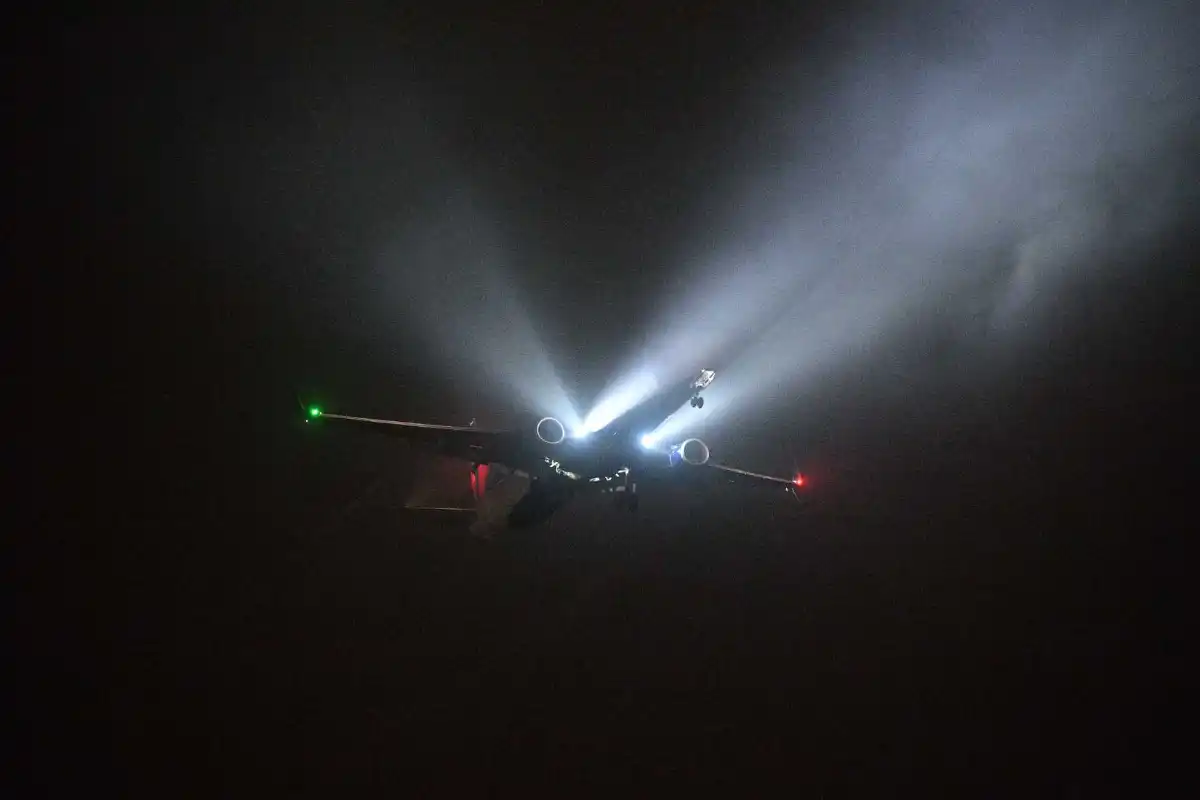
Landing lights serve a different purpose from many of the lights passengers see around an aircraft. They provide intense forward illumination during low-altitude portions of a flight and also make the aircraft more visible to other aircraft and people on the ground. Because they are powerful and generally used when operating close to the airport, their location and aerodynamic characteristics matter.
The original 737-100 and 737-200 featured an outboard landing-light arrangement that mechanically extended below the outboard flap-track bearing area. The same basic concept continued into the Boeing 737 Classic family. When the lights were needed, the mechanism moved them into position. Once their job was finished, they could be withdrawn from the airflow.
This arrangement provided an obvious aerodynamic advantage. Anything projecting into the air stream creates additional drag, and landing-light assemblies are no exception. At cruise speed, even a relatively small protrusion can require additional thrust to overcome the resulting aerodynamic resistance. By retracting the lights, Boeing could remove that source of drag for the majority of the flight.
The idea remained relevant when Boeing developed the 737 Next Generation. Rather than retaining exactly the earlier installation, Boeing relocated the retractable landing lights to the underside of the fuselage. They were positioned underneath the engine ram-air intakes, creating a different physical arrangement while retaining the basic principle: deploy the lights when necessary and hide them when they were no longer needed.
For pilots, that meant the landing-light system required more than a simple on-or-off decision. The cockpit controls included positions for RETRACT, EXTEND and ON. A pilot could extend the lights first and then illuminate them when appropriate, an operating procedure that was particularly useful around clouds and fog where reflected light could otherwise be distracting.
The Hidden Cost of Retractable 737 Landing Lights
Although retractable landing lights offered an aerodynamic benefit, they also introduced mechanical complexity. The lights had to move, remain properly aligned, tolerate repeated cycles and survive the demanding environment outside an aircraft. They were exposed to vibration, weather and potential foreign object damage, particularly during ground operations and low-altitude flight.
The lamps themselves were another important consideration. Earlier systems used Parabolic Aluminized Reflector, or PAR, lamps, which had a relatively short operating life of roughly 70 hours. For an airline operating a large fleet, a component with such a short service life creates a continuing maintenance burden. Replacing lamps may seem insignificant compared with an engine overhaul, but thousands of aircraft cycles and countless operating hours turn small maintenance requirements into substantial costs.
The aerodynamic benefit was also not simply theoretical. According to the reference material, operating the older lights in their extended configuration from takeoff until 10,000 feet could consume approximately 26.5 pounds, or 12 kilograms, of additional fuel. Another estimate cited a fuel-burn reduction of around 2 percent when the lights were retracted. The precise effect varies with operating conditions, but the underlying engineering principle is straightforward: keeping unnecessary equipment out of the airflow reduces drag.
That made the retractable system a logical solution when lighting technology required relatively bulky and maintenance-intensive lamps. But once LED technology became sufficiently capable, Boeing had another option that addressed several disadvantages at once.
Boeing Replaced the Retractable System With LEDs
The decisive change came in 2015, when Boeing introduced a new LED Landing, Taxi and Runway Turnoff Lights, or LTRTL, system for later-build 737 Next Generation aircraft. The retractable landing lights, retractable taxi lights and runway turnoff lights were replaced by fixed LED light arrays integrated into the aircraft’s wing roots.
Instead of moving into and out of the airflow, the new lights sit behind protective outer surfaces. The installation is visually closer to the way modern automobile headlights are integrated into a vehicle body. This allowed Boeing to eliminate the moving mechanisms while retaining an aerodynamic external shape.
The change began with aircraft 3,846 in the 737 production sequence and was subsequently incorporated into the 737 MAX. That means two 737 Next Generation aircraft can look almost identical from a distance while having noticeably different lighting hardware underneath their skin.
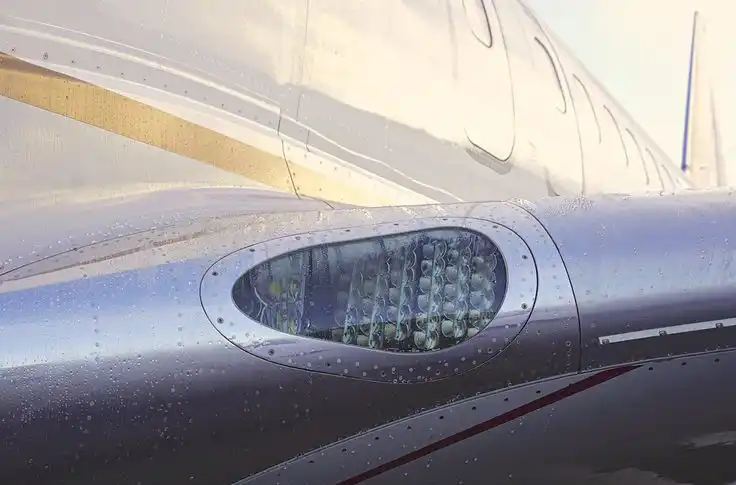
The most important advantage was maintenance. LED light sources can operate for dramatically longer periods than traditional PAR lamps. The reference material gives an approximate operational life of 10,000 hours for the LED units, compared with roughly 70 hours for the older PAR lamps. That difference changes the economics of maintaining a fleet.
The LED installation also eliminated the mechanical movement associated with retracting and extending the lights. With fewer moving parts exposed to the environment, there were fewer opportunities for mechanical wear, damage or malfunction. The fixed units were better protected from the combination of vibration, weather and foreign object damage that could affect the older retractable assemblies.
Boeing also estimated a weight saving of approximately 16 pounds, or 7.3 kilograms, from the new arrangement. That may sound trivial when compared with the maximum takeoff weight of a 737, but commercial aircraft engineering is full of small savings. A few pounds saved in one system can become meaningful when multiplied across years of operation and combined with weight reductions elsewhere.
The Change Also Altered How 737 Pilots Use the Lights
The disappearance of the retractable mechanism did more than change the hardware. It simplified the way pilots operated the system and changed the altitude guidance associated with the lights.
With the older retractable arrangement, pilots had to manage both illumination and physical deployment. The lights needed to be extended before they could be used, and the system was designed around retracting them as the aircraft climbed. The newer fixed LED arrangement removed that additional mechanical step.
The operating guidance also changed. The retractable landing lights were required to be turned off when passing through 10,000 feet, while the fixed landing lights could remain on to a considerably higher altitude, with the stated limit reaching 18,000 feet. This gave crews more flexibility in deciding how the lights should be used during climb.
The cockpit controls were also reorganized around the fixed LED arrays. The taxi light has its own control, while runway turnoff lights have separate left and right controls. The landing-light switches operate the main high-power portions of the LED array. Because there is no longer a need to command the lights mechanically into position, the cockpit no longer needs the same extend-and-retract procedure.
That is a good example of how a seemingly minor engineering change can affect both the aircraft and the people operating it. The passenger may never notice the difference, but maintenance personnel, pilots and airline fleet planners all interact with the system differently.
Why Boeing Did Not Retrofit Every Existing 737
One of the most interesting aspects of the transition is that Boeing did not simply replace the old landing lights on every existing aircraft. The new system required substantial structural and wiring modifications, making a universal retrofit less attractive.
As a result, some older 737 aircraft continued flying with their original retractable landing-light arrangements even after Boeing had introduced the fixed LED system on later production aircraft. This explains why the feature can appear to have disappeared gradually rather than overnight.
From the outside, the distinction may be difficult for a casual observer to recognize. Both systems perform the same broad function, but one relies on a mechanical assembly that moves into the airflow while the other integrates LED light sources into a fixed aerodynamic structure.
The decision illustrates an important reality of aircraft design: a newer technology does not automatically become a universal replacement for an older one. Retrofitting an aircraft can require removing panels, changing wiring, modifying structures and certifying the resulting configuration. If the operational and financial benefits do not justify that work, airlines can continue operating the older equipment until the aircraft itself eventually leaves service.
The 737 MAX Shows How Much Has Changed Beneath the Familiar Shape
The landing-light story is also a useful reminder that the 737 MAX is far removed from the aircraft Boeing first introduced in the 1960s, even though the family resemblance remains obvious.
The MAX uses a modern glass cockpit with four large 15.1-inch LCD displays arranged in landscape orientation. The cockpit is considerably more advanced than the analog flight decks of the 737-100 and 737-200. Yet Boeing has retained other elements of the original aircraft’s philosophy, including the distinctive manual trim wheel available to pilots as a backup to electronic trim systems.
This mixture of old and new is one of the defining characteristics of the 737. Some systems have been comprehensively modernized, while other design choices have been preserved because they remain useful or because changing them would have consequences far beyond the individual component.
The aircraft’s low stance is another example. The original 737 was designed with relatively short landing gear, allowing easier access to the aircraft and reducing the need for specialized ground equipment. But modern high-bypass turbofan engines have become much larger than the engines available when the 737 was designed.
Boeing responded by moving the engines forward and upward and using specially shaped nacelles to provide the necessary clearance. Those changes contributed to aerodynamic and handling differences that had to be addressed through the evolution of the aircraft’s systems and flight-control logic.
A Small Landing-Light Change Reveals the 737’s Larger Engineering Story
The disappearance of retractable landing lights therefore tells a much larger story about how the Boeing 737 has evolved. The original solution made sense when mechanical deployment reduced drag and conventional lamps were the available technology. Decades later, LEDs offered much longer service lives while fixed installations eliminated mechanisms that were vulnerable to wear, vibration and damage.
The change also demonstrates why aircraft modernization is rarely about replacing one component with something simply newer. Boeing had to consider aerodynamics, electrical wiring, structure, maintenance, weight, reliability and cockpit procedures before adopting the new lighting system. The result was a feature that passengers barely notice but that can reduce maintenance requirements throughout an aircraft’s operating life.
The 737 MAX retains the fixed LED approach, meaning that the retractable landing light has effectively become a feature associated with earlier generations of the aircraft. Some older 737s can still reveal the mechanical system to careful observers, but newer examples have replaced that visible piece of aviation machinery with a cleaner, simpler and longer-lived lighting arrangement.
For an aircraft family that has survived more than half a century of technological change, that is hardly unusual. The 737’s most recognizable features often attract the most attention, yet some of its most revealing changes are hidden in small systems such as landing lights. In this case, the disappearance of a retractable light is a quiet example of how advances in technology can gradually erase mechanical features that once seemed essential to an aircraft’s design.