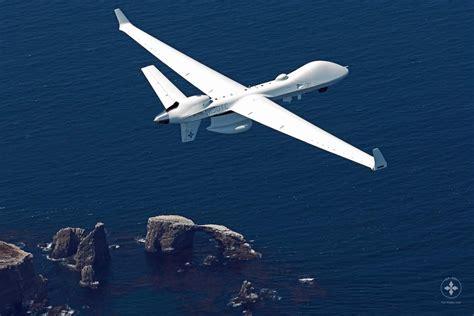
India has taken a decisive leap in bolstering its maritime surveillance capabilities with the approval of two additional MQ-9B Sea Guardian drones, a critical asset for long-endurance intelligence, surveillance, and reconnaissance (ISR) missions in the vast Indian Ocean Region. The decision, cleared by the Defence Acquisition Council (DAC) chaired by Defence Minister Rajnath Singh, comes at a strategic juncture marked by increasing Chinese naval presence and growing maritime tensions across the Indo-Pacific.
Strategic Significance of the Lease
The newly approved lease, valued at ₹1,600 crore, expands India’s Sea Guardian fleet to four units. Originally inducted under emergency procurement in 2020, the first two MQ-9Bs have logged over 12,000 hours of operational sorties, demonstrating their reliability and mission effectiveness. The lease model enables India to rapidly enhance surveillance capacity without being bogged down by the complexities of a long-term acquisition pipeline.
Stationed at Naval Air Station Rajali in Tamil Nadu, the Sea Guardians will remain under Indian operational command while the contractor—U.S.-based General Atomics—handles technical and maintenance support. This model, proven since initial deployment, ensures maximum uptime and mission readiness without diverting naval personnel from core responsibilities.
MQ-9B Sea Guardian: A Technological Force Multiplier
The MQ-9B Sea Guardian is a maritime-enhanced variant of the battle-proven MQ-9 Reaper, uniquely tailored for long-duration missions over vast oceanic expanses. It is engineered for:
- 40+ hours of endurance, allowing sustained surveillance over strategic sea lanes.
- 6,000+ nautical miles range, providing full coverage of India’s maritime zones.
- Operational ceiling of 40,000 feet, ideal for high-altitude ISR.
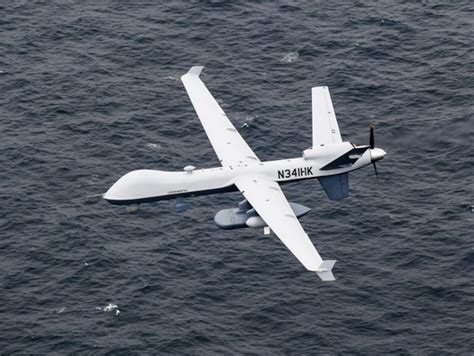
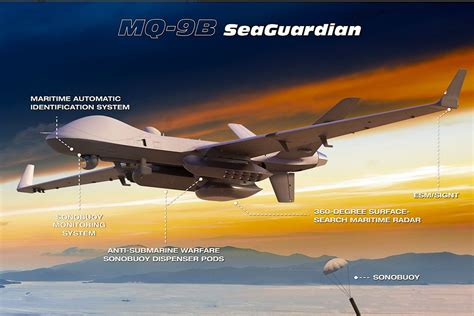
Powered by a Honeywell TPE331-10 turboprop engine, the Sea Guardian cruises at over 310 km/h. Its sensor suite includes synthetic aperture radar (SAR), inverse SAR, and EO/IR systems, which offer high-resolution imaging in diverse conditions. The drone’s Automatic Identification System (AIS) enables real-time tracking of maritime traffic, a crucial tool for monitoring both commercial and military vessels.
Addressing the Chinese Naval Challenge
India’s move comes amid a noticeable uptick in Chinese naval deployments in the Indian Ocean, particularly near chokepoints such as the Malacca Strait, Andaman Sea, and Arabian Sea. These waterways form the lifelines of global commerce and energy flows, making them strategic flashpoints. Chinese submarines and surface ships have been detected operating more frequently in these regions, prompting India to reevaluate its surveillance posture.
With the enhanced Sea Guardian fleet, the Indian Navy will be able to sustain persistent ISR coverage across key maritime corridors, including the Bay of Bengal and waters around the Andaman and Nicobar Islands. These drones act as a digital sentry, capable of detecting, tracking, and cataloging maritime movements with a precision unmatched by manned aircraft.
Integration with Naval ISR Ecosystem
The MQ-9B has already demonstrated seamless interoperability with India’s existing ISR ecosystem. It complements platforms like the Boeing P-8I Neptune, shore-based radar chains, and satellite surveillance infrastructure. Its real-time data feeds have been used in:
- Tracking suspicious vessel movement during peak tension scenarios.
- Enhancing maritime situational awareness in international naval exercises.
- Supporting Humanitarian Assistance and Disaster Relief (HADR) operations with live aerial overwatch.
Moreover, the Sea Guardian contributes data to multilateral domain awareness frameworks, particularly under the Quad alliance comprising India, the U.S., Japan, and Australia. This real-time sharing of maritime intelligence strengthens joint operational planning and fosters interoperability across allied navies.
A Stop-Gap with Strategic Depth
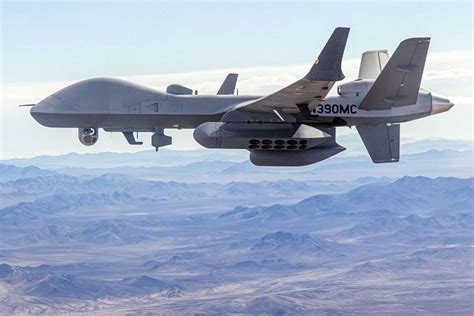
While the leased drones are unarmed, the MQ-9B airframe is fully capable of supporting a combat configuration. In fact, India’s long-term plan includes acquiring up to 31 armed MQ-9Bs under a Foreign Military Sales (FMS) program approved by the U.S. government in 2023. This larger procurement, which would allocate 15 drones to the Navy and the remainder to the Army and Air Force, is still undergoing procedural formalities.
The current lease serves as a tactical bridge, offering immediate operational benefits while the comprehensive FMS deal progresses. More importantly, it allows Indian personnel to deepen operational familiarity with the platform, paving the way for smooth integration once the armed variants arrive.
Cutting-Edge Sensor Capabilities
The Sea Guardian’s sensor payload distinguishes it from legacy platforms. Its radar system, either the Leonardo Seaspray 7500E AESA or Raytheon SeaVue XMC, can detect and classify vessels over large swaths of ocean regardless of weather or sea state. The EO/IR turret, positioned beneath the fuselage, delivers high-definition video for day and night operations.
Satellite communications (SATCOM) provide beyond line-of-sight (BLOS) control and real-time data relay to ground control stations thousands of kilometers away. This capability ensures that critical intelligence reaches naval commanders instantly, enabling rapid decision-making in volatile operational environments.
Enhancing Strategic Alignment with the U.S.
The Sea Guardian lease reflects New Delhi’s growing strategic convergence with Washington in securing the Indo-Pacific. By operating a frontline American drone, India is aligning its operational doctrines and equipment with that of U.S. forces, enabling future combined maritime operations.
The move also underscores India’s shift towards flexible procurement models. Leasing high-value platforms accelerates capability buildup while sidestepping delays inherent in conventional defense acquisitions. This dynamic approach is especially valuable in contested regions where security environments evolve rapidly.
Deployment Timeline and Operational Outlook
The two new MQ-9Bs are expected to enter full operational deployment by early 2026. Their arrival will double the Navy’s unmanned aerial surveillance footprint and enable continuous coverage of India’s Exclusive Economic Zones (EEZs). The Indian Navy, already among the most technologically advanced in the region, will gain a further edge in:
- Maritime domain awareness
- Anti-submarine surveillance
- Maritime interdiction support
- Search and rescue operations
As adversaries test India’s maritime boundaries and global sea lanes face threats from piracy, illicit trafficking, and geopolitical instability, the Sea Guardian fleet will serve as both a deterrent and a shield.
Conclusion: A Calculated Strategic Advance
India’s decision to expand its MQ-9B Sea Guardian fleet signals a calculated escalation in maritime surveillance capacity—a message to allies and adversaries alike that New Delhi is resolute in safeguarding its maritime interests. With these drones flying high above the Indian Ocean, India is positioning itself not only as a regional power but as a maritime sentinel of the Indo-Pacific, capable of deterring threats, securing commerce, and shaping the security landscape of the 21st century’s most vital waters.