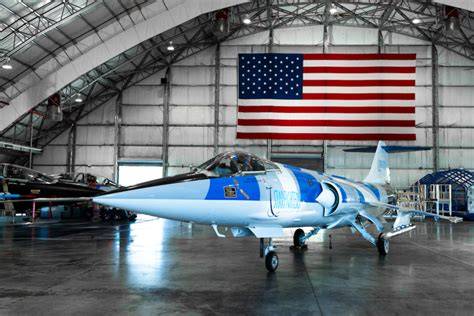
The hangar sits a few hundred yards from the threshold of the Shuttle Landing Facility, its doors opening onto the same five-kilometer concrete strip where orbiters once rolled out after returning from space. Inside, five Lockheed F-104 Starfighters rest in various states of readiness, their needle noses pointed toward a runway that has hosted some of the most consequential landings in aerospace history. This is Starfighters Space, the only organization on Earth operating a civilian fleet of flight-ready Starfighters, and the address alone explains much of why the company exists. Kennedy Space Center has become the gravitational center of a new commercial launch economy, and Starfighters Space positioned itself as the one tenant whose aircraft can fly the profile of a rocket without ever lighting a booster.
Founded by pilot Rick Svetkoff in 1995, the company began as a preservation project with an entertainment ambition. Svetkoff wanted to keep the F-104 alive on the civilian air show circuit, flying a three-aircraft precision demonstration team built around former Royal Canadian Air Force CF-104s. He had learned to fly after joining the US Navy in 1978, spending six years in the cockpit of the A-4 Skyhawk before leaving the service in 1984 for an airline career. That blend of naval attack experience and airline discipline shaped the way he approached the Starfighter: as an aircraft to be flown precisely, maintained rigorously, and eventually monetized in ways its original Cold War operators never imagined. Over three decades, that instinct turned a hobbyist’s tribute into a defense contractor with a public listing and a rocket program bolted under a wing.
A Private Tenant On The Shuttle Runway At Kennedy Space Center
The move to Florida in 2007 changed the company’s trajectory more than any single aircraft purchase. Starfighters Space would make its first flight from the Shuttle Landing Facility that same year, and NASA soon invited Svetkoff’s team onto the installation under a Space Act Agreement. The agency contracted the F-104s to fly simulated suborbital profiles from the runway, measuring sonic boom effects that would inform future commercial launches, and described the flights as a pathfinder for routine use of the site by private projects. For a small operator, the arrangement was extraordinary: access to one of the longest runways in the world, embedded inside the most famous launch complex on the planet, with NASA’s institutional blessing attached.
That runway is not a convenience but an operational necessity. The F-104’s slender wing and high landing speed demand long rollouts, and when the jets carry heavy or unusually shaped external payloads, take-off distances stretch further still. Kennedy’s concrete offers margins that few civil airfields can match, which is why the company later opened a second base at Midland International Air & Space Port in Texas without ever abandoning its Florida home. The geography also places Starfighters Space inside the daily rhythm of Cape Canaveral, surrounded by launch providers, range operators, and the constant traffic of a commercial space race that needs exactly the kind of high-speed, high-altitude data collection the fleet provides.
How Five Italian Jets Became A Test Fleet
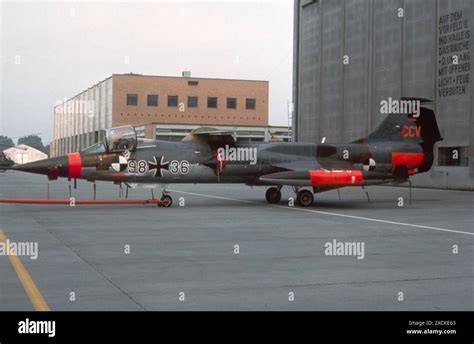
The fleet took its present shape in 2011, when five F-104s purchased from the Italian Air Force arrived in Florida. Italy had been the last nation to operate the Starfighter in squadron service, and its aircraft were among the youngest and best-supported examples anywhere, a detail that matters enormously for a civilian operator dependent on spare parts, engineering drawings, and airworthiness knowledge. Those five jets became the backbone of a business that quietly pivoted away from air shows and toward government and private aerospace contracts, flying as high-speed photo chase planes, training targets for military exercises, and real-world technology testbeds.
The centerpiece of that work is the ‘Wind Tunnel in the Sky’, a modular underwing pylon system engineered to carry external customer sensors, experimental materials, and advanced electronics into an environment no laboratory can reproduce. A single F-104 mission can deliver up to ten minutes of continuous Mach 2+ exposure, a duration that lets researchers gather flight-testing data under genuine aerodynamic and thermal loads rather than simulated ones. Clients including the US Air Force Research Laboratory and Lockheed Martin have used the platform for exactly this purpose, and the aircraft’s thrust-to-weight ratio allows it to climb and accelerate along angles that closely mirror the ascent profile of a spacecraft’s early stages.
The ATLAS Flights And A Supersonic Propulsion Milestone
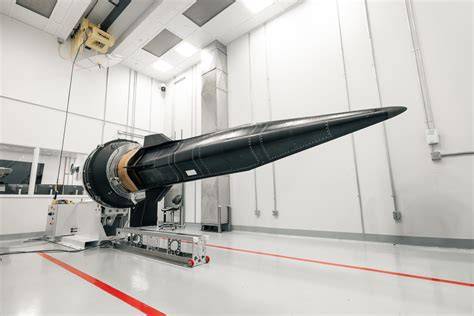
In 2025, a Starfighters Space F-104 carried GE Aerospace’s ATLAS test vehicle on three supersonic flights from Kennedy Space Center. The Atmospheric Test of Launched Air-breathing System program used one of the team’s Starfighters for a three-phase captive-carry series, flying an advanced propulsion test vehicle at supersonic speeds and validating performance for next-generation solid-fuel ramjet technology aimed at future hypersonic defense programs. The campaign illustrated the fleet’s core commercial value: a customer with a propulsion concept and a wind tunnel model can move to flight-relevant conditions in months rather than years, with a crewed, recoverable, reusable carrier doing the lifting.
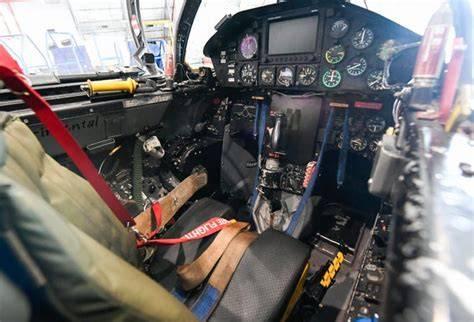
The two-seat trainer variants extend the same logic to human performance. Starfighters Space offers flights that prepare pilots and astronauts for the physical demands of rocket travel, validating cockpit human-machine interface devices and evaluating crew physiological limits under sustained high-G maneuvers. Because the F-104 can reproduce the acceleration and climb characteristics of a launch vehicle without the cost and irreversibility of an actual launch, it functions as a rehearsal platform for the people who will eventually ride rockets, not just the hardware that will fly them.
Microgravity, Aggressor Missions, And A Broader Test Portfolio
Beyond high-speed exposure, the fleet has expanded into microgravity research, achieving 60 to 90 seconds of sustained weightlessness per run through steep climbs that climax in parabolic arcs mimicking spaceflight profiles. The jet’s thrust-to-weight ratio lets pilots pull into extreme climbs before pushing the nose over into a controlled free-fall, a maneuver that subjects ruggedized, space-bound technology such as sensors and rocket components to realistic conditions at a fraction of the cost of a suborbital flight. That capability inspired a strategic partnership with Mu-G Technologies, which operates a specially modified Dassault Falcon 50 at Midland; Starfighters supplies ground support, FAA certification, and pilots while Mu-G manages the payload monitoring software.
Another core function serves the military directly. The fleet provides aggressor and target aircraft for exercises in the Gulf region, where US Air Force, Navy, and Marine Corps squadrons train frequently. The F-104’s tiny frontal radar cross-section and sustained speeds above Mach 2 let it replicate the flight profiles of modern supersonic cruise missiles or high-performance foreign fighters, giving radar operators and air defense crews unscripted practice tracking a genuinely fast target. Few civilian companies can offer that combination of performance, availability, and willingness to fly against front-line units.
From Wind Tunnel Models To The Starlaunch Test Flight
Even with NASA and defense work paying the bills, the company’s stated primary mission has always been launching spacecraft. Starfighters Space has already tested its Starlaunch 1 configuration in a wind tunnel operated by the joint engineering college of Florida A&M and Florida State universities, validating how a rocket separates from the jet at speeds between Mach 0.85 and Mach 1.3 and confirming clean separation across all tested conditions. In February, then director and vice president of development Tim Franta described the program as “a series of practical, documented steps to space,” a phrase that captures the incremental, documentation-heavy culture the company has adopted.
In September, Starfighters Space partnered with Vaya Defense & Space to integrate the Vortex-Hybrid rocket engine that will power the Starlaunch 1 suborbital vehicle. The propulsion system is throttleable, restartable, and entirely non-explosive, using a solid 3D-printed plastic fuel mixed with a liquid oxidizer, a combination stable enough to carry bolted to the wing of a crewed jet. In October, the company announced a December test flight carrying an inert rocket under one wing from Kennedy to Cecil Spaceport in Jacksonville, to be followed by a drop test over the Atlantic and then a demonstration of the integrated propulsion system. This winter’s captive carry flight is the milestone that precedes it all, and the partners aim to complete a suborbital launch in 2027, climbing past the Karman line at roughly 100 kilometers to prove the system can carry a small research payload or microsatellite to the edge of the atmosphere.
What To Watch Before The Rocket Flies
If Starlaunch 1 succeeds, the lessons feed a more advanced Starlaunch 2, a full orbital satellite delivery vehicle developed under a continuation of the collaborative research arrangement with Vaya Space. That architecture will likely use a multi-stage configuration, with a hybrid first stage pushing the payload out of the dense atmosphere and an upper stage igniting in vacuum to reach the velocity required for permanent low Earth orbit insertion. The suborbital flights are designed to supply the missing data on atmospheric separation mechanics, aerodynamic drag at high speed, and hybrid motor performance that no ground test can fully replicate.
The greater risk may not be technical. A $26 million lawsuit between current CEO Timothy Franta and founder Rick Svetkoff remains unresolved, and the company’s share price has fallen sharply since its $40 million IPO. If the court sides heavily with the founder, the dispute could reach the underlying intellectual property or even the physical fleet that serves as the literal wings of the launch program. New management insists operations continue unhindered, but resolving the boardroom fallout is as essential to reaching orbit as the hybrid motor itself. For now, the Starfighters keep flying from the Shuttle Landing Facility, carrying sensors, experiments, and eventually a rocket, on a runway built for spacecraft but now home to the fastest civilian jets in private hands.