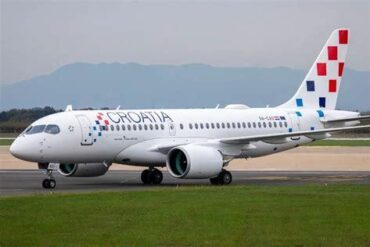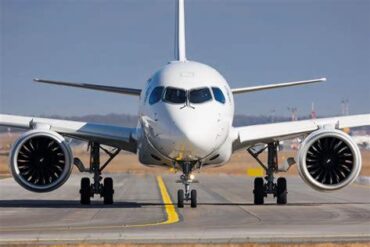
The Airbus A220 occupies a fascinating niche in modern commercial aviation. Designed originally as the Bombardier CSeries before Airbus assumed control of the program in 2018, the aircraft was created with a very specific mission: to dominate the 100–160 seat market while delivering exceptional efficiency. Airlines wanted an aircraft capable of serving thinner routes without sacrificing passenger comfort, and the A220 answered that call with remarkable precision.
Yet the real surprise for many travelers is not its range or fuel efficiency. It is the cabin. Step inside an A220 and the experience feels noticeably different from many aircraft in the same size category. The interior appears wider, brighter, quieter, and more spacious than expected for a narrowbody jet.
That effect is not accidental. The aircraft’s designers approached the cabin as a core feature rather than an afterthought. By combining advanced materials, an unconventional seating layout, larger windows, smarter storage, and improved cabin pressurization, the A220 delivers a travel environment that feels closer to a larger jet while maintaining the operational efficiency airlines demand.
A Clean-Sheet Aircraft Built Around Passenger Experience
The story of the A220 begins with a clean-sheet design philosophy. Unlike many aircraft that evolve from older platforms, the CSeries program started with a blank page. Engineers were free to rethink nearly every aspect of the aircraft’s structure, aerodynamics, and interior environment.
The result was an aircraft engineered to reduce fuel burn and carbon emissions by roughly 25% compared with previous-generation regional and small narrowbody aircraft. Achieving this required advanced engineering solutions, including new aluminum alloys, extensive use of composite materials, and highly efficient Pratt & Whitney geared turbofan engines.
Those technologies also enabled designers to reshape the cabin itself. Lighter structures allowed thinner sidewalls, freeing up interior space without increasing the aircraft’s external dimensions. Large windows could be installed without excessive structural penalties, and overhead storage could be expanded without compromising weight targets.
Instead of treating passenger comfort as secondary to efficiency, the A220 integrates both objectives into a single architecture. The cabin’s airy feel is therefore not merely aesthetic; it emerges directly from the aircraft’s engineering DNA.
The Five-Abreast Layout That Redefines Narrowbody Comfort
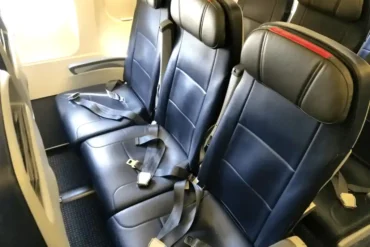
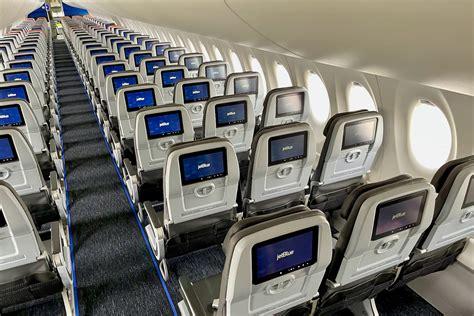
One of the A220’s most distinctive characteristics is its five-abreast seating configuration arranged in a 2-3 layout. Most narrowbody airliners adopt either four-abreast seating, common among smaller regional jets, or six-abreast layouts seen on aircraft like the Airbus A320 and Boeing 737.
The A220 occupies the middle ground, but the benefits go far beyond simply splitting the difference.
In practice, the five-abreast arrangement produces a cabin environment that feels far more comfortable than its modest capacity might suggest. Passengers encounter wider seats, fewer middle seats, and a noticeably roomier aisle, all within an aircraft designed for efficient operations on shorter and medium-range routes.
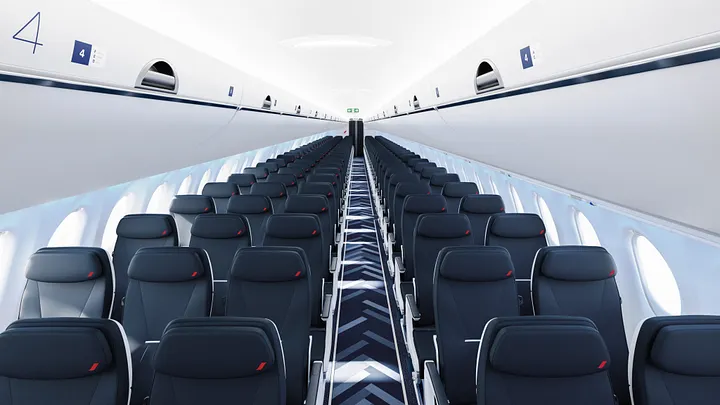
Airbus designed the fuselage specifically around this seating configuration, allowing each seat to offer 18–19 inches of width, wider than the economy seats typically found on many A320 or 737 aircraft. Even the middle seat—often the least popular option on any flight—is slightly wider than its neighbors at 19 inches.
The psychological effect is powerful. Travelers frequently perceive narrowbody aircraft as cramped tubes, but the A220 subtly breaks that perception. The cabin feels balanced rather than crowded, and the presence of only one middle seat per row significantly reduces the probability of being stuck between two passengers.
For airlines, this design also delivers a powerful operational advantage. With total seating capacity ranging from 100 to around 160 passengers, the A220 fits perfectly between smaller regional jets and larger narrowbodies. Routes that would be inefficient for an A320 or 737 suddenly become profitable, allowing airlines to expand networks while maintaining strong passenger satisfaction.
Large Windows and Lighting That Transform the Cabin Atmosphere
Cabin comfort is shaped as much by psychology as by physical dimensions. Humans instinctively respond to light and spatial cues, and aircraft designers have increasingly embraced this reality in recent years.
The A220 features the largest windows of any aircraft in its category. They are not only bigger but also positioned slightly higher on the fuselage, improving sightlines for passengers seated at the window.
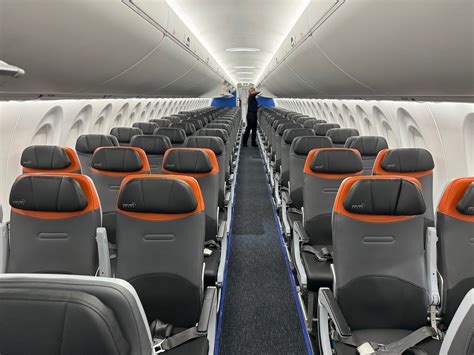
This seemingly small adjustment dramatically alters how the cabin feels. Natural light flows deeper into the cabin, reducing the sense of confinement often associated with smaller aircraft. Window-seat passengers enjoy clearer views of the horizon, while passengers across the aisle still benefit from the brighter environment.
Even the aircraft’s lavatory design reflects this emphasis on openness. The aft port-side lavatory famously includes a window, an unusual feature in commercial aviation that further contributes to the cabin’s distinctive character.
Lighting technology adds another layer to the experience. The A220 uses LED mood lighting systems that can subtly change color and intensity throughout the flight. These lighting adjustments are more than decorative. Research shows that light exposure influences the body’s circadian rhythm, the internal biological clock that regulates sleep and alertness.
By adjusting cabin lighting during boarding, cruising, and descent, airlines can create a more comfortable environment that reduces fatigue—especially on longer flights approaching seven hours or more, which the A220 is capable of operating.
High Ceilings and Spatial Geometry
Physical dimensions also play a crucial role in how passengers perceive space. The A220’s cabin ceiling stands approximately four inches higher than competing aircraft in its class, a seemingly minor measurement that produces a noticeably different interior feel.
Passengers walking down the aisle rarely need to duck, even in the rear portion of the cabin. That extra headroom creates the sensation of a taller, more open environment, something rarely associated with smaller narrowbody aircraft.
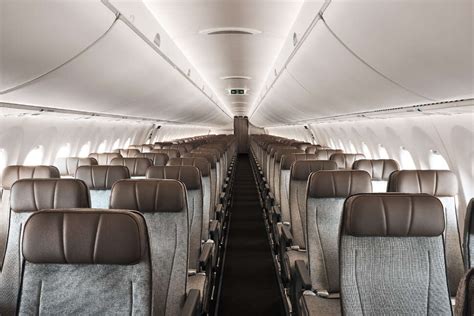
Combined with the aircraft’s wide aisle and sculpted sidewalls, the cabin geometry subtly encourages a sense of openness. These design decisions influence passenger comfort long before takeoff. The moment travelers step onboard, the aircraft feels less like a regional jet and more like a scaled-down widebody.
Airlines benefit from this perception as well. Passenger satisfaction plays an increasingly important role in airline brand loyalty, and the A220’s cabin experience often generates positive reactions among first-time flyers.
Overhead Bins Designed for Real-World Travel
Storage is one of the most underestimated aspects of aircraft cabin design. A lack of overhead space can quickly create congestion, stress, and delays during boarding.
The A220 addresses this problem with large pivot-style overhead bins capable of accommodating more carry-on luggage than many earlier regional aircraft.
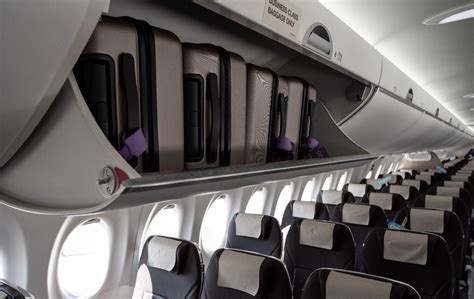
Unlike traditional bins that open downward, the pivot mechanism rotates upward and outward. This allows bags to be placed vertically rather than horizontally, maximizing the available storage volume. Passengers can bring standard carry-on suitcases without struggling to find space, reducing the need for last-minute gate-checked baggage.
For airlines, the benefits extend beyond comfort. Faster boarding translates into shorter turnaround times, enabling aircraft to return to the air more quickly. In commercial aviation, an aircraft generates revenue only when it is flying, so every minute saved on the ground matters.
The impressive part is that these larger bins do not impose a significant weight penalty. Engineers achieved this by integrating lightweight materials and thin structural sidewalls, ensuring that the expanded storage capacity does not compromise the aircraft’s efficiency targets.
Lower Cabin Altitude and Reduced Passenger Fatigue
Another subtle but important advantage of the A220 lies in its cabin pressurization system. Most narrowbody aircraft maintain a cabin altitude equivalent to roughly 8,000 feet above sea level while cruising.
The A220 reduces that figure to around 6,000 feet.
While the difference may seem small, the physiological impact is meaningful. At higher altitudes, the partial pressure of oxygen decreases, meaning the body must work harder to absorb sufficient oxygen from the air. This can lead to fatigue, dehydration, and headaches after a flight.
A lower cabin altitude helps mitigate these effects. Passengers often step off an A220 feeling more alert and less fatigued, particularly on longer journeys approaching the aircraft’s range limits.
The quieter cabin environment also contributes to reduced stress. The aircraft incorporates noise-dampening materials and benefits from the naturally quieter operation of its geared turbofan engines. Together, these features create one of the quietest cabins in the single-aisle market.
Crew members benefit as well. Flight attendants and pilots spend far more time onboard than passengers, and the reduced pressure difference lowers the risk of barotrauma, a condition caused by pressure imbalances affecting the ears and sinuses.
The Arrival of Airbus Airspace on the A220
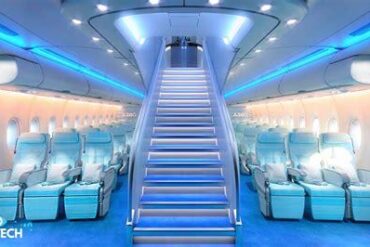
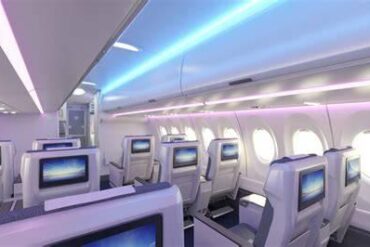
Airbus continues to refine the A220’s cabin experience with the introduction of the Airspace interior, a design philosophy already used on several larger Airbus aircraft.
Announced in 2025 and expected to enter service starting in 2026, the Airspace upgrade aims to push the A220 even closer to a widebody-like environment.
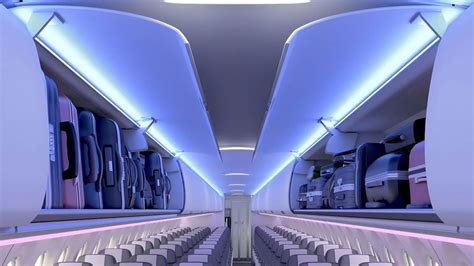
One of the most significant changes is the introduction of XL overhead bins. These new bins are designed to provide 15% more storage volume while being approximately 20% lighter than the current versions. Their improved mechanism allows them to open more smoothly and close with less effort, simplifying the boarding process.
The new Passenger Service Unit (PSU) will also incorporate advanced lighting technology capable of producing over 16 million color variations. Airlines can customize the lighting to match brand colors, adjust the mood during different phases of flight, or simulate daylight patterns on longer routes.
The goal is straightforward: create a single-aisle aircraft that feels remarkably similar to a widebody cabin, despite its smaller size.
Why the A220 Cabin Sets a New Benchmark
The Airbus A220 demonstrates how thoughtful engineering can transform the passenger experience without sacrificing operational efficiency. Every element of the cabin—from seating layout to lighting and pressurization—serves both comfort and performance objectives.
The aircraft proves that smaller aircraft do not have to feel cramped. By prioritizing human perception alongside engineering constraints, designers created an interior that feels unexpectedly spacious, calm, and comfortable.
For airlines, the benefits are equally compelling. The A220’s cabin helps attract passengers while its fuel efficiency and right-sized capacity enable profitable service on routes that once seemed marginal.
In a market increasingly focused on both environmental performance and passenger satisfaction, the A220 stands as one of the most thoughtful aircraft designs of the modern era. Its cabin is not simply a place to sit during a flight—it is a carefully engineered environment that balances space, efficiency, and human comfort in a way few aircraft have achieved before.