For decades, the public image of presidential air travel has centered on a single aircraft: the unmistakable blue-and-white Boeing 747 carrying the callsign Air Force One. The aircraft projects power, continuity, and national prestige. Yet the famous VC-25A is only the visible centerpiece of a much larger airborne ecosystem designed to keep the President of the United States moving under almost any circumstance imaginable.
Behind every presidential trip exists a carefully orchestrated aviation network involving backup transports, airborne command posts, aerial refueling tankers, cargo aircraft, covert support jets, and military helicopters. Some of these aircraft are publicly acknowledged. Others operate quietly enough that most travelers standing beside them at an airport would never realize they are looking at part of one of the most sophisticated continuity-of-government systems on Earth.
The aircraft trailing the president are not simply spare airplanes waiting for a mechanical emergency. They are layered insurance policies against technical failures, security threats, infrastructure collapse, communications disruption, and even nuclear war. Together, they form what aviation insiders sometimes call the presidential shadow fleet.
The deeper one looks into this network, the clearer it becomes that the iconic presidential Boeing 747 rarely travels alone.
The most intriguing aircraft in this airborne support structure are the little-discussed Boeing 757 transports and the formidable E-4B Nightwatch “Doomsday Plane.” Both operate in the background of presidential missions, often unnoticed by the public despite their enormous strategic importance.
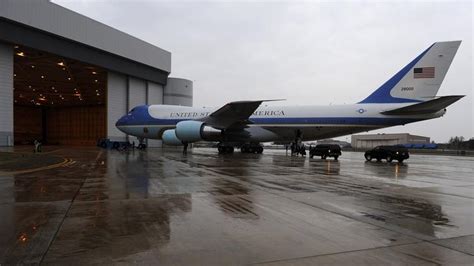
Why “Air Force One” Is Not Actually A Specific Aircraft
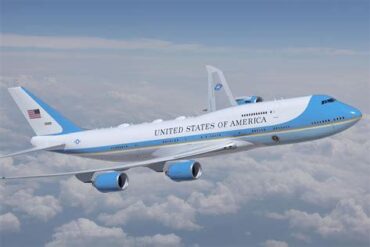
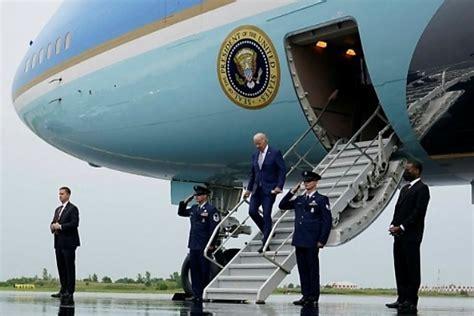
One of the most misunderstood aspects of presidential aviation is the term Air Force One itself. Contrary to popular belief, it is not the name of a specific airplane model. It is a callsign assigned to any United States Air Force aircraft carrying the President.
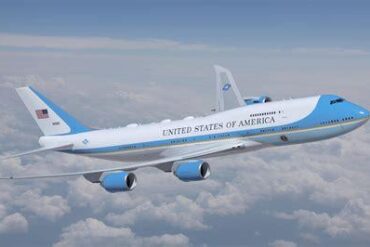
Most people associate the term with the two heavily modified Boeing 747-200 aircraft designated VC-25A. Those jets became globally recognizable because they are the primary presidential transports. However, the callsign can technically apply to many different aircraft.
When the president flies aboard a smaller Boeing C-32A, that aircraft becomes Air Force One during the flight. If the president were to board a military cargo plane, that aircraft would temporarily inherit the same callsign.
The same naming logic applies across military branches. Marine helicopters carrying the president use the callsign Marine One, while Coast Guard aircraft become Coast Guard One if transporting the commander-in-chief.
This distinction matters because presidential transportation planning is built around flexibility. The VC-25A may be the preferred aircraft for major international trips, but it is not always the most practical option. Smaller airports cannot accommodate a jumbo jet easily. Certain missions demand lower visibility. Others require contingency planning that includes alternative aircraft capable of taking over instantly.
That is where the mysterious Boeing 757 fleet enters the story.
The Hidden Boeing 757s Following The President Around The World
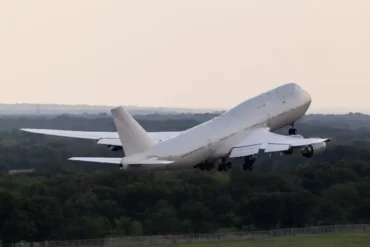
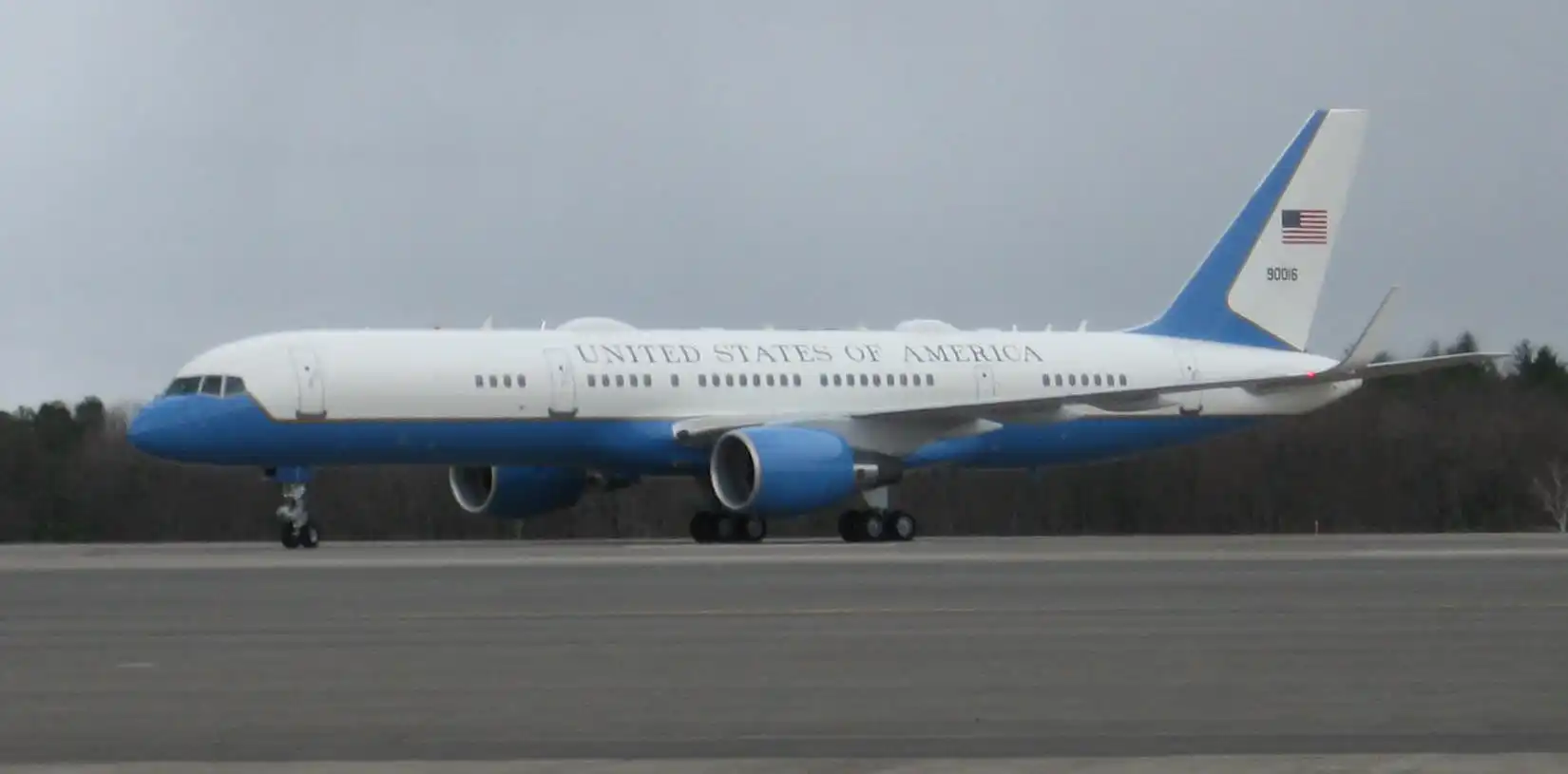
Minutes after Air Force One departs, another aircraft often lifts off behind it with significantly less attention. Aviation observers have repeatedly identified blue-and-white Boeing 757 aircraft carrying similar “United States of America” markings quietly trailing presidential travel itineraries.
These aircraft rarely appear in official press releases. They are seldom discussed publicly by the Pentagon. Yet aircraft spotters and defense analysts have pieced together enough evidence to reveal the existence of an unusual parallel fleet.
The Air Force officially acknowledges four C-32A aircraft, military variants of the Boeing 757-200 commonly used by the Vice President and senior government officials. However, evidence strongly suggests another set of modified 757s exists alongside them.
These aircraft are sometimes referred to as the shadow 757 fleet.
Unlike the well-known C-32As, the shadow aircraft operate with very little public documentation. Their acquisition histories are obscure, their operational roles remain partially classified, and their interiors are rarely photographed.
Defense analysts believe the fleet functions primarily as:
- Backup presidential transport aircraft
- Emergency continuity-of-government platforms
- Alternate communications aircraft
- Flexible VIP transports for sensitive missions
- Redundant evacuation assets
Their operational logic is straightforward. If the main presidential aircraft suffers a technical problem, security issue, or infrastructure limitation, another aircraft must immediately assume the mission.
That contingency became highly visible when Donald Trump’s VC-25A reportedly suffered an electrical issue en route to the World Economic Forum in Davos. The president transferred to a backup Boeing 757 to continue the journey.
The incident offered a rare public glimpse into how seriously redundancy is treated in presidential aviation.
How The Shadow Fleet Was Secretly Acquired
The origins of the shadow Boeing 757 fleet reveal a fascinating intersection of military procurement and commercial aviation recycling.
Unlike brand-new military aircraft programs that generate enormous congressional scrutiny, these jets appear to have been assembled quietly through the secondhand commercial market. Boeing ceased 757 production in 2005, meaning any later acquisitions had to come from existing airline fleets.
Aircraft tracking databases and historical records reveal several Boeing 757s transitioning through commercial operators before ultimately entering U.S. government service.
One aircraft reportedly began life with Chile’s Ladeco Airlines in 1991 before moving to Far Eastern Air Transport and later L3 Communications. Another previously flew for Trans World Airlines and American Airlines before modification. Others passed through operators including Aeromexico and Finnair.
L3 Communications — now L3Harris — played a major role in converting these civilian airliners into specialized government aircraft.
The transformation process likely included:
- Hardened communications systems
- Military-grade encryption equipment
- Defensive countermeasure systems
- Specialized interiors
- Secure conference facilities
- Enhanced navigation and survivability equipment
Very little official information exists regarding the aircrafts’ final capabilities. That silence is probably intentional.
The aircraft previously carried identifiable tail numbers including 90015, 90016, 90017, and 90018, but observers later noted some markings disappearing from public visibility.
That only intensified speculation about their missions.
Inside The Presidential Airlift Group’s Layered Security System
The President of the United States never travels in isolation. Every overseas trip involves an enormous airborne logistics operation coordinated across multiple military branches and agencies.
A typical presidential travel package may include cargo aircraft transporting armored limousines, helicopters, communications gear, Secret Service vehicles, and support personnel. Aerial tankers stand ready to refuel accompanying military aircraft. Additional business jets carry advisors, staff, intelligence personnel, and medical teams.
The complexity resembles a mobile military deployment more than a diplomatic trip.
Among the most important supporting aircraft are the massive C-17 Globemaster III transports. These cargo aircraft routinely carry the presidential limousine known as “The Beast,” along with helicopters and security equipment.
Presidential helicopter detachments usually deploy with VH-3D Sea Kings or VH-60N White Hawks, enabling rapid movement after arrival.
Meanwhile, smaller Gulfstream aircraft often operate in parallel missions supporting Secret Service and communications operations.
This layered aviation architecture ensures the president can maintain mobility even if multiple systems fail simultaneously.
The philosophy underpinning the system is simple: there must always be another option.
Why The Boeing 757 Is Perfect For Presidential Backup Missions
At first glance, the Boeing 757 may seem like an unusual choice for presidential support duties. Yet from an operational standpoint, it offers remarkable advantages.
The aircraft combines long-range capability with access to smaller airports unsuitable for jumbo jets. It can operate from shorter runways, maneuver more flexibly, and maintain lower visibility than the enormous VC-25A.
The 757’s relatively narrow profile also makes it easier to disperse discreetly at military or civilian airfields.
For presidential planners, versatility matters enormously. A smaller aircraft provides contingency options if weather, infrastructure limitations, diplomatic sensitivities, or emergencies prevent the larger Air Force One aircraft from operating safely.
The aircraft’s strong performance characteristics also contribute to its appeal. Pilots have long praised the 757 for its impressive thrust-to-weight ratio and operational reliability.
Inside, the modified government variants reportedly include spacious seating arrangements, conference tables, communications suites, and secure workspaces comparable to airborne executive offices.
These aircraft effectively function as compact flying command centers.
The shadow fleet’s presence beside presidential travel routes also complicates potential adversary planning. Multiple visually similar aircraft moving through coordinated flight patterns create uncertainty regarding which aircraft may contain key personnel or sensitive assets.
Ambiguity itself becomes a security tool.
The Growing Challenge Of Tracking Presidential Aircraft
Modern presidential aviation faces a challenge unimaginable during the Cold War: public flight tracking.
Open-source intelligence communities now monitor military aircraft movements in near real time using publicly available transponder data, satellite imagery, radio communications, and crowdsourced aviation tracking networks.
Operations once considered relatively discreet can now be reconstructed online within minutes.
This issue became especially visible during military operations in the mid-2020s, when online observers tracked U.S. Air Force movements with startling precision. Analysts on social media identified tanker movements, support aircraft routes, and probable strike preparations before official announcements emerged.
Military leaders increasingly view this transparency as a genuine operational security concern.
The presidential fleet exists inside this same environment.
Even when aircraft use generic SAM callsigns — shorthand for “Special Air Mission” — aviation enthusiasts frequently correlate movement patterns, departure timing, and support activity to infer presidential travel details.
This cat-and-mouse dynamic has transformed modern military aviation secrecy.
The government can still conceal classified systems and mission details, but physically hiding large aircraft in the age of global flight tracking has become extraordinarily difficult.
Ironically, this visibility also explains why redundancy matters more than ever. Backup aircraft provide flexibility if routes, schedules, or operational assumptions become compromised.
The E-4B Nightwatch: America’s Flying Nuclear Command Center
If the shadow Boeing 757s represent continuity planning, the E-4B Nightwatch represents survival planning.
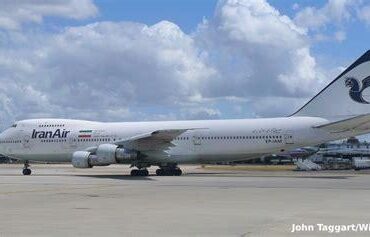
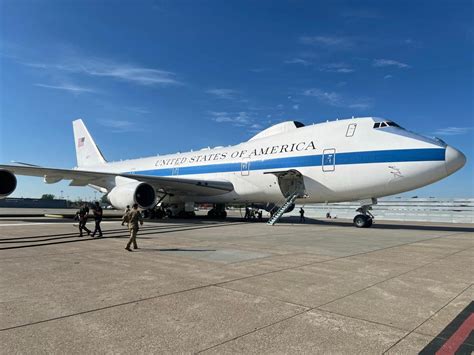
Officially designated the National Airborne Operations Center, the E-4B is one of the most extraordinary aircraft ever operated by the United States military. Built from modified Boeing 747-200 airframes, these aircraft serve as airborne command centers designed to function during catastrophic national emergencies.
Their mission is chillingly straightforward: preserve command-and-control capability during nuclear war.
The aircraft are hardened against electromagnetic pulse effects, equipped with extensive communications systems, and capable of coordinating military operations even if ground infrastructure has been destroyed.
Inside the aircraft are command workstations, briefing rooms, communications suites, and operational areas enabling senior leaders to direct military responses under apocalyptic conditions.
The aircraft can remain airborne for extended periods through aerial refueling.
At least one E-4B is believed to remain on alert status continuously.
Although the Nightwatch aircraft are not secret, they attract surprisingly little public attention considering their strategic significance. Yet aviation observers frequently note their presence during major presidential trips, particularly international travel involving elevated security risks.
Their role is not ceremonial.
The E-4B ensures the United States government retains a survivable command platform even during worst-case scenarios involving attacks on national infrastructure.
That capability remains central to American nuclear deterrence doctrine.
Why The E-4B Fleet Is Being Replaced
Like the VC-25A presidential aircraft, the E-4B fleet is aging rapidly.
The current aircraft originated from Boeing 747-200 airframes dating back decades, creating mounting maintenance and sustainability challenges. Replacement planning became increasingly urgent as costs rose and aircraft availability pressures intensified.
Boeing reportedly declined to pursue the replacement contract under the government’s proposed fixed-price structure after suffering substantial financial losses on other Air Force programs, including the next-generation presidential VC-25B aircraft.
As a result, the replacement effort shifted toward Sierra Nevada Corporation (SNC).
SNC acquired multiple former Korean Air Boeing 747-8 aircraft intended for conversion into the next-generation E-4C Survivable Airborne Operations Center fleet.
The new aircraft are expected to enter service in the 2030s.
Very few technical details have been disclosed publicly, though analysts expect major improvements in communications resilience, cybersecurity, survivability, and operational endurance.
The core mission, however, remains unchanged: guarantee national command authority survives under any circumstances.
That mission ensures the aircraft will remain among the most secretive and strategically important platforms in American military aviation.
The Invisible Air Armada Behind Every Presidential Trip
The public sees a presidential departure ceremony. Military planners see a mobile continuity-of-government operation involving dozens of aircraft, thousands of personnel, and multiple overlapping contingency systems.
Air Force One itself may be iconic, but it is only one visible piece of a much larger machine.
Behind the scenes are shadow Boeing 757s ready to assume the mission instantly. Cargo aircraft transport armored convoys across continents. Tankers sustain operational flexibility in the air. Helicopter detachments provide rapid mobility on the ground. Secure communications aircraft maintain connectivity. And somewhere nearby, an E-4B Nightwatch may quietly orbit as the ultimate insurance policy against national catastrophe.
This network reflects a central reality of presidential security: no single aircraft, location, or system can ever become a single point of failure.
That philosophy explains why the United States maintains backup aircraft for its backup aircraft.
It also explains why so many aspects of presidential aviation remain partially hidden from public view.
The aircraft following the president around the world are not merely logistical support tools. They are airborne extensions of national command authority, crisis response planning, and strategic deterrence.
Most travelers at an airport will never notice them.
Yet these shadow aircraft remain among the most important planes in the sky whenever the President of the United States travels abroad.