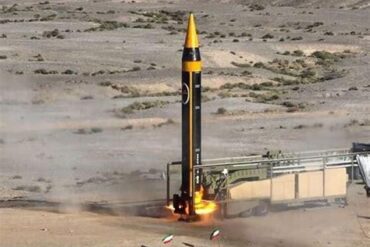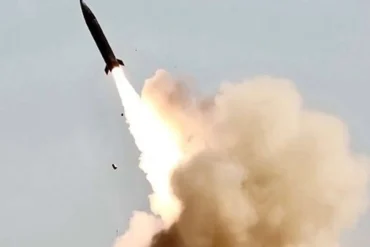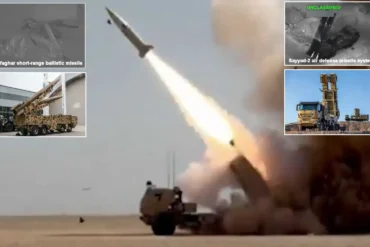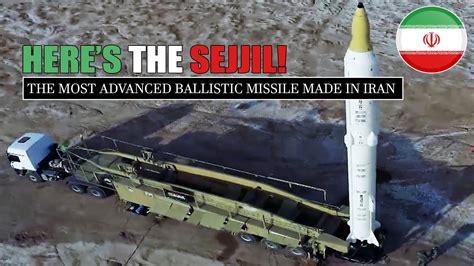
Iran’s Islamic Revolutionary Guard Corps (IRGC) announced on 16 March 2026 that one of its most capable strategic weapons—the Sejjil medium-range ballistic missile—was used during a new wave of strikes against Israeli military infrastructure. The declaration came as the ongoing Iran–Israel confrontation entered its third week of escalating retaliatory attacks, with both sides expanding the scope and intensity of operations across the region.
According to Iranian state media, the launches formed part of the fifty-fourth wave of missile strikes conducted during the campaign. Iranian officials stated that the attacks targeted Israeli air command facilities, defense industrial sites, and concentrations of military personnel, suggesting a deliberate focus on operational infrastructure connected to Israel’s airpower and logistical network. The claim that Sejjil missiles were included in the strike package immediately drew attention among military analysts, as the system represents one of the most sophisticated ballistic weapons developed within Iran’s domestic missile program.
The announcement coincided with continued Israeli air operations against military installations in western Iran, part of a cycle of retaliation that began in late February. Israeli forces have reportedly focused on airbases, radar sites, and weapons depots believed to support Iran’s regional military capabilities. Against this backdrop, the potential deployment of the Sejjil missile signals a shift toward higher-capability strategic systems, raising questions about how far both sides may be willing to escalate the conflict.
Iran’s Sejjil Missile: A Cornerstone of Its Strategic Arsenal
The Sejjil ballistic missile occupies a prominent position in Iran’s strategic deterrence doctrine. Developed domestically by the Aerospace Industries Organisation, a branch of Iran’s Ministry of Defence, the missile was designed to provide the country with a long-range strike capability that can be deployed rapidly and launched with minimal preparation time.
Unlike older Iranian ballistic missiles derived from the Shahab family, which rely on liquid fuel propulsion, the Sejjil employs a two-stage solid fuel propulsion system. This technological shift represents one of the most significant advancements in Iran’s missile engineering efforts over the past two decades. Solid propellant eliminates the lengthy fueling procedures required by liquid-fuel rockets, allowing launch crews to move from authorization to firing in a much shorter timeframe.
This difference is not merely technical—it has substantial battlefield consequences. Liquid-fueled missiles must be fueled shortly before launch, leaving them exposed for extended periods while they are prepared. Solid-fuel missiles such as the Sejjil can remain stored in a ready-to-launch condition, significantly reducing vulnerability to pre-emptive strikes. For countries facing sophisticated surveillance networks, that advantage can determine whether a missile force survives the opening hours of a conflict.
Iranian officials have frequently highlighted the Sejjil as evidence of the country’s progress toward indigenous advanced propulsion technologies. The system’s development also reflects Tehran’s broader objective of replacing older missile designs with more survivable and responsive solid-fuel platforms capable of rapid deployment.
Technical Characteristics and Performance
Open-source intelligence assessments estimate that the Sejjil missile has a maximum operational range of roughly 2,000 to 2,500 kilometers. From launch sites within Iranian territory, that reach places much of the Middle East and parts of southeastern Europe within potential striking distance.
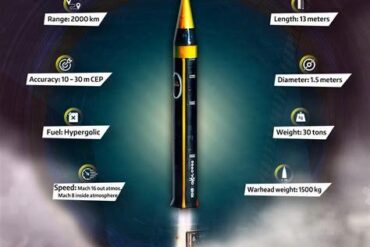
Basic technical characteristics frequently cited by defense analysts include:
- Length: approximately 18 meters
- Launch weight: around 23.6 metric tons
- Propulsion: two-stage solid fuel rocket motor
- Estimated payload capacity: about 700 kilograms
- Deployment platform: road-mobile transporter erector launcher (TEL)
These figures place the Sejjil among the longest-range conventional ballistic missiles currently fielded by Iran. With a range exceeding two thousand kilometers, the missile theoretically covers a vast strategic arc stretching from the eastern Mediterranean to the Arabian Peninsula.
The missile is believed to support several warhead configurations, including conventional high-explosive payloads and specialized penetrator warheads intended to strike hardened structures. Analysts have also discussed fragmentation-type payloads designed to damage dispersed military targets or infrastructure.
More recent variants of the system are believed to incorporate improved inertial navigation systems, which guide the missile along its ballistic trajectory. During the powered phase of flight, the missile may also employ jet vane steering, a control technique in which vanes placed within the rocket exhaust help adjust the missile’s orientation. These engineering refinements aim to improve trajectory stability and potentially enhance targeting accuracy against high-value installations.
Mobility and Rapid Launch Capability
One of the defining operational features of the Sejjil missile system is its deployment from road-mobile transporter erector launcher vehicles. These large mobile launchers carry the missile horizontally before raising it to a vertical firing position shortly before launch.
Mobility plays a central role in the survivability of modern missile forces. Mobile launchers can disperse across wide geographic areas, operate from concealed positions, and frequently relocate between firing operations. Such movement complicates detection by satellite reconnaissance, airborne surveillance platforms, and electronic intelligence systems.
Combined with the solid-fuel design, this mobility allows missile units to minimize the interval between launch authorization and missile firing. In high-intensity conflict environments where adversaries maintain constant surveillance, reducing this timeline can be decisive in preserving operational capability.
Iran has invested heavily in this approach over the past decade, developing networks of hardened launch sites, underground storage facilities, and dispersed road-mobile missile units. The goal is to ensure that even under heavy air attack, enough launch systems remain operational to maintain a credible deterrent posture.
Implications for Regional Missile Defense
Ballistic missiles like the Sejjil follow a high-altitude ballistic trajectory, climbing into the upper atmosphere before descending toward their targets at extremely high speed. This flight profile makes them difficult to intercept, though modern missile defense systems attempt to counter them at multiple stages.
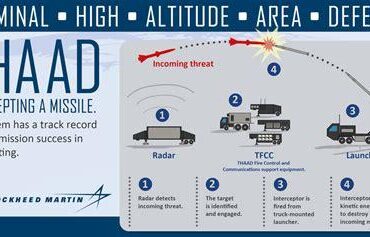
Israel operates one of the world’s most sophisticated layered missile defense architectures, designed to intercept threats ranging from short-range rockets to long-range ballistic missiles. At the upper tier of this system is the Arrow interceptor, developed specifically to destroy ballistic missiles during the high-altitude or exo-atmospheric phase of their trajectory.
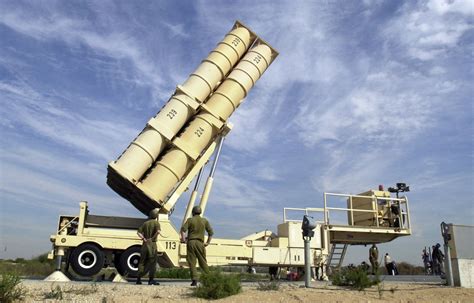
In theory, systems like Arrow are capable of intercepting missiles such as the Sejjil before they reach their targets. However, missile defense becomes more complex when multiple missiles of different types are launched simultaneously. Iranian officials stated that the latest attack wave included a mix of ballistic missile systems, including the Khorramshahr, Kheibar Shekan, Qadr, Emad, and Sejjil missiles.
This tactic can place sustained pressure on defensive networks by forcing them to track and intercept several incoming threats at once. Over time, large volleys can also deplete interceptor inventories, which are far more expensive and limited in number than offensive missiles.
Strategic Messaging Behind the Missile’s Use
Beyond its immediate battlefield role, the reported use of the Sejjil missile carries a significant strategic signaling dimension. Deploying one of the most advanced systems in Iran’s arsenal sends a message about the country’s willingness to escalate technologically as the conflict intensifies.
Missile launches also serve as real-world testing opportunities. Combat conditions allow military planners to observe how weapons perform under operational stress while evaluating the effectiveness of adversary defenses. In this sense, every launch provides data not only about the missile itself but also about interception rates, radar tracking performance, and response timelines.
For regional defense planners, the potential combat use of a missile with a 2,000-plus kilometer range inevitably attracts attention. Such capabilities influence military planning across the Middle East, particularly for states that host U.S. military bases or maintain strategic partnerships with Israel.
Uncertainty and the Fog of Missile Warfare
Despite Iran’s claims, independent verification of the Sejjil missile’s use remains limited. At the time of the announcement, no publicly confirmed debris or technical evidence had definitively identified the missile among those fired during the strike wave.
This uncertainty is common in missile warfare. Interceptions can destroy incoming missiles before they reach their targets, leaving little recoverable evidence. At the same time, governments engaged in conflict often release partial or strategic information intended to shape public perception and strategic messaging.
It also remains unclear whether any of the alleged Sejjil launches were successfully intercepted by Israeli or allied missile defense systems. Information about interception outcomes often emerges slowly, as governments analyze radar data and battlefield evidence.
What is clear is that the reported deployment of the Sejjil missile highlights the growing technological sophistication of Iran’s missile program and the increasing role that long-range precision strike capabilities play in modern regional conflicts. As the confrontation continues to unfold, the interaction between offensive missile forces and defensive interception systems will likely remain a defining feature of the evolving strategic landscape in the Middle East.