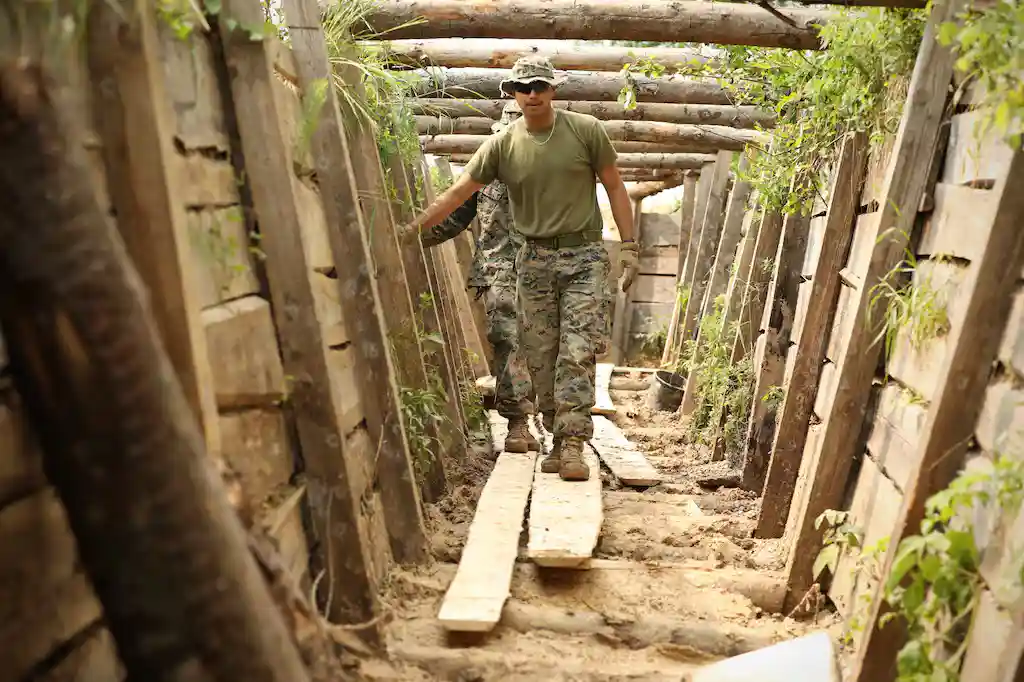
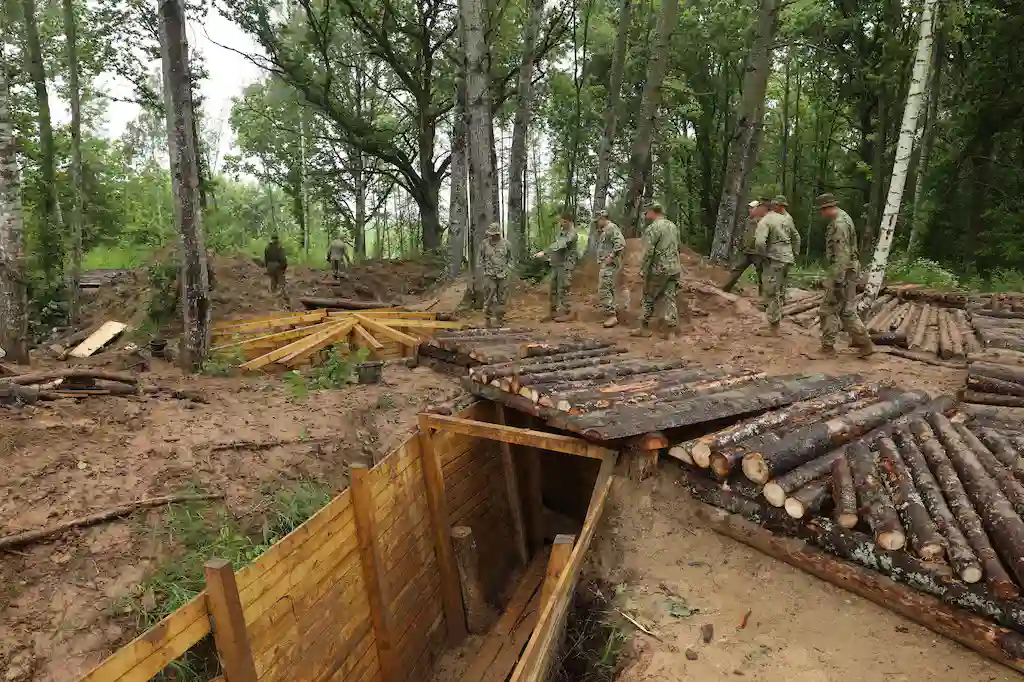
Amid the evolving threats of modern drone warfare, the U.S. Marine Corps and Navy have turned to a battle-hardened tactic from the past — digging in. But these aren’t the muddy, open trenches of World War I. They are a new breed of engineered, fortified trenches designed specifically to shield troops from drone surveillance and attacks, incorporating modern concealment methods and anti-detection strategies. In Skrunda, Latvia, Marines from the 8th Engineer Support Battalion and Navy Seabees from Naval Construction Battalion 14 joined forces with the Latvian Army in a rigorous field exercise to construct a defensive trench system tailored to the current reality of unmanned aerial threats.
The multinational effort took place as part of BALTOPS (Baltic Operations), the U.S.-led annual military training series focusing on maritime and air scenarios across the Baltic region. This year’s iteration introduced a critical ground combat dimension — tactical preparation against aerial drone surveillance and strikes. The exercise served a dual purpose: to enhance defensive combat engineering techniques and test evolving methods for force protection under persistent drone presence.
Fortified Trenches: The First Line of Drone Defense
As drones have become ubiquitous on the battlefield — from ISR (intelligence, surveillance, reconnaissance) roles to strike platforms — their use in the Ukraine-Russia conflict has forced NATO members to rethink their approach to troop protection. The U.S. Navy release covering the exercise in Latvia makes this shift explicit. The fortified trench systems, built in heavily wooded terrain, were crafted to reduce aerial visibility, mitigate thermal detection, and offer physical protection from munitions dropped by drones.
Unlike traditional foxholes or bunkers, these new trenches are designed with multidimensional threats in mind. Lt. j.g. Wiatt Lewis of Naval Construction Battalion 14 explained that these field fortifications were intentionally designed to be low-observable, camouflaged, and thermally insulated, adapting the terrain and available materials to create a layered defense.
To reinforce the trenches, troops harvested timber using the Latvian Army’s deployable sawmill, transforming nearby logs into structural supports. These wood structures were used to brace trench walls, establish overhead cover, and integrate natural camouflage for concealment against drones equipped with thermal and electro-optical sensors.
Training for Tomorrow’s Battlefield
Beyond just digging and reinforcing, the exercise demanded high-level coordination across units with different specializations. Combat engineers, Seabees, and Latvian troops worked side-by-side, mirroring joint operations that would be expected in a real-world deployment. The construction process itself was a feat of field logistics — carried out in forested terrain with minimal heavy equipment, relying instead on modular fortification techniques and man-portable tools.
The field conditions were a calculated decision, reflecting the kind of austere, contested environments that U.S. and NATO forces are increasingly expected to operate in. Staff Sgt. Austin Leigh, a Marine combat engineer with the 8th Engineer Support Battalion, underscored the constant awareness of aerial threats:
“We are always thinking about our visibility from above, the effects of thermal detection, and how to keep the position secure from multiple angles.”
This level of situational awareness — 360-degree coverage and overhead protection — has now become standard for troops deployed in drone-accessible zones. Even low-flying quadcopters, increasingly available to both state and non-state actors, can render traditional defensive postures obsolete if not reinforced with modern countermeasures.
Ukraine: A Case Study in Drone Dominance
The urgency behind the Marines’ and sailors’ work in Latvia stems directly from the real-world consequences witnessed in Ukraine, where drones have become decisive battlefield tools. Ukraine’s Operation Spider’s Web, conducted earlier this month, highlighted the lethal potential of coordinated drone strikes. During the operation, 117 unmanned aerial systems struck targets deep in Russian territory, destroying 20 military aircraft on the ground in a single wave.
That level of success has prompted Western military analysts and commanders to reevaluate fixed-position vulnerabilities. Aerial threats once limited to satellite or high-altitude surveillance have now expanded to tactical levels, where squad-sized units must expect and prepare for drone encounters at any time of day or night.
The lesson from Ukraine is unambiguous: mobility, camouflage, and fortified shelter are not just strategic luxuries; they are survival imperatives.
Integrated Engineering: The Role of Seabees and Combat Engineers
The inclusion of U.S. Navy Seabees in the trench-building mission was essential to its success. These specialist units bring decades of expertise in expeditionary construction, rapidly building infrastructure in hostile or remote environments. Working with Marines and Latvian partners, the Seabees introduced techniques to ensure that trenches would withstand prolonged environmental exposure, resist collapse, and offer genuine defensive capability.
Rather than relying on prefabricated materials, the engineers adapted local resources — especially timber — to provide structural integrity. According to the Navy release, the collaborative use of a field-deployable sawmill allowed troops to not only reinforce their positions effectively but to do so without relying on lengthy supply chains, a critical capability in conflict zones where logistics can be vulnerable.
The trenches featured overhead latticing, cross-braced supports, and leaf-based camouflage netting, all of which combined to offer concealment from optical and thermal imaging. These measures, though relatively simple in design, mirror decades of guerrilla engineering and modern adaptations from across global conflicts.
The Strategic Value of Terrain Modification
While technology often steals the spotlight in military innovation, the manipulation of terrain remains a powerful tool — and it’s one with renewed importance in the drone age. Every trench cut, every pile of camouflage, and every reinforced wall changes the detection probability equation. Even in high-tech warzones, mud and timber can still outwit million-dollar UAV systems.
The Skrunda exercise provided valuable insight into how terrain shaping and micro-topography affect drone efficacy. By selectively clearing woods, digging below the tree line, and blending fortifications with natural formations, engineers reduced the signature footprint of their positions, creating “ghost trenches” invisible to most flyovers.
Importantly, these modifications also accounted for thermal management — understanding how heat emissions from bodies, electronics, and even sunlight on materials can create visible signatures for drones equipped with FLIR or other thermal sensors. Covering trenches with multilayered insulation and organic matter helped mitigate these signals.
Futureproofing the Fight: Evolution of Counter-Drone Tactics
With drones set to dominate the future of warfare, the trenches in Latvia represent more than defensive positions — they’re a testbed for doctrine development. This type of terrain defense may soon become standard operating procedure for NATO troops operating in contested areas.
The BALTOPS training demonstrated that even in a world of AI, satellites, and hypersonics, a spade and a sawmill still matter. More importantly, the exercise signals a broader shift: a convergence of old-school tactics with next-generation threats. The battlefield is once again being fought in the dirt — just with a lot more eyes in the sky.
The U.S. military, learning from allies like Ukraine and integrating lessons into their exercises, appears to be moving quickly to adapt. The reality is unavoidable: drones see everything — unless you give them nothing to see.
Conclusion: Fortifications as Force Multipliers
As military operations evolve in complexity and technological sophistication, simple physical defenses are experiencing a renaissance. The trenches carved into Latvian soil this summer mark more than just training achievements — they represent a return to fundamentals, infused with modern strategic understanding of how drones change the rules of ground warfare.
For the Marines and sailors in Latvia, each reinforced trench was not just a shelter but a statement of resilience: that even under constant threat from the sky, effective engineering, thoughtful concealment, and cohesive cooperation can secure the ground below.
What once was old has become new again — and in the drone era, digging deep may be the smartest move of all.