As commercial pilots, the ability to execute precise maneuvers is a critical component of flight training. Maneuvers such as 360° Turns, Steep Turns, Lazy Eights, Chandelles, and Steep Spirals form the foundation of pilot skills and are vital for maintaining safety, coordination, and control in various flying conditions. This article delves into the detailed steps and techniques for executing these maneuvers flawlessly, ensuring both safety and performance under varying flight scenarios.
360° Turns: Precision in Every Degree
One of the most essential maneuvers for commercial pilots is the 360° turn, which tests the pilot’s ability to maintain control while navigating a full circle. This maneuver focuses on a combination of altitude maintenance, bank control, and coordination to ensure a smooth, efficient turn without deviating from the established flight parameters.
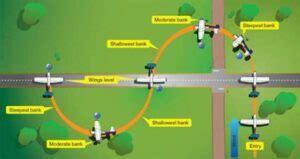
To begin, perform two 90° clearing turns to ensure the airspace is clear. Then, align your aircraft to a cardinal heading or a section line for reference. The power should be set to 2300 RPM with the mixture rich, and the airspeed should be maintained at 100 knots throughout the maneuver. As you initiate the turn, apply a 45°-50° bank, progressively increasing back pressure on the yoke to maintain altitude. This should be done without losing airspeed—if necessary, slightly increase power to compensate.
When nearing the completion of your 360° turn, start rolling out by reducing your bank angle by 10° before reaching your target heading, while simultaneously reducing back pressure through the 30° bank. Finally, reduce power to maintain your airspeed at 2300 RPM and return to straight and level flight.
Steep Turns: A Test of Coordination and Control
Steep turns are a critical maneuver that requires constant adjustment of pitch and bank angles. This maneuver is designed to test a pilot’s ability to control the aircraft during large bank angles while maintaining coordinated flight.
To begin, perform two 90° clearing turns to check for any potential hazards in the airspace. The airspeed should be set to 100 knots at 2300 RPM with a clean configuration. Choose a reference point off the wing to monitor the aircraft’s position throughout the maneuver. Begin by slowly increasing both pitch and bank. At the 45° point, aim for a 15° pitch-up and 15° bank, then gradually increase the bank while decreasing the pitch as you continue the turn.
At the 90° point, your pitch should be level, and the bank should reach a minimum of 30°. It’s essential to maintain a speed that is 5-10 knots above the stall to ensure full control. As you approach the 135° point, your pitch should decrease, and the bank angle should reduce to 15°. By the 180° point, the aircraft should be in level flight at the entry airspeed and altitude. Perform the maneuver in the opposite direction to complete the turn and return to straight and level flight.
Lazy Eights: Achieving Maximum Performance
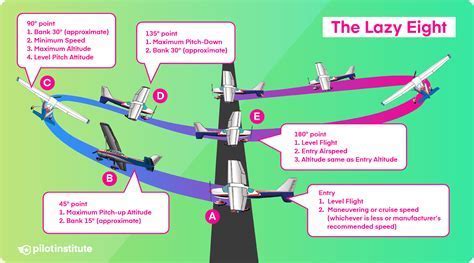
The Lazy Eight maneuver is designed to test a pilot’s ability to manage pitch and bank angles while performing a smooth 180° turn. The primary objective is to execute the turn with maximum performance, maintaining a smooth transition between the two 90° points of the maneuver.
Start by performing two 90° clearing turns to check your surroundings. The airspeed should be set to 105 knots, and the aircraft should be in a clean configuration. As you initiate the maneuver, select a reference point off the wing and begin to increase the bank to 30°, while applying full throttle. Gradually increase the pitch to approximately 10-12° at the 90° point. During the first half of the turn, the bank remains constant at 30°, while the pitch increases.
At the 90° point, maintain constant pitch while gradually reducing the bank to attain level flight at the 180° point. The second half of the turn will require you to reduce pitch and decrease the bank angle, ensuring the aircraft reaches level flight at the 180° point at a speed that is approaching the stall limit. Finally, after completing the maneuver, maintain level flight and accelerate to return to your desired altitude.
Chandelle: A Rapid Descent for Emergency Situations
The Chandelle maneuver is performed in emergency situations where a rapid descent is necessary to quickly descend and prepare for a potential landing. The objective is to achieve a controlled descent while maintaining the proper flight configuration and positioning.
The maneuver should be initiated at an altitude of at least 3000 feet AGL. Start with two 90° clearing turns to ensure the airspace is free of obstacles. Set the airspeed to 90 knots and the power to 1800 RPM. Maintain the aircraft in a clean configuration and select an appropriate landing site as a visual reference.
To perform the Chandelle, reduce throttle to idle and begin executing a series of constant radius circles around your reference point. The bank angle should not exceed 60° to avoid over-banking, and it is important to clear the engine once every 360° turn. The goal is to maintain a constant airspeed while adjusting the pitch to compensate for any wind changes.
At the end of the maneuver, roll out on the specified heading and adjust the DG/HSI to the compass. Perform the necessary cruise checklist to complete the maneuver.
Steep Spirals: Maintaining Precision Around Pylons
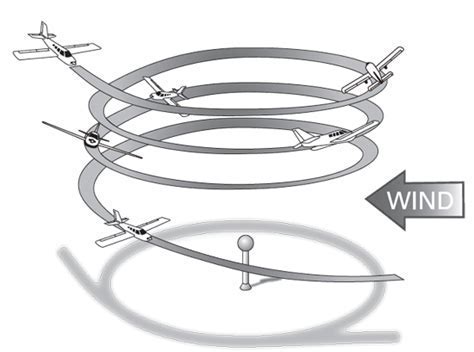
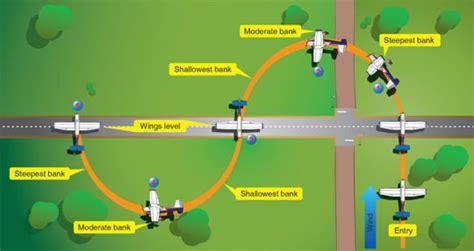
The Steep Spiral maneuver is a visual technique that simulates a descent around a fixed point, often referred to as a pylon. The objective is to maintain a constant turn around the pylon while continuously adjusting the altitude to compensate for changes in groundspeed.
To begin, calculate the pivotal altitude for the maneuver, which will vary depending on the groundspeed. For instance, if the groundspeed is around 110 MPH, the pivotal altitude will be approximately 900 feet AGL. After performing two 90° clearing turns, enter the maneuver and select two pylons to work with. These should be spaced 2/3 to 3/4 miles apart to allow for adequate turning time.
During the maneuver, you will need to adjust your pitch to maintain a constant reference to the pylon. If the pylon moves toward the nose of the aircraft, pitch forward, and if it moves toward the tail, pitch back. Begin rolling out on the diagonal, and after completing the first turn, initiate a second turn in the opposite direction.
Finally, exit the maneuver on the entry heading, ensuring a smooth transition back to level flight. Complete the cruise checklist to finalize the procedure.