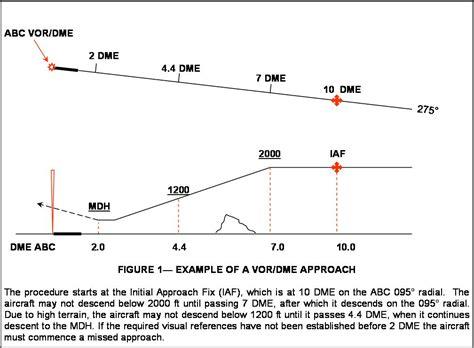
A non-precision approach is a type of instrument approach and landing that provides lateral guidance but lacks vertical guidance. According to ICAO Annex 6, these approaches depend on pilot interpretation and utilize ground beacons along with aircraft equipment like VHF Omnidirectional Radio Range (VOR), Non-Directional Beacon, and the Localizer (LLZ) part of an Instrument Landing System (ILS). Often, they work in tandem with Distance Measuring Equipment (DME) to determine range. Lateral guidance can be shown through a display of either the bearing to or from a radio beacon on the approach track or at the airfield. In cases of an LLZ-only approach, the relative position of the LLZ track appears on the aircraft’s ILS instruments. Vertical guidance relies on the range from the airfield, as indicated by DME at the airfield or on the track, or by timing based on passing overhead radio beacons along the designated procedure.
Non-precision approaches typically involve less automation compared to precision approaches. However, many modern aircraft allow pilots to keep automatic systems engaged until reaching the Minimum Descent Altitude/Height (MDA/H) or even beyond. For pilots flying older aircraft, where automated assistance is limited, a high level of skill is essential to execute these approaches accurately. Frequent practice is necessary, but it can be hard to find opportunities if precision approaches are more common.
Statistically, a significant number of Controlled Flight Into Terrain (CFIT) accidents occur during non-precision approaches. This often stems from a loss of situational awareness, such as descending before the initial approach fix, and the absence of precise vertical guidance. Pilots may need to level off at intermediate points between the initial approach fix and MDA/H, which can lead to complications. To reduce risks associated with traditional step-down approaches, the Continuous Descent Final Approach (CDFA) technique has been promoted. This method can also be simplified through the vertical navigation (VNAV) feature of the Flight Management System (FMS).
Examples of non-precision approach procedures include those that do not fully meet the standards for precision approach and landing operations, such as Surveillance Radar Approaches (SRA) or VDF approaches. For additional context, refer to Aerodrome Operating Minima (AOM).