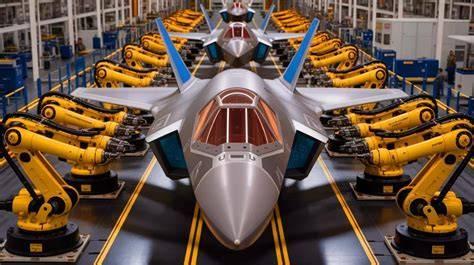
Northrop Grumman has quietly reshaped the rhythm of modern fighter production at one of the most advanced aerospace facilities on the planet, introducing a collaborative robot that reduces a once laborious F-35 assembly task from hours of meticulous handwork to just a handful of minutes. The announcement, made on September 30, marks another step in the defense industry’s slow but deliberate march toward automation, yet it also raises pointed questions about whether such precision improvements can meaningfully untangle the deeply knotted production troubles that continue to plague the Joint Strike Fighter program.
The co-bot, a collaborative tooling device designed to work alongside human technicians rather than replace them, has taken over the fastening sequence that secures the front housing of the Communications, Navigation, and Identification module. This is no peripheral component. The CNI module serves as the electronic nerve center of the F-35 Lightning II, governing radios, navigation arrays, and the friend-or-foe tracking systems that allow the stealth fighter to identify allies and threats in contested airspace. Bolting that housing into place was once a painstaking operation consuming hours of a skilled technician’s day. Now, it unfolds in minutes, freeing those same specialists to concentrate on tasks that demand human judgment and dexterity.
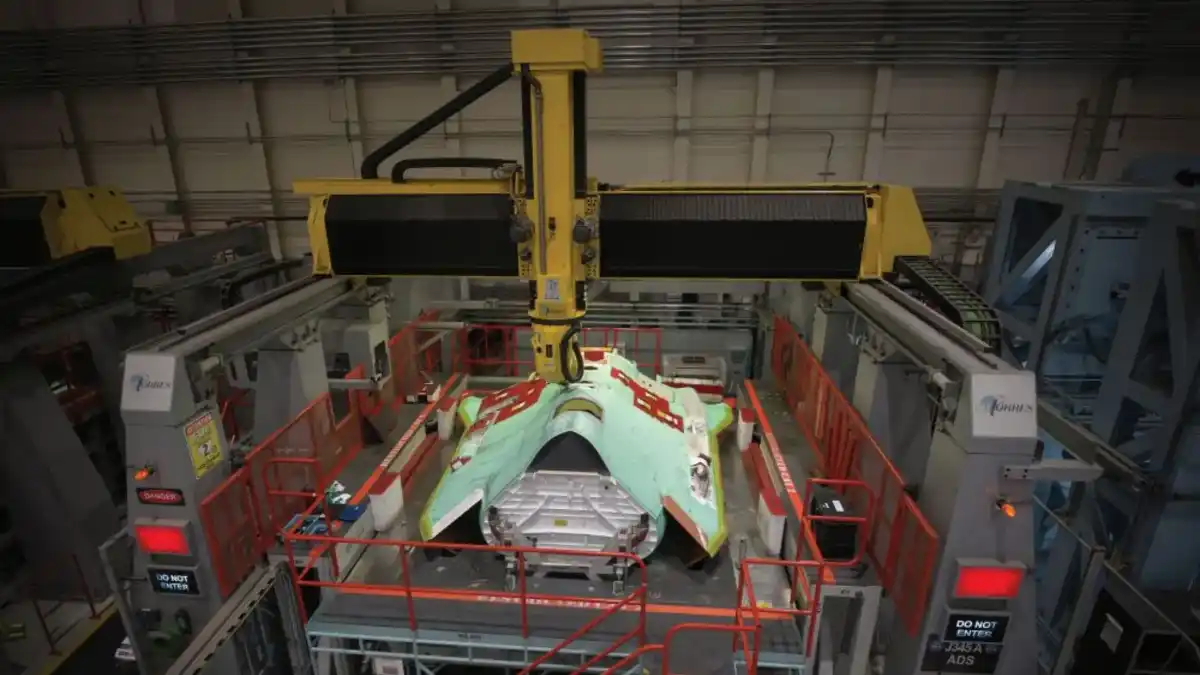
Lavell Catlin, manufacturing manager for the CNI production line, framed the change in stark terms. The co-bot, he explained, assists technicians in precisely installing the bolts that attach the front housing area of the CNI module, cutting what used to take hours down to only a few minutes. In the same breath, Catlin highlighted the parallel deployment of artificial intelligence-based quality control systems that scan completed modules for microscopic flaws, ensuring that every unit leaving the line meets the exacting standards demanded of fifth-generation stealth aircraft. The combination of robotic fastening and AI inspection represents a genuine leap in manufacturing discipline, even if its broader effects remain difficult to quantify.
What Northrop has not disclosed is how much this robotic helper shortens the total end-to-end manufacturing timeline of a complete CNI module, let alone a finished F-35. Nor have the US Air Force or Lockheed Martin authorized any increase in overall production rates to accompany the introduction of the co-bot. The phrase “hours to minutes” carries an undeniable rhetorical punch, suggesting a sweeping transformation, but the true scope of impact is not yet quantifiable. The co-bot optimizes one step, on one subsystem, within a production system whose bottlenecks extend far beyond the factory floor.
The CNI Module: The F-35’s Integrated Avionics Brain
To understand why the fastening of a single housing matters, one must appreciate what the CNI module actually does. Lockheed Martin is responsible for roughly 40 percent of the industrial effort behind every F-35 that leaves Air Force Plant Four in Fort Worth, Texas, but the CNI module itself is a Northrop Grumman product, and it ranks among the most advanced integrated avionics architectures ever engineered. It consolidates more than 27 distinct functions into a single, highly integrated software-defined radio framework, replacing the sprawling arrays of standalone avionics boxes that once cluttered legacy fighters.
At the heart of this system sits Northrop’s AN/ASQ-242, which bundles friend-or-foe transmitters and receivers, high-precision GPS and inertial navigation systems, radios, and flight computers into a unified package. The CNI also houses critical elements of the Multifunction Advanced Data Link, one of the F-35’s most important combat systems, enabling fifth-generation aircraft to share data with one another and with fourth-generation platforms in ways that older architectures could never support. When the US Marine Corps’ F-35B variant achieved initial operational capability in 2015, Jeannie Hilger, then vice president and general manager of Northrop Grumman’s communications division, described the milestone as validation of more than a decade of effort to advance communication among fifth-generation aircraft. The CNI, she noted, also provides a core capability for fifth-to-fourth generation networked data sharing and unparalleled interoperability.
The module manages UHF and VHF voice radios alongside the Joint Precision Approach and Landing System, eliminating the need for dozens of isolated avionics boxes and drastically reducing the aircraft’s internal size, weight, and power demands. Rather than dedicating hardware to every individual function, the CNI dynamically distributes tasks through centralized processing units. That architectural elegance, however, comes with manufacturing complexity. Every bolt, every housing, every connection must meet tolerances that leave no room for error, which is precisely why the co-bot’s precision fastening represents a meaningful advance.
The Palmdale Line That Set The Automation Pattern
Northrop’s embrace of robotics did not begin with the CNI co-bot. The company’s Integrated Assembly Line, or IAL, spun up in late 2001 when Northrop became a major member of Lockheed’s F-35 development team. Meeting the demanding pace of the fighter program required new automation techniques and cutting-edge robotics, and Northrop looked beyond aerospace to the US automotive industry for inspiration. The company partnered with KUKA Systems North America, a Detroit-based firm specializing in production line integration, to blend automotive line practices with aerospace tooling. Scott Johnson, integrated product team lead for the F-35 center fuselage, described the result as a replacement of standalone islands of earlier processes with a modern, automated flow.
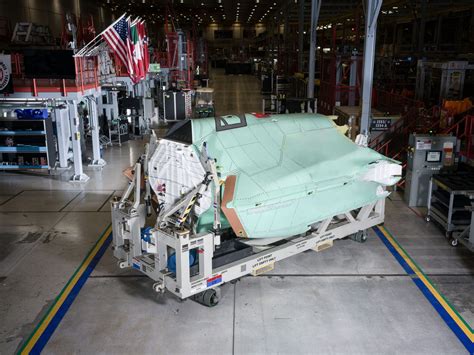
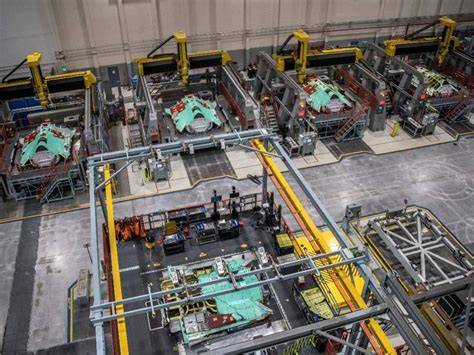
Manufacturing output at the Palmdale assembly line has scaled continuously, delivering more than 1,400 center fuselages by July 2025. The line reached full-rate output in 2011 and operates within a U-shaped building at Northrop’s Aircraft Integration Center of Excellence. It holds more than 115 build stations and 22 automated systems, engineered to complete an end-to-end sequence in an interval of 30 hours. The facility delivered its 1,500th unit on January 12, and the 1,600th airframe segment was handed off recently. This high-rate production line processes roughly 10 million individual components annually using 3,000 specialized tools, churning out completed center fuselages for all three F-35 variants every 30 hours. Its integrated augmented and virtual reality systems have slashed baseline assembly timelines by 35 percent while accelerating technician training curves by 20 percent.
Those metrics paint a picture of a facility operating at the pinnacle of modern aerospace manufacturing. Yet they sit uneasily alongside the F-35 program’s persistent shortfalls. Jets have been delivered with major systems missing, including primary radar arrays. Hundreds of mostly completed stealth fighters remain delayed on the line or grounded at depots due to missing parts and software glitches. The question that lingers is whether shaving hours off single component sub-assemblies provides any tangible benefit to US and foreign military customers still waiting for aircraft that are fully mission-capable.
TR-3 Software Delays And The Fort Worth Assembly Rate
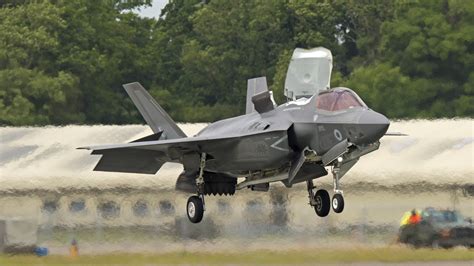
Plant Four has maintained an impressive annual manufacturing pace of 156 stealth fighters per year, eclipsing all other fighters being built around the world today. Lockheed leadership has confirmed to investors during summer financial calls that the assembly lines can hold this high-rate output for the foreseeable future. Yet many deliveries have slipped by months, and costs have continued to rise due to recurring technological deficiencies. Severe software instability and flight-certification delays for the Technology Refresh 3 upgrade forced Lockheed to park finished jets on the tarmac, causing delivery delays that averaged 238 days per aircraft. The TR-3 package is vital to the sophisticated core processing and display upgrade that the aircraft’s broader Block 4 modernization depends on.
These systemic TR-3 software maturation defects prompted a complete Pentagon delivery freeze that marooned more than 110 completed aircraft in long-term storage. While deliveries eventually resumed under a truncated agreement, every single jet delivered during that cycle arrived late by an average of 238 days. Furthermore, the overall Block 4 modernization initiative has surged at least $6 billion over budget. Because of these ongoing technical failures, the military has scaled back its near-term operational requirements, delaying full combat-ready Block 4 capabilities until 2031 at the earliest. The co-bot on the CNI line cannot write stable software code, cannot force the government to accelerate flight-safety certifications, and cannot resolve the fundamental mismatch between production ambition and technological readiness.
Supply Chain Obsolescence And The Limits Of Factory Automation
Lockheed cleared its massive backlog of parked jets last year by cutting a deal with the military to install an incomplete, training-only version of the TR-3 software. This allowed the company to officially deliver a record number of 191 aircraft, but those jets are restricted to training units and are not ready for actual combat. The deal was a result of the unprecedented shortage of the AN/APG-85 Active Electronically Scanned Array radar. New F-35s were built ready to receive the AESA array, but the mounts and software are incompatible with the older, readily available AN/APG-81 radars. Faced with a complete halt in production and massive backlogs, the US military made the highly controversial decision to begin accepting F-35 airframes without radars.
Marine Corps spokesperson Captain Jacob Sugg addressed the decision in March, explaining that the Department of War deliberately undertook a highly concurrent development and production program for Block 4 capabilities, including the APG-85, and the largest fighter aircraft production line in the world. Officials made this decision with full understanding of the risk of having production aircraft ahead of Block 4 capabilities, Sugg said, ensuring that production aircraft could accept Block 4 capabilities rather than continuing to build Block 3 F-35s that would require extensive retrofit. Beyond software and advanced sensors, the assembly line is also choked by basic component deficits. The Government Accountability Office found that Lockheed has faced over 4,000 parts shortages in its audits, double its historical average on preceding major defense aerospace endeavors. This logistical breakdown has stalled dozens of aircraft on the factory floor because of missing hardware as simple as wing flaps.
The co-bot remains a hyper-efficient band-aid on a system that is broken in ways no robot can mend. It excels at building hardware faster, at reducing the hours of skilled labor required for a single fastening sequence, at introducing consistency where human hands might waver. But it cannot fabricate obsolete microchips out of thin air, cannot untangle a supply chain that spans continents and thousands of suppliers, cannot rewrite the millions of lines of code that must function flawlessly before a stealth fighter can be cleared for combat. Northrop Grumman’s collaborative robot is a genuine achievement in manufacturing engineering, a demonstration that automation can meaningfully accelerate discrete tasks on the factory floor. Yet the F-35 program’s most stubborn obstacles lie elsewhere, in software laboratories and certification offices and supplier networks, beyond the reach of even the most precise robotic arm. The hours-to-minutes headline is real, but it describes a fraction of a fraction of the problem, and until the broader ecosystem catches up, the co-bot’s contribution will remain a bright spot in a persistently dim production landscape.