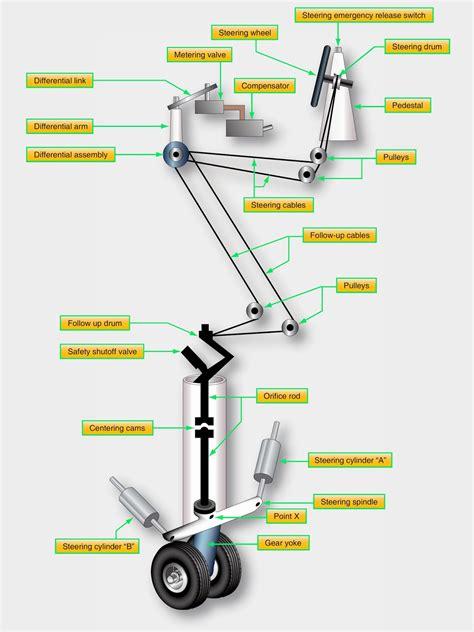
Nose Wheel Steering
In aircraft with a tricycle landing gear, the nose wheel plays a crucial role in steering. It can either swivel freely or be controlled through a mechanism, helping pilots navigate during takeoff, landing, and while on the ground.
Most modern aircraft use a tricycle configuration for their landing gear. This setup typically consists of a single nose wheel at the front and two main wheels on either side. The landing gear may or may not retract during flight. Larger planes might have multiple wheels on each strut or additional assemblies. Regardless of the design, the nose wheel must be steerable to ensure effective maneuvering and directional control during critical phases of flight.
In simpler designs, the nose wheel is free castoring, meaning it can swivel without any steering mechanism. Pilots can influence direction using aerodynamic forces from the rudder, differential braking, or in multi-engine aircraft, through differential thrust. Free castoring nose wheels are mainly found in some light general aviation planes and older models like the Grumman Mallard. A centering mechanism ensures proper alignment of the nose wheel for landing after takeoff.
More advanced configurations include bungees or mechanical linkages connecting the rudder pedals to the nose wheel. Here, steering occurs by pressing the left or right pedal. Pilots can also combine rudder input with brakes to make tighter turns. Generally, nose wheel steering has a maximum deflection limit, and when the aircraft takes off, the nose wheel will self-center due to the loss of weight.
For larger aircraft, hydraulic steering assists the nose wheel’s movement. These planes often feature a steering tiller, which is a small wheel located on the left side of the cockpit. Some designs even include a second tiller on the right side. This tiller connects mechanically or electronically to the steering system. In newer aircraft, the response to tiller input may vary, meaning that small movements can lead to larger changes in the nose wheel’s position.
In earlier aircraft designs, pilots had to use the tiller during takeoff and landing phases when aerodynamic control was limited. This often required the second pilot to manage the wing until sufficient airflow allowed for more control. Today, many modern aircraft allow for nose wheel steering through both the tiller and rudder pedals, reducing the need for simultaneous inputs from both pilots during takeoff and landing. Additionally, some aircraft adjust steering sensitivity based on ground speed, enhancing safety and control.
Pushback and Towing
Aircraft frequently undergo pushback and towing procedures on the ground. These operations can sometimes exceed the nose wheel’s maximum deflection limits or damage the hydraulic steering components. To ensure safe towing, many designs include features that allow the nose wheel to freely castor. This can involve disconnecting the mechanical linkage or using a hydraulic bypass mechanism. Proper configuration is essential before towing or pushback, and all connections must be restored before taxiing.
Steering Failure
Failures in the nose wheel steering mechanism are rare. While mechanical parts may break or jam, most steering issues arise from hydraulic system failures. If steering fails, crews should stop the aircraft and consult the Aircraft Flight Manual (AFM) or Quick Reference Handbook (QRH). If no specific guidance is available, pilots should use their judgment to ensure safety. Although it may be possible to maneuver using brakes or differential thrust, large aircraft pilots are generally not trained for this method. Therefore, stopping the aircraft and arranging for a tow is often the safest choice. If pilots anticipate steering issues upon landing, they should coordinate to have a tow crew ready.
Accidents & Incidents
-
B734, Barcelona Spain, 2004: On November 28, 2004, a KLM B737-400 veered off the runway upon landing in Barcelona due to a bird strike that affected its nose wheel steering during takeoff from Amsterdam.
-
A320, Los Angeles USA, 2005: On September 21, 2005, an Airbus A320 operated by Jet Blue Airways made an emergency landing at Los Angeles Airport with the nose wheels turned 90 degrees after a fault occurred during gear retraction.
-
A320, Tehran Mehrabad Iran, 2016: On August 13, 2016, an Airbus A320 left the runway during takeoff from Tehran Mehrabad, becoming stuck in soft ground. The investigation revealed that the captain failed to stabilize both engines before setting takeoff thrust, leading to control difficulties. Poor crew resource management (CRM) contributed to this incident.