The NOTAR (No Tail Rotor) system represents a landmark innovation in helicopter design, eliminating the need for a traditional external tail rotor while delivering enhanced safety, reduced noise, and simplified mechanics. Developed by McDonnell Douglas Helicopter Systems through its acquisition of Hughes Helicopters, this ingenious approach leverages advanced aerodynamics to achieve anti-torque control without the exposed hazards of a spinning tail rotor.
Origins and Development of the NOTAR System
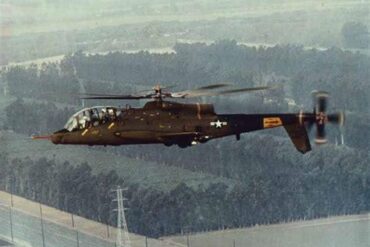
The quest for a tail rotor-less helicopter can be traced back as early as 1945, when the British Cierva W.9 experimented with directed air for anti-torque control. In 1957, the Spanish Aerotecnica AC-14 prototype took this concept further by channeling turbine exhaust gases instead of relying on a mechanical tail rotor. Meanwhile, the Fiat 7005 introduced a pusher propeller that directed airflow across tail vanes to achieve a similar effect.
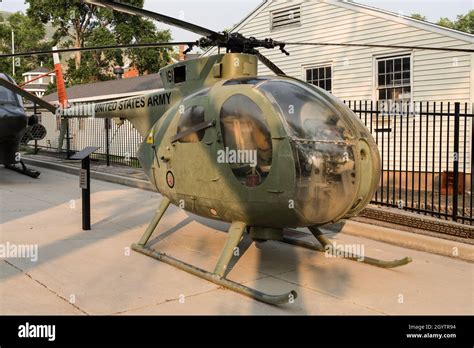
It wasn’t until 1975 that Hughes Helicopters formally began refining the NOTAR concept, setting the stage for its technological breakthrough. On December 17, 1981, Hughes conducted the first flight of a modified OH-6A helicopter equipped with the NOTAR system. This milestone marked the operational debut of a fundamentally safer and quieter anti-torque mechanism. Further improvements culminated in the first flight of a more advanced prototype in March 1986, under the newly merged McDonnell Douglas Helicopters. The legacy of this developmental journey is preserved at the U.S. Army Aviation Museum in Fort Novosel, Alabama, where the original prototype remains on display.
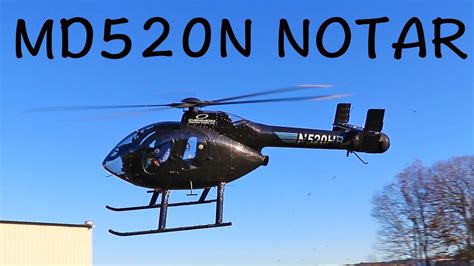
By May 1, 1990, the production model NOTAR 520N (N520NT) took to the skies, embodying decades of engineering refinement. Although its operational history included a tragic collision with an Apache AH-64D in 1994, the NOTAR 520N demonstrated the feasibility and reliability of this innovative technology.
How NOTAR Works: Harnessing the Coandă Effect
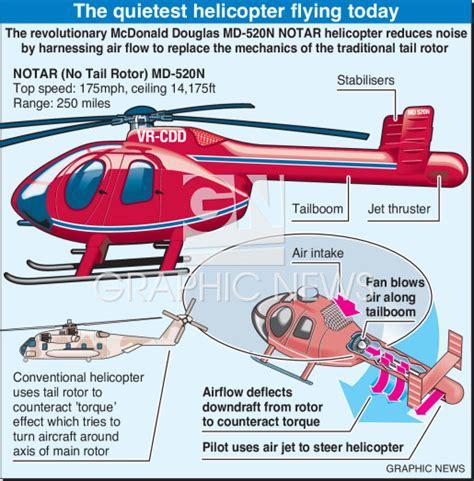
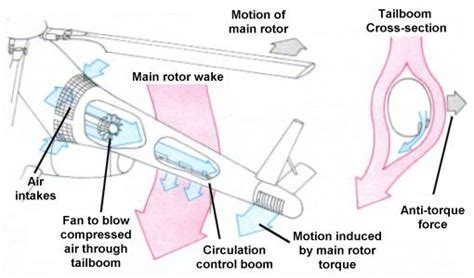
At its core, the NOTAR system utilizes the Coandă effect, an aerodynamic phenomenon where a jet of air adheres to a curved surface. This principle is ingeniously applied along the helicopter’s tail boom to create anti-torque thrust without mechanical blades.
A variable-pitch fan situated inside the fuselage, just forward of the tail boom, draws in ambient air and accelerates it through the internal ducting system. This high-volume, low-pressure air is then expelled through two longitudinal slots on the right side of the tail boom. As the downwash from the main rotor flows over these slots, the Coandă effect causes the airflow to cling to the boom, generating lift and counteracting the fuselage’s torque.
Complementing this effect is a direct jet thruster—a rotatable, vented drum at the tail boom’s end—that provides fine-tuned yaw control. Together with vertical stabilizers, these elements maintain directional stability even in complex flight conditions. The result is a helicopter capable of precise maneuvering, reduced mechanical complexity, and superior safety in confined environments.
Advantages of the NOTAR System
The elimination of the tail rotor offers multiple benefits that extend beyond mechanical simplicity. Foremost among these is enhanced operational safety. Tail rotors are inherently vulnerable to ground strikes, foreign object damage, and inadvertent contact with personnel during takeoff, landing, or ground handling. By internalizing the anti-torque system, NOTAR removes this risk entirely.
Noise reduction is another hallmark of the NOTAR system. Tail rotors are a primary source of the characteristic high-pitched sound produced by helicopters. By eliminating these spinning blades, NOTAR-equipped helicopters achieve significantly lower external noise levels, earning them a reputation as some of the quietest helicopters certified by the Federal Aviation Administration (FAA).
Additionally, the NOTAR configuration reduces pilot workload, thanks to its smoother and more predictable yaw control, especially during hover and low-speed maneuvers. Maintenance demands are also lowered, as the system omits complex tail rotor gearboxes, linkages, and pitch control mechanisms.
Applications and Operational Use
Today, several production helicopters employ the NOTAR system, prominently those manufactured by MD Helicopters. The lineup includes:
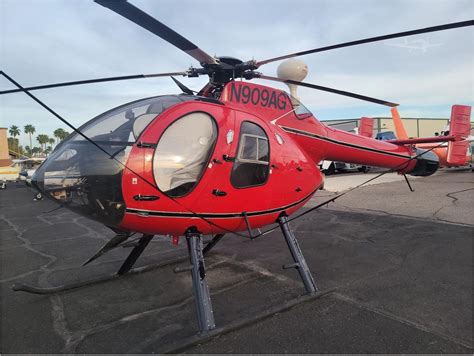
- MD 520N: A NOTAR variant of the popular Hughes/MD500 series, offering nimble handling and lower acoustic footprint.
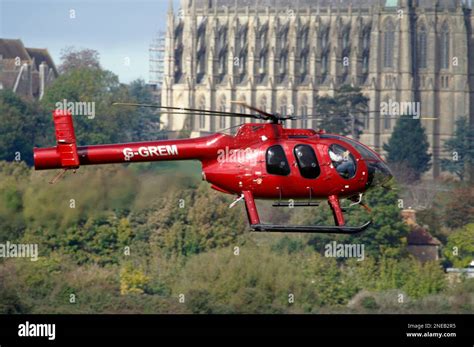
- MD 600N: A larger, stretched version that provides increased payload and seating capacity.
- MD Explorer: A twin-engine, eight-seat light helicopter frequently used in air ambulance, law enforcement, and corporate transport roles.
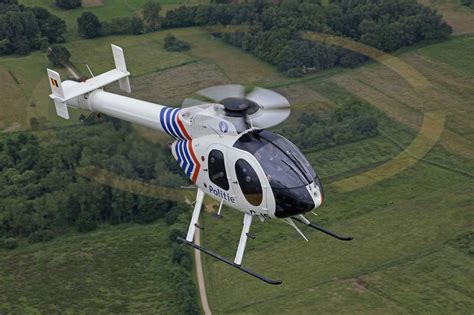
These helicopters have found widespread use in scenarios where quiet operation and enhanced safety are mission-critical. For example, air ambulance services benefit from the reduced risk of tail rotor strikes near buildings or tight landing zones, while police aviation units leverage the lower noise signature for stealthier operations in urban environments.
Engineering Challenges and Future Prospects
Despite its advantages, the NOTAR system faces certain engineering challenges. The design demands meticulous integration of airflow management, requiring precise balancing of fan speed, slot geometry, and thruster effectiveness across varying flight regimes. Pilots transitioning from traditional helicopters may also require additional training to adapt to NOTAR’s distinct yaw response, particularly in autorotation or emergency procedures.
Nonetheless, the NOTAR system’s proven benefits in safety and noise reduction continue to position it as a compelling alternative in helicopter design. As urban air mobility initiatives and noise-sensitive aviation environments gain prominence, NOTAR’s quiet operation aligns well with emerging regulatory and societal demands.
Conclusion: Redefining Helicopter Safety and Silence
The development of the NOTAR system embodies a visionary shift in rotorcraft engineering. By replacing the exposed tail rotor with an enclosed, aerodynamically driven anti-torque system, NOTAR enhances both safety and acoustic performance without sacrificing maneuverability or control authority. As helicopters increasingly operate in noise-sensitive and confined environments, the NOTAR system stands out as a technological solution addressing both operational and environmental imperatives.
With its proven deployment across multiple MD Helicopters platforms and ongoing relevance in specialized aviation sectors, NOTAR continues to demonstrate that sometimes, the most revolutionary changes come not from adding complexity—but by removing the rotor itself.