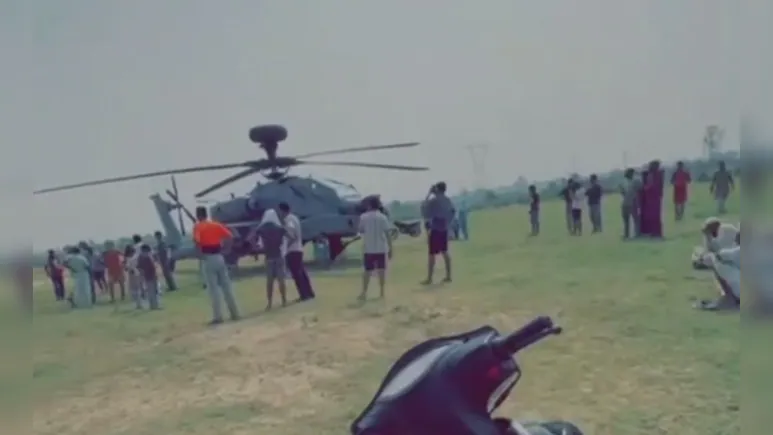
An Indian Air Force Apache helicopter made an emergency landing in the Nangalpur area of Pathankot, marking the second such incident involving an IAF chopper in just one week. While the aircraft landed without damage and the crew members were reported safe, the frequency of such incidents has raised concerns within defense circles about the operational reliability and mechanical endurance of India’s elite attack helicopter fleet. The helicopter involved in the latest incident was an AH-64E Apache Guardian, widely recognized as one of the most advanced combat rotorcraft in the world.
The Nangalpur Emergency: No Damage, But Questions Remain
The landing occurred under what officials have described as a “precautionary measure,” and preliminary assessments indicate there was no structural damage to the aircraft. The Apache was not in distress due to combat conditions, but rather a technical snag, which has now become a recurring theme in recent deployments.
Just days before the Nangalpur incident, another IAF Apache made an emergency landing in a field near Saharanpur, Uttar Pradesh. That aircraft, also facing a cockpit warning for a potential malfunction, was thoroughly examined on the ground before being flown back to Sarsawa air base later that day. The proximity of these two incidents—both in terms of time and technical similarities—points to potential systemic issues that merit deeper scrutiny.
The AH-64E Apache Guardian: Backbone of India’s Attack Helicopter Fleet
The Boeing AH-64 Apache is no ordinary helicopter. Initially developed by Hughes Helicopters and later produced by McDonnell Douglas and Boeing, the Apache has earned its reputation in combat zones across the world, from Iraq to Afghanistan. Its current iteration, the AH-64E Apache Guardian, is outfitted with an advanced sensor suite, enhanced network-centric warfare capabilities, and superior weapons systems, making it a cornerstone of modern battlefield dominance.
In Indian service, the Apache represents a quantum leap in airborne firepower. Equipped with a 30mm M230 chain gun, AGM-114 Hellfire missiles, and Hydra 70 rocket pods, the helicopter is capable of neutralizing enemy tanks, bunkers, and troop concentrations with lethal precision. Its target acquisition and night vision systems allow for 24/7 operability, even in adverse weather and high-altitude terrains.
Deployment Along India’s Most Sensitive Borders
India’s decision to induct the Apache into both the Indian Air Force and Indian Army was motivated by the need to enhance offensive capabilities along sensitive geopolitical frontiers. The IAF began operating Apaches in 2019, and their presence has become a fixture at forward operating bases near the Line of Actual Control (LAC) with China and the Line of Control (LoC) with Pakistan. In 2024, the Indian Army began receiving its own fleet of AH-64Es, positioning them to provide close air support to frontline units.
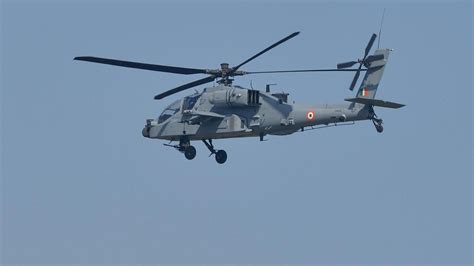
These helicopters have been particularly useful in high-altitude conflict zones like Ladakh, where mobility, visibility, and rapid engagement capabilities are essential. The rugged nature of such deployments, however, also subjects these complex machines to environmental stresses that can exacerbate technical vulnerabilities.
April 2023: Hard Landing in Ladakh Highlights Risks
The memory of a previous Apache hard landing in April 2023 still lingers in defense aviation circles. During an operational sortie near Khardung La in Ladakh, an Apache experienced mechanical issues mid-flight and was badly damaged during a hard landing. The incident, although not resulting in fatalities, underscored the inherent risks of operating advanced rotary-wing platforms in high-altitude, low-oxygen environments.
The combination of reduced air density, temperature extremes, and terrain-induced turbulence creates a hostile operational theater for even the most resilient helicopters. These challenges necessitate meticulous pre-flight checks, component fatigue analysis, and comprehensive maintenance protocols, especially when flying missions over India’s Himalayan frontiers.
Technical Complexity: A Double-Edged Sword
What makes the Apache a deadly war machine also makes it highly maintenance-intensive. With over 1,200 system parts, sophisticated avionics, and precision weaponry, the AH-64E requires continuous upkeep. Even a minor fault in the target acquisition system, electrical subsystems, or rotor assemblies can prompt emergency measures. The recent twin incidents may not indicate a fundamental flaw but rather the normal mechanical stress that comes with high operational tempo.
But as India increases its Apache flying hours, especially in remote and rugged terrains, the frequency of technical alerts is also likely to rise. That makes the role of ground support teams, technical diagnostics, and preventive maintenance even more critical. Moreover, pilot training protocols must increasingly emphasize handling in-flight technical snags, especially during solo or minimal-crew sorties.
Strategic Concerns: Are Apaches Being Over-Deployed?
Strategic analysts have begun to ask whether the Indian armed forces are stretching Apache deployments too thin across multiple frontiers. The helicopters have been spotted performing reconnaissance missions, live-fire drills, and air-ground coordination in various sectors simultaneously. This over-utilization could lead to premature component wear and increase the likelihood of mechanical failure.
While emergency landings are a standard safety precaution in modern aviation, their recurrence in combat aircraft can be a red flag. The IAF’s decision to fly the Saharanpur Apache back to base after on-ground checks suggests a level of confidence in the system’s redundancy and reliability. However, from a public perception and morale standpoint, multiple emergency landings in a short period raise eyebrows.
Lessons from Global Apache Operations
Globally, Apache helicopters have seen extensive use in both NATO and non-NATO countries, with over 2,000 units delivered worldwide. In the United States Army, where Apaches form the backbone of its attack helicopter regiments, similar issues of in-flight anomalies have been documented but are usually mitigated by a robust logistical support ecosystem.
India, still expanding its Apache logistics footprint, may benefit from increased collaboration with Boeing’s technical experts, including predictive maintenance algorithms and AI-assisted diagnostics, which are already being tested in Western militaries. If adopted more widely, such systems could detect wear patterns and prevent technical failures before they occur.
Public Trust and Operational Transparency
The Indian Air Force has been transparent in its public communication, promptly confirming that both recent landings were safe and damage-free. This kind of proactive disclosure is essential in maintaining public trust in military readiness, especially in an era where real-time news dissemination and social media videos can influence national sentiment.
Still, transparency should be matched by long-term systemic action. Regular flight audits, maintenance policy reviews, and engineering upgrades are necessary to prevent such emergency landings from becoming routine headlines.
Conclusion: Tactical Win, Strategic Wake-Up Call
The safe landing of the Apache in Nangalpur is, without doubt, a testament to the professionalism of IAF pilots and the aircraft’s safety features. But the broader pattern emerging from recent incidents should prompt the Indian defense establishment to take a hard look at fleet management, airworthiness procedures, and long-term sustainment plans.
As India continues to project military strength along contentious borders, the reliability of its frontline assets like the AH-64E Apache Guardian will be closely watched—not just by citizens, but also by adversaries.
The Apache may be a beast in battle, but to remain dominant, it must also prove itself as a dependable machine in peace.