This article explores findings from a survey conducted by EUROCONTROL in 2019, aimed at understanding how European Air Navigation Service Providers (ANSPs) handle laser attack notifications. Most laser incidents occur near airports, but some aircraft also experience these attacks while in flight. For instance, one major European ANSP reported that around 5% of such events happen during the cruise phase, translating to about 10 to 40 occurrences each year. Another significant ANSP noted that air traffic control (ACC) controllers are responsible for submitting reports regarding laser incidents.
Laser attacks and drone activities are often categorized similarly in terms of threat level. Despite their differences, both involve relatively new technologies that are widely accessible, have emerging regulations, and possess the potential to inflict harm from a distance, whether intentionally or unintentionally. Some ANSPs even view drones as a more significant risk to aviation safety than lasers.
When air traffic controllers receive a report of a laser attack, they typically follow a standard procedure. This includes notifying the supervisor and the police, usually through direct phone lines or with the supervisor’s assistance. In certain regions, police notification is managed by airport authorities. Some areas have specific agreements in place, such as dedicated police officers available around the clock or police stations capable of deploying helicopters swiftly. In many European nations, informing the police is a legal obligation, while in others, it relies on agreements between ANSPs and local law enforcement. After landing, police may question pilots to gather information that could aid in apprehending the attackers.
Controllers must also inform the relevant airport authority and the regulator. Under Regulation (EU) 2015/1018, there is a legal requirement to notify the regulator within a set timeframe, often within 72 hours of the incident. The focus here is on collecting safety data rather than identifying the perpetrators. Additionally, crews of flights entering the affected area are alerted. Sometimes, the air traffic controller from the upstream ATC sector is notified to relay warnings to flight crews sooner. In certain Air Traffic Service (ATS) units, laser attack warnings might be included in the Automatic Terminal Information Service (ATIS) for a specific duration. If the issue continues, a Notice to Airmen (NOTAM) may be issued.
Legal frameworks vary across Europe since laser attacks on aircraft are a relatively recent challenge. In countries like Germany, Norway, and France, using lasers against aircraft is a criminal offense, resulting in arrests and court proceedings. Other nations are updating their laws to criminalize such actions. However, in some places, data on laser attacks is only collected for statistical purposes, without any follow-up investigations. Some European regulators have established no-laser zones or require prior permissions for certain laser activities. Reports indicate that some ANSPs have observed a decrease in laser attacks in recent years, partly due to legal actions taken against offenders.
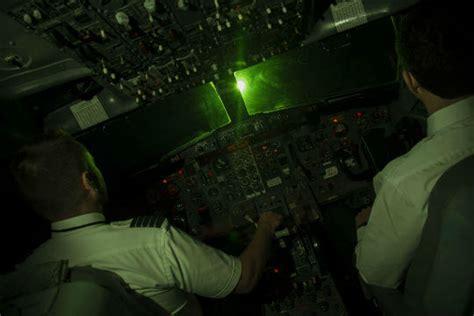
An example of a laser incident occurred on September 5, 2015, involving a Boeing 737-800 near Porto, Portugal. While beginning its descent on a non-precision final approach, a green laser was directed at the aircraft. The Pilot Flying quickly shielded his eyes and remained unaffected, but the other pilot experienced flash blindness, compromising crew coordination. As a result, the approach became unstable, leading to a go-around and a successful landing on a reciprocal runway. The investigation highlighted the increasing use of powerful green lasers in such incidents, noting that this practice was not illegal under Portuguese law.