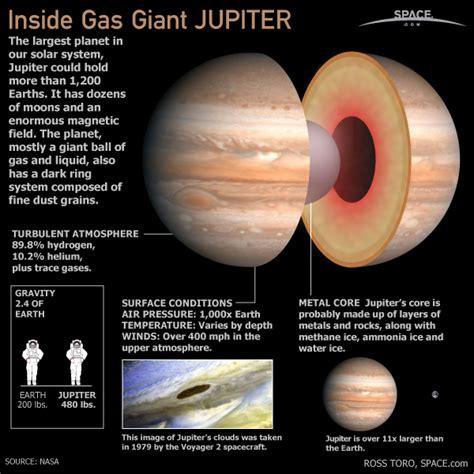
Jupiter has long stood as the Solar System’s colossal monarch, a gas giant so immense it could swallow more than a thousand Earths without complaint. For decades, astronomers believed they had a reasonably precise understanding of its size, structure, and atmospheric composition. Now, a groundbreaking study published in Nature Astronomy has forced a recalibration of that confidence. The findings reveal that Jupiter is slightly smaller, more flattened, and more complex than previous models suggested—subtle differences that carry profound implications for planetary science.
A Smaller, Flatter Jupiter Emerges
The new research demonstrates that Jupiter’s radius is approximately 12 kilometers smaller from pole to pole and 4 kilometers smaller at the equator than earlier estimates indicated. While those numbers may sound trivial on a planetary scale, they matter enormously in astrophysical modeling. Jupiter’s immense gravity, rapid rotation, and fluid composition combine to create an oblate spheroid—a sphere flattened at the poles and bulging at the equator.
This updated measurement confirms that Jupiter is more oblate than scientists previously believed, meaning its equatorial bulge is more pronounced. That shape is not cosmetic. It encodes information about the planet’s internal mass distribution, rotational dynamics, and even the behavior of its deep atmospheric currents.
In planetary science, a few kilometers can ripple through equations that describe how a world formed billions of years ago. Refining Jupiter’s dimensions is akin to correcting the foundation measurements of a cathedral—everything built on top must be reconsidered.
Juno’s Revolutionary Perspective
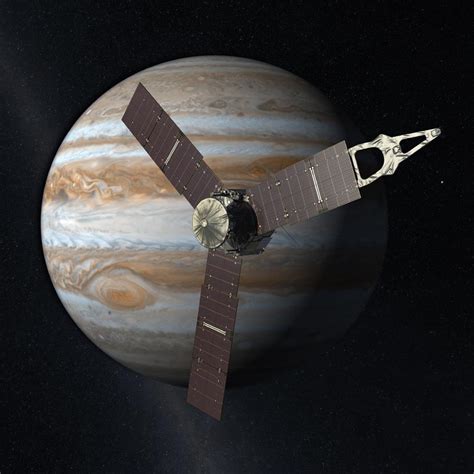
The key to this revelation lies with NASA’s Juno spacecraft, which has orbited Jupiter since 2016. Earlier models relied heavily on radio occultation data collected more than five decades ago by the Pioneer and Voyager missions, supplemented by the Galileo probe that plunged into Jupiter’s atmosphere in 1995. Those missions were extraordinary for their time, but their measurements contained blind spots.
Juno approached Jupiter from a novel orbital geometry, traveling behind the planet relative to Earth. As Jupiter’s immense mass bent and distorted the spacecraft’s radio signals, scientists carefully measured these distortions. This method allowed researchers to construct a highly detailed map of Jupiter’s size, gravitational field, and atmospheric temperature profile.
Crucially, previous analyses had not fully accounted for the impact of Jupiter’s powerful zonal winds—jet streams that can exceed 300 miles per hour. These winds subtly influenced signal interpretation, introducing discrepancies into earlier models. Juno’s refined calculations corrected for this factor, delivering a more accurate planetary portrait.
Resolving a Longstanding Atmospheric Mystery
For years, planetary scientists faced a puzzling contradiction. Data from the Galileo probe suggested Jupiter’s atmosphere was hotter and relatively poor in heavy elements, while Voyager and Pioneer observations indicated a cooler, metal-rich environment. The two pictures seemed irreconcilable.
Juno’s findings reveal that the disagreement was not a measurement failure but a sampling issue. Jupiter’s atmosphere is not uniform. It contains significant regional variability, with water vapor heavily concentrated near the equator and drier conditions elsewhere. Galileo appears to have descended into an unusually dry and chemically sparse region, skewing its readings.
This realization reshapes our understanding of Jupiter’s atmospheric chemistry. The planet is indeed rich in heavier elements—astronomers refer to these collectively as “metals”—but their distribution varies dramatically with latitude and depth. The atmosphere also appears cooler overall than many earlier models predicted, further refining simulations of gas giant behavior.
Implications for Planetary Formation and Solar System History
Jupiter is widely believed to be the oldest planet in the Solar System, forming early enough to shape the architecture of everything that followed. Its gravity influenced the distribution of asteroids, redirected comets, and may even have played a protective role in Earth’s development.
A more accurate model of Jupiter’s size and composition provides tighter constraints on theories of planetary formation. The degree of oblateness reveals information about the density of Jupiter’s core and the distribution of mass within its deep interior. Its metal abundance informs models of how primordial material coalesced in the protoplanetary disk.
Understanding Jupiter is not an exercise in remote curiosity. It is a window into how giant planets assemble, migrate, and influence neighboring worlds. Since gas giants are common in other star systems, refining Jupiter’s profile improves our interpretation of countless exoplanets observed across the galaxy.
The lesson is clear: even in our cosmic backyard, certainty is provisional. With each technological advance, the universe quietly adjusts the numbers, and our textbooks must follow. Jupiter remains vast and majestic, but it is now smaller, flatter, cooler, and more intricate than we once believed—and in that refinement lies a deeper grasp of how planetary systems come to be.