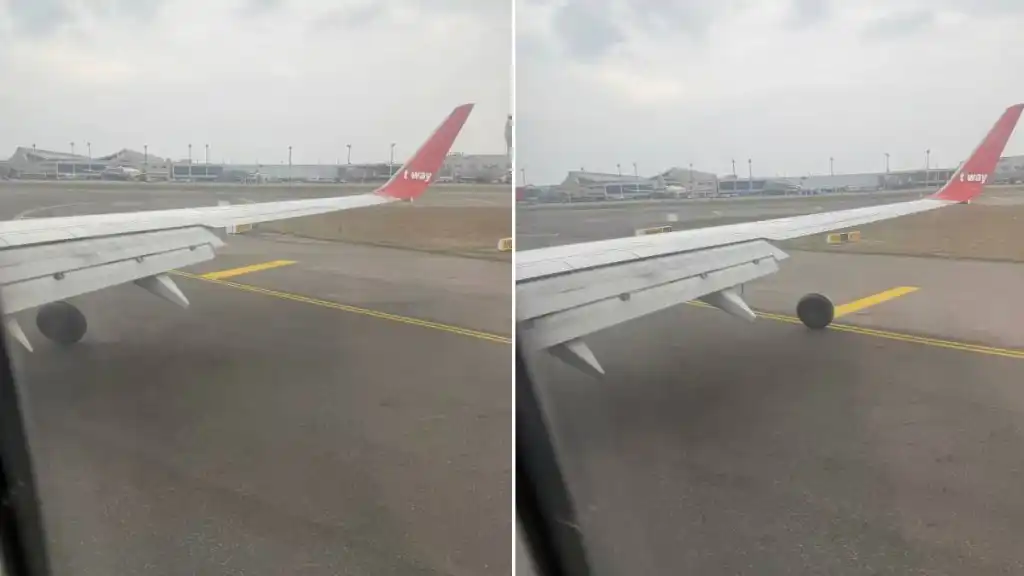
Taipei’s Taoyuan International Airport (TPE) experienced a sudden operational shock on February 8 after a T’way Air Boeing 737-800 suffered a right main landing gear tire failure during landing. What began as a contained mechanical anomaly quickly escalated into airport-wide disruption, exposing how fragile peak-hour operations can be at a major international hub when runway capacity is abruptly reduced.
The aircraft, operating T’way Air flight TW687 from Jeju Island, touched down at 3:52 p.m. local time when the right main-gear tire detached on contact with the runway. Despite the failure, the flight crew maintained full control, taxied the aircraft clear, and reached parking stand A2 within two minutes. No injuries were reported, and passengers disembarked safely. On the surface, the landing itself was a success. The real impact unfolded in the minutes that followed.
Debris from the failed wheel assembly scattered across the north runway, triggering an immediate suspension of operations on that strip. With arrival traffic building rapidly during the afternoon bank, controllers were forced to consolidate all movements onto the south runway. The result was a tightening spiral of airborne holding, delayed departures, and rising fuel concerns among inbound aircraft.
As holding patterns stacked above Taipei, aviation monitoring accounts reported that three separate flights declared fuel emergencies within a ten-minute window. These declarations underscored how quickly manageable delays can become critical when aircraft are forced to circle longer than planned. While fuel emergencies do not automatically indicate imminent danger, they do signal that margins are shrinking and priority handling is required.
The Incident Timeline and Immediate Response
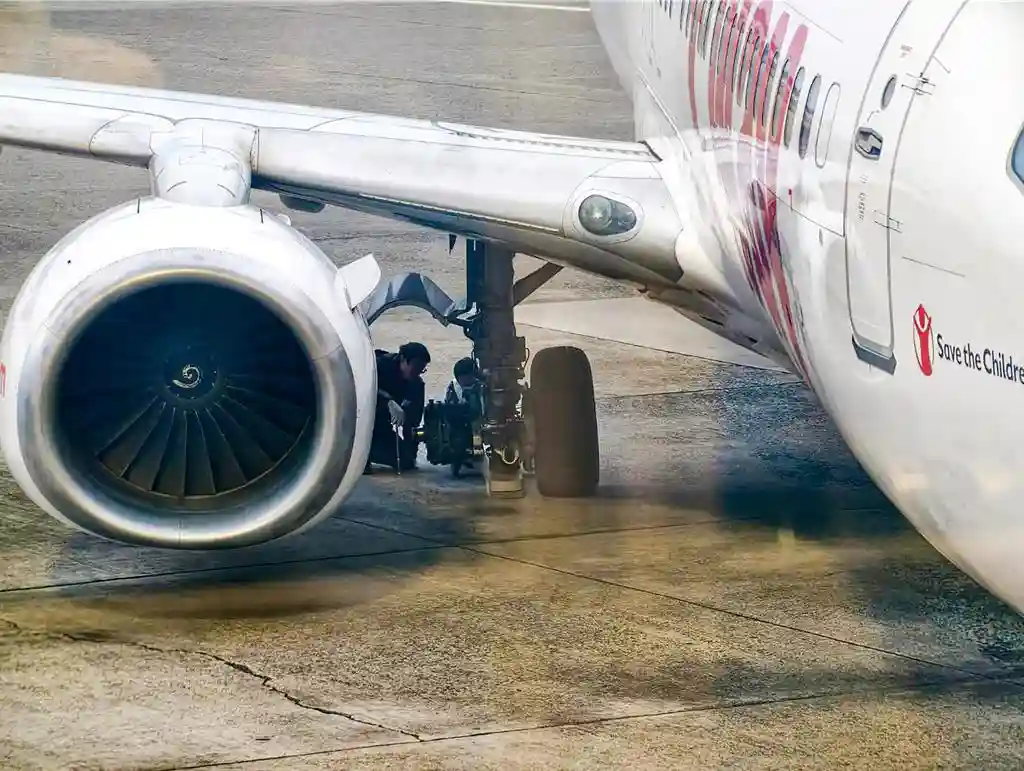
Taoyuan International Airport Corporation moved swiftly once the tire detachment was confirmed. Ground crews initiated a foreign object debris (FOD) sweep, carefully locating and removing tire fragments and associated wheel hardware. The north runway remained closed for nearly two hours, reopening at 5:35 p.m. after inspections were completed and the surface declared safe.
By the time the evening arrival peak tapered off, delays had eased to under 20 minutes. Approximately 14 flights were affected overall, with the longest delay involving a Japan Airlines aircraft that spent close to an hour taxiing and waiting for gate access. From an operational standpoint, the disruption was contained. From a systems perspective, it was revealing.
Why a Single Runway Closure Has Outsized Impact
Taoyuan International operates with two parallel runways, a configuration that provides redundancy only as long as both remain available. When one runway closes, the airport does not simply lose capacity; it loses flexibility. Arrival spacing must be increased to manage wake turbulence, departures must be slotted carefully between landings, and taxiway congestion becomes a real risk.
During peak arrival banks, aircraft in holding patterns burn fuel at a steady rate. Missed arrival slots cascade into missed gate availability, delayed turnarounds, and downstream schedule disruptions. Even a two-hour closure can generate effects that linger well into the evening. This is why FOD removal is non-negotiable. A single overlooked fragment can puncture another tire or be ingested by an engine, compounding the original problem.
The fuel emergencies reported during this event highlight the delicate balance between efficiency and safety. Airlines plan fuel loads with contingencies, but extended holding during peak congestion compresses those buffers quickly. Controllers must then juggle prioritization while maintaining separation and safety margins.
What Caused the Wheel Failure?
A landing gear tire detachment is rare but not unprecedented. Investigators typically examine several potential contributors, including underinflation, overheating from braking, foreign object damage, or issues with the wheel hub and axle assembly. Maintenance records, recent wheel changes, torque application procedures, and parts traceability all come under scrutiny.
For T’way Air, the focus now shifts from immediate response to accountability and prevention. Even when no injuries occur, such incidents attract regulatory attention because the consequences can scale rapidly in busy environments. The aircraft involved may remain grounded until inspections are complete, tightening schedules for a low-cost carrier that relies on high utilization.
Airline and Passenger Implications
The financial impact of a wheel assembly is trivial compared to the downstream costs of delays, missed connections, crew displacement, and potential compensation claims. For passengers, the experience often feels chaotic, even when safety is never compromised. Public perception tends to treat wheel-related incidents as near-disasters, regardless of how professionally they are handled.
T’way Air has stated that it is cooperating fully with authorities and has apologized to affected passengers. In the longer term, incidents like this place pressure on airlines to demonstrate robust maintenance quality control and proactive risk management. Pre-flight inspection processes, supplier oversight, and internal audits often receive renewed emphasis after high-visibility events.
A Small Failure With System-Wide Lessons
The Taipei runway disruption serves as a case study in how modern aviation systems behave under stress. A single mechanical failure, safely managed at the aircraft level, propagated outward to affect air traffic control, airport operations, multiple airlines, and dozens of flight crews within minutes. The system worked, but it worked hard.
Airports built for efficiency rather than slack rely on precision, coordination, and rapid decision-making. When one component falters, resilience is tested. In this case, safety held firm, passengers were protected, and operations recovered. The lesson is not about blame, but about understanding how thin the margins can be when traffic peaks and runways narrow to one.