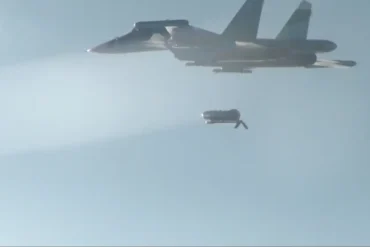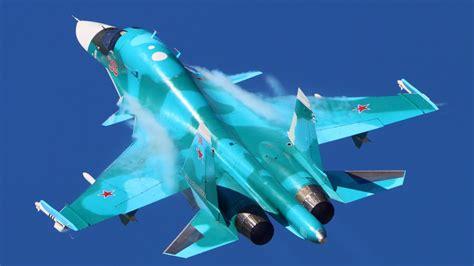
Russia has significantly expanded the role of its Su-34 fighter-bomber, transforming it into a multi-role reconnaissance platform in response to the evolving demands of the war in Ukraine. This strategic adaptation, announced by Rostec on July 10, 2025, reflects a major doctrinal shift within the Russian Aerospace Forces (VKS), underscoring the Kremlin’s focus on real-time battlefield intelligence and tactical flexibility amid growing attrition of legacy reconnaissance systems.
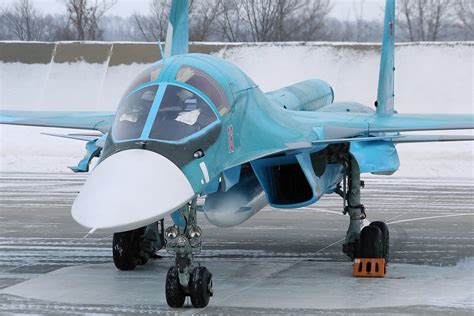
The Su-34’s Evolution from Strike to Sensor
Originally developed as a long-range strike aircraft based on the Su-27 Flanker design, the Sukhoi Su-34 Fullback has long served as Russia’s primary tactical bomber. It entered service in 2014 and has since seen extensive combat use in Syria and Ukraine. However, in recent years—and particularly since the intensification of hostilities in Ukraine—the VKS has looked to expand the Fullback’s utility beyond conventional bombing runs.
The integration of the Sych universal reconnaissance pod system marks a turning point in this process. Developed in three distinct variants—radio-technical, radar, and optical-electronic—the Sych system can be externally mounted under the aircraft, allowing it to gather battlefield intelligence in real time. Critically, the Su-34 retains its ability to perform strike missions while carrying the pod, giving it a true dual-role combat capability.
Reconnaissance Under Fire: Why Fighters Are Taking the Lead
The move toward multi-role ISR (Intelligence, Surveillance, and Reconnaissance) fighters like the Su-34 stems from a growing realization within the VKS: traditional ISR platforms are increasingly vulnerable in contested airspace. Aircraft such as the Il-20M Coot-A, Tu-214R, and Su-24MR have either been shot down, are aging, or cannot operate effectively in environments saturated with modern Western-supplied air defense systems.
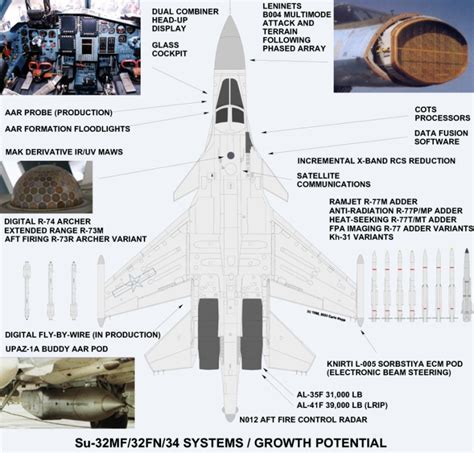
Modern fighters such as the Su-34 offer a compelling alternative. Capable of speeds exceeding 1,900 km/h, with an operational ceiling of up to 17,000 meters, the Fullback can conduct fast, high-altitude passes over hostile territory. Its electronic warfare (EW) suites—including the Khibiny (L-175V) and Sorbtsiya-S (L005-S)—allow it to jam and evade radar-guided systems. When paired with anti-radiation missiles like the Kh-31P, the Su-34 becomes not only a sensor platform but also a potent SEAD (Suppression of Enemy Air Defenses) asset.
Technical Overview of the Su-34’s Recon Configuration
At its core, the Su-34 is a robust and heavily engineered strike aircraft, with design features that set it apart from other tactical bombers. It boasts:
- Length: 23.3 meters
- Wingspan: 14.7 meters
- Maximum Takeoff Weight: 45,000 kg
- Top Speed: 1,900 km/h
- Ferry Range: 4,500 km (7,000 km with refueling)
- Ordnance Load: 12,000 kg across 12 hardpoints
The aircraft’s Sh-141 radar supports terrain-following and synthetic aperture modes, crucial for low-altitude reconnaissance. The upgraded Su-34M variant also reintroduces rearward threat detection using the Kopyo-DL radar, enhancing situational awareness. Meanwhile, the Platan electro-optical system and foreign-licensed Damocles targeting pod give the Su-34 advanced capabilities for target acquisition and visual intelligence.
Its crew cabin, a rare side-by-side configuration, is armored with 17 mm titanium plating and pressurized for operations up to 10,000 meters without masks. Amenities such as a galley and toilet extend mission endurance—crucial for long-range ISR sorties.
Combat-Tested Over Ukraine
Since the outset of the full-scale invasion in 2022, Su-34s have played an integral role in Russian aerial operations. Initially deployed for precision and standoff strikes, the aircraft has adapted to broader roles amid rising attrition. According to open-source data from Oryx, by mid-2024 at least 30 Su-34s had been destroyed—by MANPADS, SAMs, or accidents. Notable incidents include:
- A crash into a residential area in Yeysk in October 2022 due to engine fire.
- An unintentional ordnance drop over Belgorod in April 2023.
- The destruction of multiple Su-34s during Ukrainian drone strikes on Marinovka Airbase in June 2025.
These losses have not deterred continued investment. On July 10, 2025, UAC (United Aircraft Corporation) delivered new Su-34 units to front-line units and confirmed plans to increase production rates through the year, fulfilling Russia’s state defense order.
The Sych Pod: Russia’s Tactical ISR Lifeline
The heart of the Su-34’s reconnaissance capability lies in the Sych pod system, developed to counteract ISR shortfalls exposed by Ukraine’s deep strike and EW capabilities. These pods are designed for plug-and-play use, with three operational modules:
- Radio-Technical Reconnaissance: Detects and locates enemy communication and radar sources.
- Radar Surveillance: Provides synthetic aperture radar imaging and terrain mapping.
- Optical-Electronic Surveillance: Captures high-resolution imagery for visual confirmation and targeting.
Unlike legacy platforms requiring dedicated airframes, the Sych system empowers multi-role adaptability, enabling Su-34s to switch from reconnaissance to combat roles within the same sortie. This flexibility is increasingly critical as Russian forces face distributed, decentralized, and mobile Ukrainian defenses.
Filling the Reconnaissance Gap in a Degraded Force
The Su-34’s reassignment reflects a broader recalibration of Russian ISR strategy. With reconnaissance-dedicated platforms suffering losses or being technologically outdated, Moscow has moved to multi-role solutions. The Su-34 now joins the ranks of other Russian fighters performing reconnaissance duties:
- Su-30SM: Two-seat multirole fighter using ELINT pods for mapping and laser designation.
- Su-35S: Air superiority platform conducting radar reconnaissance and acting as forward sensors.
- Su-57: Fifth-generation stealth fighter reportedly used for deep ISR and SEAD missions.
However, while these aircraft offer ISR potential, the Su-34—with its extended range, armored cockpit, EW systems, and payload—remains uniquely positioned to carry out high-risk reconnaissance under fire. The decision to pivot toward Su-34s as ISR workhorses may signal a decentralized ISR doctrine, with reconnaissance functions increasingly integrated into frontline air regiments rather than being reserved for strategic assets.
Order of Battle and Production Outlook
To date, over 150 Su-34s have been delivered to the Russian Aerospace Forces across multiple contracts. Current deployment includes:
- 47th Bomber Regiment (Voronezh)
- 277th Regiment (Khabarovsk)
- 559th Regiment (Rostov)
- Additional units in Lipetsk Training Center and Akhtubinsk Flight Test Center
As of 2024, the VKS maintained 102 standard Su-34s and about 22 Su-34M variants. The delivery of new aircraft in April and July 2025 confirms ongoing investment. A 2019 export deal with Algeria for 14 Su-34s also underscores its relevance on the international market.
Strategic Implications: Reconnaissance in the New Era of Air Warfare
The Russian decision to retrofit its Su-34 fleet for reconnaissance duties is not merely a logistical adaptation—it reflects a strategic necessity born from battlefield realities. In a theater where Western-supplied air defenses have pushed back Russian aerial dominance, ISR superiority has become as critical as kinetic strike capability.
Fighter-based reconnaissance solutions such as the Su-34 offer survivability, speed, and tactical adaptability. They reduce the risk associated with deploying slow-moving ISR platforms and can penetrate deeper into contested airspace. Their ability to support multi-domain operations, from strike to SEAD to intelligence collection, make them indispensable tools in 21st-century warfare.
As the war in Ukraine drags on, the Russian military’s shift toward flexible, pod-equipped ISR fighters like the Su-34 may determine its capacity to adapt and respond in a conflict increasingly defined by technology, sensors, and the real-time flow of information.