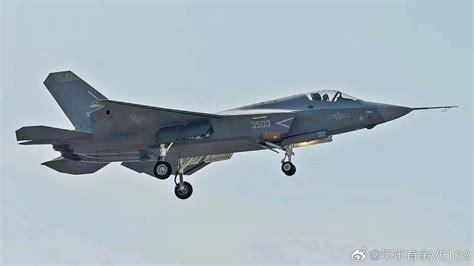
The Shenyang J-35 represents a critical leap in Chinese military aviation, marking China’s ambition to close the technological gap with Western stealth fighter platforms. Developed by Shenyang Aircraft Corporation (SAC), the J-35 stands as a sophisticated, fifth-generation, twin-engine, multirole stealth fighter, crafted to fulfill both naval and land-based roles while projecting China’s growing aerospace prowess.
The J-35’s journey began under the designation FC-31, initially envisioned as a privately funded export demonstrator after SAC’s unsuccessful bid for the J-XX program. Its public unveiling at the 2012 Zhuhai Airshow drew global attention, as the prototype, known by its tail number 31001, showcased an angular, radar-evading design powered by Russian Klimov RD-93 engines. This first iteration symbolized SAC’s determination to prove its capability without initial government backing, setting the foundation for what would evolve into a formidable combat platform.
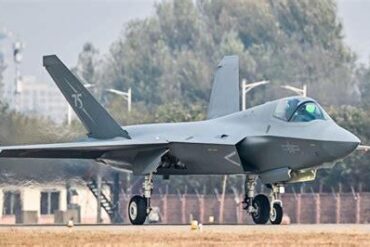
Development milestones accelerated through the mid-2010s with the introduction of the second prototype, 31003, in 2016. This iteration incorporated significant upgrades: Chinese WS-13E engines replaced the earlier Russian powerplants, enhancing thrust and reliability; the airframe saw refinements in its stealth shaping with clipped swept tails and a single-piece canopy, reducing radar cross-section; avionics improvements hinted at a maturing design, intended not merely for export but increasingly aligned with People’s Liberation Army Navy (PLAN) requirements.
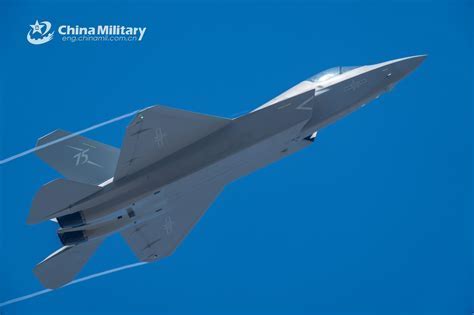
By 2020, SAC’s iterative design process had taken a navalized turn. Mock-ups of a carrier-compatible version began surfacing, revealing adaptations for CATOBAR (Catapult-Assisted Take-Off But Arrested Recovery) operations. The maiden flight of this navalized variant, officially designated J-35, occurred on 29 October 2021, featuring critical maritime adaptations: a tailhook for carrier landings, folding wings for storage aboard aircraft carriers, and a prominent Electro-Optical Targeting System (EOTS) turret beneath the fuselage. These design cues signaled Beijing’s intent to field an indigenous stealth fighter aboard its expanding fleet of catapult-equipped aircraft carriers.
Refined Airframe and Stealth Features
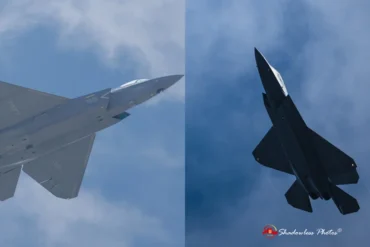
The J-35’s airframe embodies modern stealth architecture. A blended fuselage-wing design improves aerodynamic efficiency while minimizing radar reflection surfaces. The inclusion of Diverterless Supersonic Inlets (DSI) enhances stealth by eliminating traditional boundary layer diverters. Complementing the stealth profile are serrated panels, sawtooth bay doors, and serpentine air intakes, each mitigating radar exposure at various operational angles. Notably, the exhaust features stealth-optimized serrated nozzles, reducing the fighter’s infrared and radar signatures from rearward detection.
The avionics suite integrates state-of-the-art sensors: a KLJ-7A Active Electronically Scanned Array (AESA) radar, Distributed Aperture System (DAS), and Infrared Search and Track (IRST) provide all-aspect detection and tracking. Pilots are equipped with a 20×8 inch multi-function touchscreen display (MFD), helmet-mounted display (HMD), digital flight controls, and a chin-mounted EOTS, creating a digitally immersive cockpit optimized for network-centric warfare.
Powerplant evolution has been pivotal. Initial prototypes operated on WS-13E engines, offering up to 87.2 kilonewtons of thrust. However, developmental goals target the integration of WS-21 or WS-13X engines, raising output to 93.2 kN, with eventual plans to install the more powerful WS-19, delivering thrust exceeding 110 kN. The WS-19 would enable supercruise capability, a benchmark feature in fifth-generation fighter performance, positioning the J-35 closer to Western contemporaries like the F-35C.
Versatility in Armament and Payload
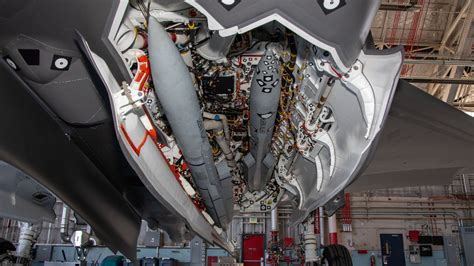
The J-35’s internal weapons bay can accommodate up to six air-to-air missiles, typically PL-10, PL-15, or PL-21, ensuring it retains a low observable profile while engaging enemy aircraft. Six external hardpoints further extend versatility, capable of deploying a mix of air-to-ground munitions, anti-ship missiles, and guided bombs totaling an impressive 8,000 kg payload. This balance between internal stealth and external firepower underscores the fighter’s adaptability across air superiority, strike, and maritime interdiction missions.
Naval Variant and Land-Based Counterpart
The naval J-35 is distinguished by its folding wing mechanisms, essential for carrier deck operations aboard the Type 003 Fujian-class aircraft carrier. It integrates reinforced landing gear for arrested landings and an enhanced tailhook assembly. These features directly respond to the operational demands of a catapult-equipped carrier fleet, enabling higher takeoff weights and faster sortie generation.
In contrast, the J-35A land-based variant, which first flew on 26 September 2023, features a smaller wing area optimized for operations from conventional airfields. Its landing gear lacks the tailhook, replaced by a single-nose-wheel configuration, reflecting its non-carrier operational focus. Despite structural differences, both variants share core avionics and propulsion systems, streamlining logistics and pilot transition between land and carrier squadrons.
Operational Testing and Strategic Trajectory
Flight testing milestones have unfolded methodically: from the FC-31 prototype’s maiden flight in October 2012 to second prototype testing in December 2016, followed by naval variant sorties in October 2021 and July 2022, and culminating with J-35A testing in late 2023. Each flight campaign introduced new technologies and structural reinforcements, reflecting a maturation process that balances stealth, agility, and durability.
Strategically, the J-35 symbolizes a paradigm shift. With its induction, China joins the United States as the only nation fielding two stealth fighter families simultaneously—the Chengdu J-20 for air superiority and the Shenyang J-35 for naval and multirole applications. This dual-capability erodes traditional Western air dominance, compelling regional adversaries like Japan and India to accelerate counter-stealth initiatives such as the Mitsubishi F-X and HAL AMCA.
Global Interest and Export Prospects
Beyond domestic adoption by the People’s Liberation Army Air Force (PLAAF) and People’s Liberation Army Naval Air Force (PLANAF), the J-35 has ignited export speculation. Pakistan, reportedly interested in acquiring up to 40 units, views the J-35 as a complement to its JF-17 fleet, enhancing its deterrence posture against regional adversaries. Pilot familiarization reportedly commenced in late 2024, signaling forward-leaning operational preparation. Simultaneously, Egypt has emerged as a potential customer amid discussions for modernizing its fighter inventory.
Future Outlook and Implications
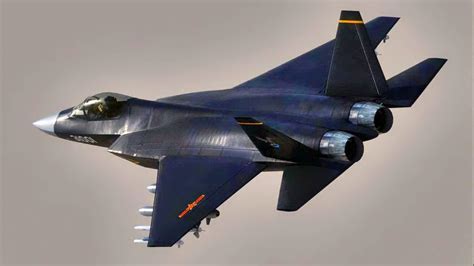
The J-35’s trajectory underscores China’s broader ambition to establish technological parity, if not superiority, over legacy Western platforms. While still awaiting full operational clearance and integration aboard Chinese carriers, its progressive development reflects China’s capacity for iterative refinement and indigenous aerospace innovation.
However, the J-35 has not escaped controversy. Western analysts have speculated about the role of industrial espionage in accelerating its development, citing similarities with the Lockheed Martin F-35 program. Alleged cyber intrusions and data thefts have raised questions about intellectual property compromise, though China maintains the aircraft is an entirely independent domestic design.
As flight testing intensifies through 2024 and beyond, the J-35 remains a program to watch—an aircraft poised to redefine Asia-Pacific airpower balances, challenge U.S. carrier air wings, and offer a competitive option to nations reluctant or unable to procure Western fifth-generation fighters.
The J-35’s operational debut, whether from the deck of the Fujian-class carrier or the runways of inland bases, will mark a decisive milestone in China’s quest to project stealth-enabled airpower across maritime and continental domains.