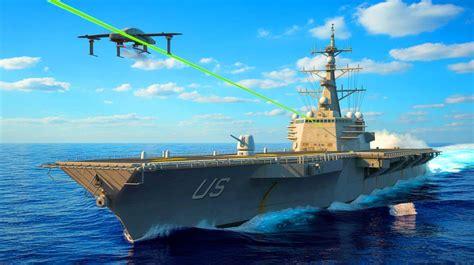
The modern battlefield is no longer defined solely by firepower—it is increasingly shaped by invisible control over information and electronics. As drone warfare escalates across global hotspots, the U.S. Navy is advancing a strategy that sidesteps traditional weapons entirely. Instead of intercepting threats with missiles or bullets, it is deploying a system that disables hostile drones mid-flight, rendering them ineffective without a single explosion.
At the heart of this shift lies a powerful idea: control the signal, control the battlefield. Drones depend on navigation systems, communication links, and onboard processing to function. Disrupt those, and even the most advanced unmanned aircraft becomes little more than dead weight falling from the sky. This philosophy defines the Navy’s newest tool, which prioritizes electronic dominance over kinetic force.
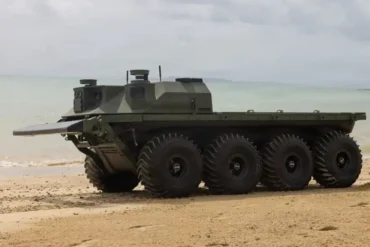
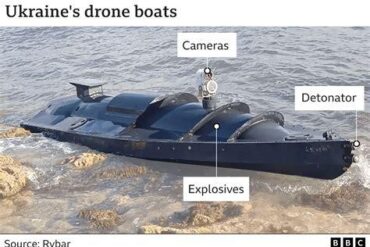
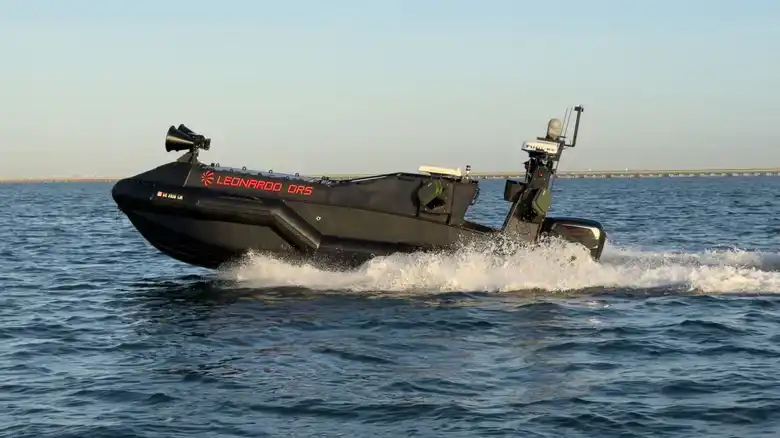
Developed by defense contractor Leonardo DRS, the Maritime-Mission Equipment Package (M-MEP) represents a modular leap forward in maritime defense. Mounted on compact unmanned surface vessels—essentially agile drone boats—this system operates as part of a distributed network. These vessels can deploy ahead of larger warships, forming a dynamic, forward-operating shield that detects and neutralizes aerial threats before they close in.
A New Kind of Warfare: Disabling Instead of Destroying
What sets the M-MEP apart is its reliance on electronic warfare systems rather than conventional weapons. Instead of firing projectiles, it targets the digital backbone of enemy drones. By scrambling navigation signals and interfering with communication channels, the system effectively blinds and disorients incoming UAVs.
This approach delivers multiple advantages. First, it reduces the logistical burden of ammunition. Second, it minimizes collateral damage, a critical factor in contested or civilian-heavy environments. Most importantly, it allows for scalable, repeatable defense—a single system can neutralize multiple threats in rapid succession without reloading or resupply.
The concept also reflects a broader strategic pivot. As adversaries increasingly rely on swarms of low-cost drones, expensive missile-based defenses become unsustainable. Electronic disruption offers a cost-effective countermeasure, turning the economics of drone warfare on its head.
Inside the Detection Engine: AI and Sensor Fusion
The effectiveness of the M-MEP begins with its ability to see what others cannot. It integrates advanced maritime radar with electro-optical and infrared sensors, creating a multi-layered detection network capable of identifying even small, fast-moving aerial targets.
All of this data feeds into the SAGEcore platform, an AI-driven system designed to process vast streams of information in real time. Rather than overwhelming human operators, SAGEcore filters and prioritizes threats, delivering actionable intelligence within seconds. The result is faster decision-making and a dramatically improved response window.
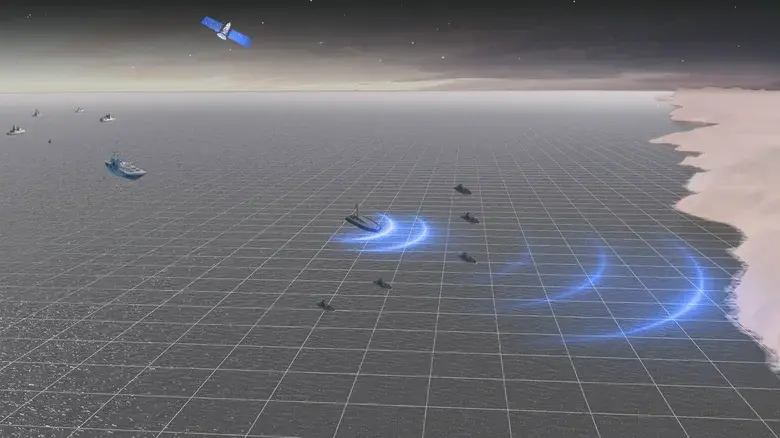
Deployed across multiple unmanned vessels, these systems form a coordinated surveillance grid. Each unit contributes to a shared operational picture, allowing commanders to track threats across wide areas and respond with precision. Even if electronic countermeasures fail to disable a drone, the system ensures that operators are never caught off guard.
Modularity and Future Adaptability
One of the most compelling aspects of the M-MEP is its modular architecture. It is not confined to a single platform or function. Instead, it can integrate with a range of “effectors,” both kinetic and non-kinetic, enabling rapid adaptation to evolving threats.
This flexibility ensures long-term relevance. As drone technology advances, so too can the M-MEP. Engineers can upgrade sensors, refine algorithms, or incorporate new countermeasures without redesigning the entire system. The result is a future-proof defense solution capable of evolving alongside the threats it is designed to counter.
Strategic Implications for Naval Warfare
The introduction of systems like the M-MEP signals a profound transformation in naval strategy. Warfare at sea is becoming less about visible power and more about invisible influence over the electromagnetic spectrum. Victory may no longer depend on who fires first, but on who controls the flow of data.
This shift also enhances survivability. By deploying unmanned systems as the first line of defense, the Navy reduces risk to personnel and high-value assets. Ships can remain at safer distances while still maintaining a robust defensive perimeter.
In an era defined by rapid technological change, the ability to adapt quickly is decisive. The M-MEP embodies that principle, offering a glimpse into a future where wars are won not by destruction, but by disruption.