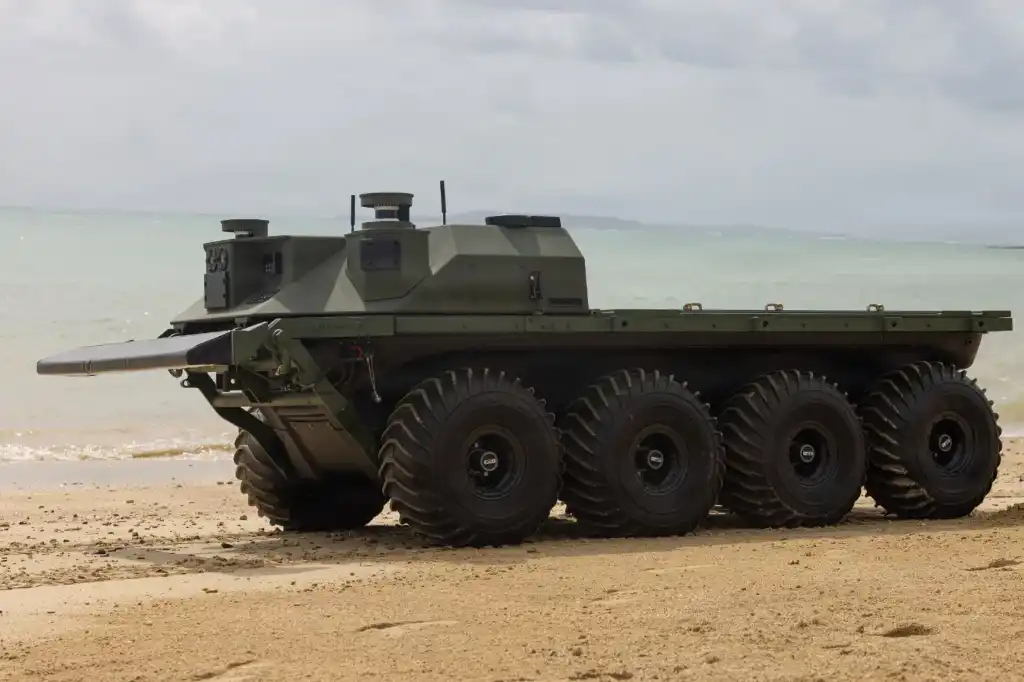
The integration of autonomous systems into the battlefield is no longer a futuristic concept—it is a tactical necessity. At Camp Schwab in Okinawa, Japan, the U.S. Marine Corps is advancing this frontier by fielding Rheinmetall’s Mission Master Silent Partner uncrewed ground vehicles (UGVs) in operational training. This significant milestone marks a shift in how the Marines envision combat logistics and battlefield survivability in the Indo-Pacific theater.
Transforming Battlefield Logistics at the Tactical Edge
In the face of increasingly sophisticated adversary surveillance and long-range strike capabilities, the U.S. Marines are adapting their logistics doctrine to sustain forward-deployed units in contested environments. Central to this evolution is the deployment of the Mission Master Silent Partner, a rugged, electric 8×8 autonomous platform designed for logistics support and casualty evacuation (CASEVAC).
Marines from the 4th Marine Regiment, 3rd Marine Division are now incorporating these robotic platforms into their section-level exercises, a clear indicator that these systems are not mere testbeds but integral components of future force structure. The Silent Partner functions as an autonomous “mule,” easing the burden on Marine squads by transporting ammunition, water, and casualties across broken, forested terrain—a vital capability in the island-hopping strategies now emphasized in Expeditionary Advanced Base Operations (EABO).
Technical Superiority: Low-Profile, High Capability
The Mission Master Silent Partner is designed with stealth and utility in mind. Measuring approximately 3 meters in length, 1.5 meters in width, and under 1 meter in height, it boasts a compact silhouette ideal for operating under the enemy’s sensor thresholds. With an empty weight of 1.5 tonnes and a payload capacity of up to 600 kg, the vehicle maintains a balanced profile between transport ability and mobility.
Its electric powertrain, combined with rubberized tracks, minimizes acoustic and thermal signatures, ensuring discreet movement even in contested or surveilled areas. This stealthy approach aligns with the need for low-emission logistics systems within enemy sensor envelopes.
Modularity as a Mission Multiplier
One of the most strategically valuable features of the Silent Partner is its modular design. The platform supports mission-specific modules that can be swapped in and out within minutes. These include:
- Cargo decks for resupply missions
- Stretcher modules for CASEVAC operations
- Sensor packages for intelligence and surveillance
- Remote weapon stations for armed support roles
This modularity enables rapid reconfiguration of the vehicle fleet based on mission demands, allowing a single platform to fulfill multiple roles within a tight operational window. For units like the 4th Marines, this versatility is a force multiplier—enhancing logistical throughput, reducing Marine fatigue, and expanding operational tempo.
A Digital Backbone for Autonomous Warfare
The Mission Master’s capabilities extend far beyond its physical chassis. At its core is the Rheinmetall Path Autonomy Kit (A-kit), a powerful digital architecture that enables autonomous navigation, waypoint movement, and convoy-following behavior. This architecture places autonomy at the vehicle level while retaining human oversight and command.
Each vehicle integrates seamlessly into Rheinmetall’s soldier systems and broader command-and-control (C2) software suites. In practical terms, this means:
- The UGV can be an active node in the Recognised Maritime Picture/Common Operational Picture (RMP/COP).
- It can maintain Emissions Control (EMCON) for stealth operations.
- It can share sensor data and positional information with allied systems, extending the networked battlespace.
These features provide Marine units with greater situational awareness, lower electromagnetic footprints, and a broader range of tactical options without increasing personnel risk.
Operational Integration in Indo-Pacific Terrain
The Okinawa trials are specifically designed to mirror the rugged, fragmented landscapes common throughout the Western Pacific islands. The Mission Master Silent Partner is deployed in close proximity to Marine squads, performing last-mile resupply missions through ravines, dense tree lines, and confined operational spaces.
Simulated CASEVAC missions further demonstrate the system’s tactical viability. Instead of assigning Marines to physically carry casualties—an exhausting and dangerous task—the Silent Partner serves as a mobile medical transport capable of reaching extraction zones without compromising force integrity.
By supporting squad-level logistics, the vehicle enhances squad endurance and increases the volume of critical supplies—ammunition, water, batteries—that can be transported in a single movement, reinforcing the Marines’ ability to operate independently and persistently within contested zones.
Strategic Value for Distributed Lethality
The Mission Master Silent Partner’s significance extends beyond its technical specs—it represents a paradigm shift in how the Marine Corps envisions distributed operations. As the Corps continues to transition toward smaller, dispersed, sensor-rich units, the need for autonomous mobility support becomes crucial.
This vehicle offers solutions to some of the thorniest problems in dispersed operations:
- Sustainment in isolation: Silent Partner ensures squads remain operationally supplied even when physically cut off from traditional supply lines.
- Risk mitigation: By evacuating casualties and moving supplies autonomously, fewer Marines are exposed to frontline hazards.
- Tactical flexibility: Units can reposition more frequently and sustain high-tempo operations without relying on slow or vulnerable logistics convoys.
When paired with Medium Altitude Long Endurance (MALE) drones, these UGVs form a layered mesh of sensors and logistical nodes that dramatically expand the reach and survivability of expeditionary units.
Joint and Allied Implications: Japan and Beyond
The presence of the Mission Master Silent Partner in Japan is not coincidental. It is part of a broader U.S.–Japan technological cooperation framework aimed at strengthening regional deterrence.
Japan’s Ground Self-Defense Force (GSDF) has already placed orders for three Silent Partner units, each in a different configuration: one cargo, one surveillance, and one armed variant. Trials are set to begin in 2025, and these early evaluations are expected to influence doctrine development and force structure planning in the Japanese military.
Furthermore, allied nations across NATO and the Indo-Pacific are closely monitoring the trials. The adaptability of the Mission Master platform, particularly its ability to blur the lines between vehicle and squad-level equipment, makes it a blueprint for future hybrid combat systems.
From Prototype to Standard Equipment: The Path Forward
The Silent Partner is no longer considered an experimental tool. At Camp Schwab, it is treated as section-level equipment, meaning it must be deployed, operated, and maintained under the same conditions as rifles and radios. This integration reflects a significant mental shift within the Corps—from technological curiosity to operational necessity.
The broader deployment roadmap includes:
- Armed demonstrations, such as those held at Fort Clinton, Ohio in early 2024, showcasing weaponized variants in live-fire exercises.
- Continuous autonomy testing to refine waypoint navigation, adaptive pathing, and EMCON protocols.
- Expanded trials with U.S. allies, particularly within EABO exercises that simulate conflict in island environments.
These developments confirm that UGVs are becoming indispensable components of future warfare, designed to thrive in an era marked by great power competition, electronic warfare, and precision strikes.
Conclusion: A New Chapter in Autonomous Warfare
As the United States Marine Corps prepares for 21st-century conflict, the Mission Master Silent Partner symbolizes a deliberate and strategic embrace of autonomous, resilient logistics. These uncrewed ground systems enable Marine units to operate with greater endurance, reduced risk, and enhanced adaptability.
With deployments in Okinawa and evaluations underway in Japan, the Silent Partner is more than just a robot; it is a vanguard asset in the modernization of allied deterrence. Its modularity, stealth, and networked integration position it not as a niche support tool, but as a core element of the emerging distributed force model.
In a region where miscalculation and confrontation remain real threats, the introduction of such platforms communicates a powerful message: the U.S. and its allies are committed to fielding decisive technologies that enhance combat effectiveness while safeguarding the lives of those who serve.