Southwest Airlines has spent decades cultivating a reputation for short-haul efficiency, quick turnarounds, and a domestic-first strategy that prizes frequency over sheer distance. That familiar image quietly shifted in early 2026, when schedule data revealed something genuinely new: Southwest now operates nonstop flights exceeding seven hours. For an airline built on simplicity, this is not a trivial milestone. It signals a deeper evolution in network design, aircraft capability, and competitive ambition.
In the first half of 2026, Cirium Diio data shows Southwest averaging roughly 3,900 daily flights, holding capacity steady year over year while refining where, how, and how far it flies. The carrier plans 916 routes with at least four departures between January and June, of which 834 are domestic and 82 international. Two new routes launched in early February, but the more interesting story is not where Southwest added flights—it is how far those aircraft now travel without stopping.
Among Southwest’s nine longest scheduled routes in 2026, measured by maximum block time from chocks-off to chocks-on, Hawaii dominates as expected. Seven of the nine city pairs link the mainland to the islands. What stands out is not just the geography, but the duration. For the first time in the airline’s history, a Southwest flight crosses the seven-hour threshold, a barrier it never breached even during the past decade of gradual westward expansion.
At the center of this shift is Phoenix–Honolulu, now scheduled at up to 7 hours and 5 minutes on select dates in February. That makes it the longest nonstop service Southwest has ever published. Until now, no route had exceeded seven hours, with the previous ceiling briefly reached by Phoenix–Lihue during the pandemic-era network reshuffle of 2021–2022.
The list of long-haul standouts reads like a map of Southwest’s modern ambitions. Phoenix–Kahului stretches to 6 hours 50 minutes, while Las Vegas–Lihue and Las Vegas–Honolulu reach 6 hours 45 minutes and 6 hours 40 minutes respectively. Even within the continental United States, the airline is testing endurance. Baltimore–San Francisco, timed at 6 hours 20 minutes, is now Southwest’s joint-longest route in the Lower 48, replacing the former Baltimore–Oakland service. Orlando–Sacramento matches that duration, underscoring that these flights are not Hawaii anomalies alone.
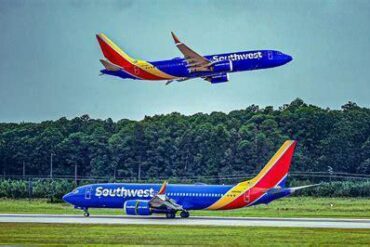
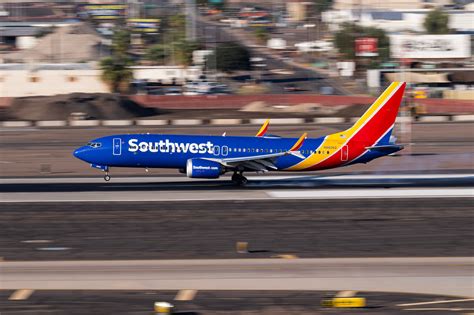
Aircraft choice makes this possible. The Boeing 737 MAX 8 dominates these longest routes, offering the range and efficiency Southwest needs to stretch its network without abandoning fleet simplicity. On certain sectors, the airline supplements with 737-700s and 737-800s, but the MAX remains the backbone. This matters because Southwest’s strategy has never been about ultra-long-haul prestige; it is about making long flights economically routine, flown daily rather than as special-case experiments.
Phoenix–Honolulu deserves special attention beyond its headline length. Southwest has operated this route since June 2021, usually daily and occasionally twice daily, most recently in April 2025. The competition is serious, with American Airlines and Alaska/Hawaiian also serving the market. Yet performance data tells a compelling story. Between November 2024 and October 2025, Southwest carried 130,064 round-trip passengers on the nonstop route. Only 26 percent were local travelers, meaning nearly three-quarters connected onward, mostly through Phoenix.
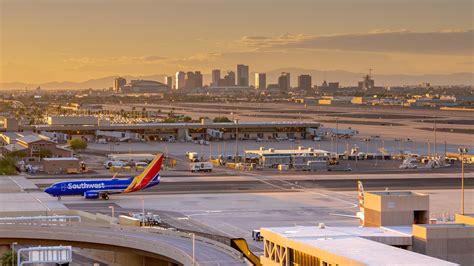
Those connections reveal how Southwest now uses Phoenix as a long-haul funnel. Popular onward destinations from Honolulu via Phoenix included Dallas Love Field, Austin, Colorado Springs, Kansas City, and St. Louis. Phoenix is already Southwest’s fourth-busiest airport by flights, and these figures show it functioning as a genuine long-distance hub rather than a simple origin-and-destination node.
The results are striking. Over that same twelve-month period, Phoenix–Honolulu posted a 94.0 percent seat load factor, dramatically higher than Southwest’s Phoenix average of 78.4 percent and its Honolulu average of 88.5 percent. By load factor alone, it ranked as the airline’s second-best route from both cities, a remarkable outcome for a flight that pushes the upper limits of Southwest’s traditional operating model.
Taken together, these seven-hour-plus schedules mark more than a curiosity. They represent a quiet but deliberate expansion of what Southwest considers normal. The airline is not chasing globe-spanning routes or widebody fleets. Instead, it is redefining long-haul within a narrowbody framework, using the 737 MAX to connect deep mainland markets directly to leisure-heavy destinations with strong connecting flows.
This evolution suggests a future where Southwest’s longest flights are no longer rare exceptions but integrated components of its network. Seven hours, once unthinkable for the carrier, is now just another block time—long, yes, but profitable, full, and increasingly familiar.