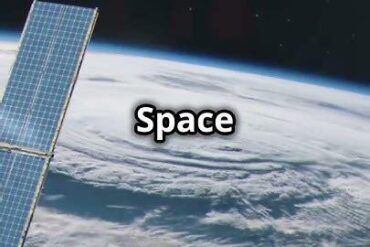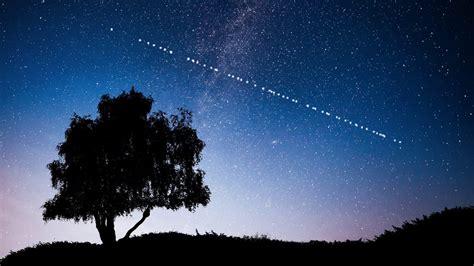
Gazing into a clear night sky can feel like peering into a slow-motion mystery. A bright streak slides overhead, silent and precise, and the mind races to label it. Is it a meteor burning up in the atmosphere, or one of the thousands of Starlink satellites gliding above Earth? With more than 15,000 active satellites in orbit as of early 2026 and SpaceX responsible for over 9,000 launches, the odds increasingly favor technology over cosmic chance. Yet the distinction matters, not just for accuracy, but for understanding how crowded and dynamic our skies have become.
The confusion is understandable. Both meteors and satellites appear suddenly, shine briefly, and vanish without ceremony. Even seasoned observers occasionally misidentify them, a fact noted by award-winning astrophotographer Alyn Wallace, who spent years documenting the night sky with scientific precision. The good news is that the sky leaves clues. Once you know where to look, the differences become strikingly obvious.
Speed is the first and most reliable giveaway. Meteors are fast—violently fast. They tear through Earth’s atmosphere at tens of kilometers per second, often visible for less than a heartbeat. Satellites, by contrast, move with patience. A Starlink satellite may take several minutes to cross the visible sky, drifting smoothly and predictably from horizon to horizon. In photography, this difference is unmistakable: a meteor flashes into a single frame, while a satellite calmly appears across multiple exposures.
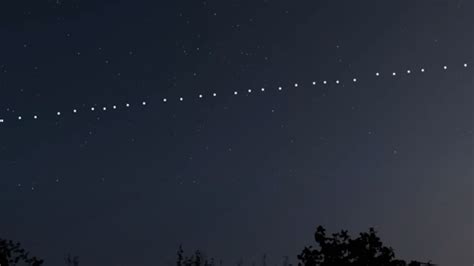
Starlink satellites add another visual signature. Shortly after launch, they often travel in tightly packed formations known as Starlink trains, appearing as a string of evenly spaced, pearl-like lights. From the ground, this can resemble a luminous white line sliding silently across the stars. Meteors never travel in formation. They arrive alone, unannounced, and die just as quickly.
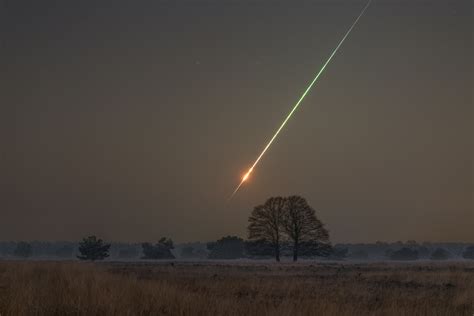
Light behavior offers another layer of evidence. Meteors generate their own light as friction superheats the air around them, creating bursts of color—greens, yellows, even reds—depending on their composition and speed. Their trails are often uneven, flaring brighter at one end before fading. Satellites, including Starlink, do not emit light at all. They simply reflect sunlight, which is why they are most visible shortly after sunset or just before sunrise. Their trails appear consistent in brightness, clean, and usually white or bluish-white from end to end.
Altitude also plays a role. Most visible satellites orbit in low Earth orbit (LEO), typically between 300 and 1,200 kilometers above the planet. This proximity makes them bright and easy to track. Meteors, however, become visible much lower, usually between 120 and 80 kilometers above Earth, where atmospheric friction takes over. That sudden ignition is why meteors feel dramatic, while satellites feel almost…civilized.
Misidentification sometimes extends beyond meteors. Aircraft can sneak into long-exposure photos as dotted, evenly spaced lines, created by blinking navigation lights. If you see repeating dots in a straight, horizontal pattern, especially with red or green flashes, you are looking at a plane. Satellites and meteors lack external lighting entirely, another small but decisive clue.
For moments of lingering doubt, technology lends a hand. Sky-mapping apps such as Star Chart or SkySafari 7 Pro can identify satellites in real time, matching their predicted paths against what you see overhead. Yet even without an app, the skill of reading the sky sharpens quickly. With a little practice, the difference between ancient cosmic debris and modern orbital infrastructure becomes second nature.
The night sky has always told stories. Today, those stories include both the fiery remnants of our solar system’s past and the reflective fingerprints of humanity’s technological present. Learning to tell them apart deepens the experience, turning a passing streak of light into a moment of understanding rather than uncertainty.