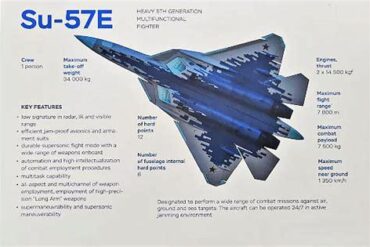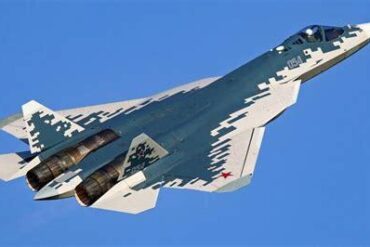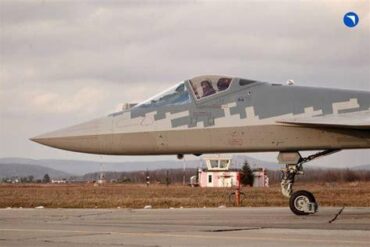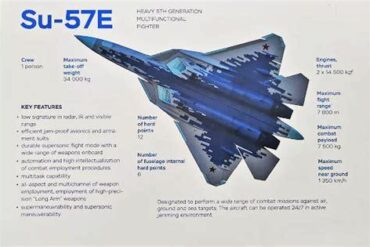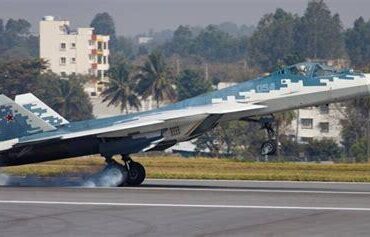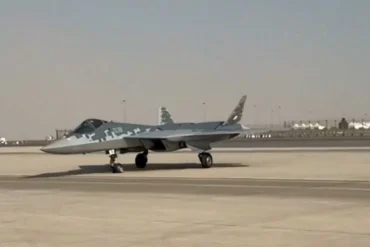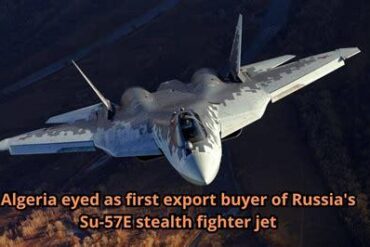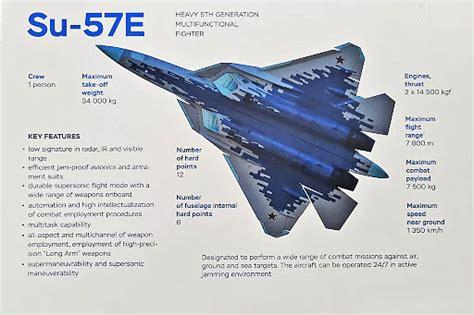
In the evolving theater of South Asian defense innovation, unverified yet persistent reports have emerged suggesting that New Delhi is demanding full integration of domestically developed gallium nitride (GaN) radar and mission systems into Russia’s advanced Su-57E stealth fighter. This push reflects India’s Aatmanirbhar Bharat initiative, a national strategy to achieve technological sovereignty by reducing dependence on foreign suppliers, and is bolstered by Russia’s unprecedented offer of full source-code access for customization of the jet. Observers argue that if India succeeds, the resulting hybrid platform could redefine air superiority in the region and establish a new precedent for collaborative aerospace partnerships.
Recently surfaced claims—originating from Indian defense experts and Arab media outlets—suggest that India is seeking to replace the Su-57E’s standard N036 Byelka active electronically scanned array (AESA) radar, based on gallium arsenide (GaAs), with DRDO’s next-generation GaN-based sensors. While neither Moscow nor New Delhi has officially confirmed these assertions as of June 21, 2025, the strategic implications are profound. India’s insistence on integrating its own avionics and weapons into the Su-57E signifies not only a technological leap but also a redefinition of traditional arms export models.
At the core of this debate lies India’s experience with previous acquisitions—most notably the Rafale deal—where restricted software access hindered the seamless integration of homegrown systems such as the Astra air-to-air missile. By contrast, Russia’s willingness to grant complete access to the Su-57E’s digital blueprint offers India a rare opportunity to tailor the jet’s sensor fusion, mission computer, and weapons employment to its unique operational requirements, potentially overcoming barriers that have long frustrated indigenous defense developers.
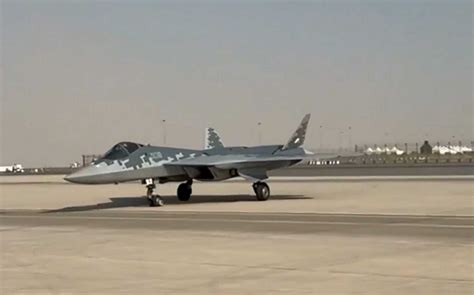
Strategic Calculus on the Subcontinent
India’s air force operates across some of the most geographically diverse and hardened theaters on earth. From the sub-zero altitudes of the Himalayas to the scorched sands of the Thar Desert and the maritime approaches of the Indian Ocean, New Delhi requires a platform that can deliver high-altitude endurance, rapid interception capability, and multi-role flexibility. The Su-57E’s combination of low-observable airframe, supermaneuverability enabled by thrust-vectoring engines, and internal weapons bays presents a compelling proposition—provided that its sensors and mission systems meet India’s rigorous standards.
Unlike Western competitors such as the F-35, whose software architecture remains tightly controlled by the manufacturer, the Su-57E offers an open-architecture framework that Russia is now willing to open fully to India. This marks a stark departure from past deals, where source-code restrictions prevented India from integrating native munitions and electronic warfare suites. The strategic calculus for India is clear: a platform that can be continuously upgraded with domestic innovations will ensure sustained air-dominance without the bottlenecks of foreign approvals.
India’s pursuit of this capability is inseparable from the broader Aatmanirbhar Bharat ethos. By insisting on system-level customization, India not only secures a cutting-edge fighter but also cultivates its own defense-industrial base. This dual benefit—acquisition of a fifth-generation asset and acceleration of indigenous R&D—embodies India’s vision of strategic autonomy and underpins the government’s broader geopolitical ambitions.
Radar Revolution: From GaAs to GaN
The Su-57E’s factory-fitted N036 Byelka AESA radar uses GaAs transmit/receive modules, a technology that, while proven, is reaching its performance ceiling. GaAs modules generate substantial heat under high-power operation and exhibit limitations in energy efficiency—constraints that can degrade sustained performance in contested electromagnetic environments.
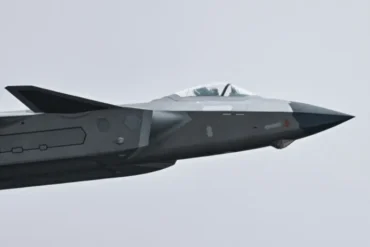
By contrast, DRDO’s GaN-based AESA radars, such as the Uttam system aboard the Tejas light combat aircraft and the Virupaksha radar slated for the Super-30 upgrade of the Su-30 MKI, provide a quantum leap in capability. GaN offers higher breakdown voltage, improved thermal conductivity, and greater power density, enabling sensors to emit stronger signals, resist electronic countermeasures, and detect low-observable targets at extended ranges. For India, integrating a GaN radar into the Su-57E would translate into superior situational awareness over the high Himalayas and contested deserts where stealthy threats like China’s J-20 may operate.
Moreover, the ability of GaN radars to sustain high duty cycles without performance degradation is crucial for air-to-air engagements requiring continuous tracking and rapid target handoff. In this context, India’s GaN revolution is not merely an upgrade—it is a reimagining of tactical advantage in envelope-pushing mission profiles.
Super-30 Blueprint: Proof of Indigenous Integration
India’s Super-30 program, a joint initiative between Hindustan Aeronautics Limited (HAL) and Russia’s United Aircraft Corporation (UAC), has already demonstrated the feasibility of melding Indian electronics with Russian airframes. Under this scheme, over 220 Su-30 MKI jets have been retrofitted with the Virupaksha GaN AESA radar, indigenous mission computers, Astra beyond-visual-range missiles, and Rudram anti-radiation weapons. The success of Super-30 highlights India’s ability to orchestrate complex systems integration within tight timelines and budge constraints.
HAL’s Nashik production facility—responsible for licensed manufacture of the Su-30 MKI—provides a ready infrastructure for localizing Su-57E production. While Russia has proposed delivering an initial batch of 20–30 off-the-shelf Su-57E fighters to meet near-term operational requirements, the longer-term plan involves a three to four-year transition to full domestic assembly and systems integration. This phased approach ensures that India’s air force maintains fifth-generation capabilities while HAL’s workforce scales up to manage the intricacies of assimilating GaN radars, mission computers, and indigenous weapon systems.
The Super-30 program’s track record of timely deliveries, rigorous flight testing, and successful weapons clearance paves the way for a similarly structured Su-57E-India collaboration. By leveraging lessons learned and supply-chain relationships established over decades, India can mitigate risks associated with introducing unproven systems into a high-performance platform.
Operational Advantages in High-Stakes Scenarios
Stealth features alone do not guarantee success; operational utility hinges on seamless integration of sensors, weapons, and data links. The Su-57E’s supercruise capability—sustaining supersonic speeds without afterburners—allows rapid reaction over vast distances, a critical asset for India when responding to incursions along the Line of Actual Control or maritime threats in the Indian Ocean Region.
Embedding the Uttam GaN radar within the Su-57E’s sensor array would enable pilots to detect and track multiple targets at ranges exceeding those achievable by GaAs systems, even in the presence of active jamming. Combined with the Astra missile’s beyond-visual-range reach and compatibility with Indian mission computers, this integration streamlines the kill-chain from initial detection to weapons release, reducing pilot workload and engagement timelines.
Thrust-vectoring nozzles grant the Su-57E exceptional agility in close-in dogfights, while internal weapons bays preserve low observability. When outfitted with a suite of indigenous air-to-ground munitions, the jet can transition seamlessly between air-superiority, interdiction, and suppression-of-enemy-air-defenses roles. Against potential adversaries—China’s J-20 and Pakistan’s planned J-35—this versatility represents a force multiplier that leverages India’s growing defense innovations rather than leaving them on the shelf.
Russia’s Strategic Gamble and Export Model Innovation
Russia’s decision to cede full source-code access and permit extensive customization of the Su-57E is a historic departure from traditional arms export practices. While this concession addresses India’s demands, it introduces significant challenges: integrating foreign subsystems into a platform architected around Russian avionics requires extensive re-engineering, and exposing sensitive software increases cybersecurity risks.
Yet, Moscow is betting on the long-term benefits. A successful collaboration with India could establish a hybrid export model in which Russia supplies the airframe, engine, and core systems, while the purchasing nation provides advanced sensors, mission computers, and weapons. This approach may appeal to other markets—Algeria, Vietnam, and others—seeking greater autonomy over their defense assets. By prioritizing deep partnerships over one-off transactions, Russia aims to sustain its market share amid fierce competition from Western platforms.
For India, the gamble promises unmatched flexibility: future upgrades to the Su-57E’s AI-enabled avionics or software-defined radio systems could be implemented domestically without waiting for foreign certification. This prospect aligns with India’s ambitions for a sovereign defense ecosystem capable of iterative innovation and rapid fielding of next-generation capabilities.
Geopolitical Tightrope: Sanctions and Strategic Balance
A major Su-57E deal carries the risk of U.S. sanctions under the Countering America’s Adversaries Through Sanctions Act (CAATSA), despite India’s history of waivers—most notably for the S-400 air defense system. Washington’s deepening engagement with New Delhi through frameworks like the Quad underscores the strategic importance of India as a counterweight to China, yet persistent U.S. export controls on advanced military technologies remain a hedge against unfettered Russian influence.
While the F-35 offers cutting-edge stealth and sensor fusion, its restrictive transfer policies and high unit cost clash with India’s self-reliance doctrine. By pursuing the Su-57E customization route, India signals a refusal to trade immediate tactical advantage for long-term strategic autonomy. Moreover, Russia’s offer to collaborate on India’s indigenous Advanced Medium Combat Aircraft (AMCA) program—sharing radar, propulsion, and stealth technologies gleaned from the Su-57E—mitigates concerns that foreign procurements will detract from domestic fighter development.
Navigating this geopolitical tightrope will require deft diplomacy: securing CAATSA exemptions, coordinating with Western partners on maintenance and interoperability, and balancing resource allocations between foreign acquisitions and homegrown R&D.
Road Ahead: A Hybrid Future for Air Combat
As India deliberates on its Su-57E radar ultimatum, the potential for co-creation looms large. A hybrid fighter—melding Russian airframe excellence with India’s GaN radar, mission computer, and weapons suite—would embody a paradigm shift in defense collaboration. It would demonstrate that emerging powers can move beyond the buyer-seller dynamic to become genuine co-developers of next-generation military technology.
Looking forward, the global fighter-jet market is poised for disruption. As GaN AESA radars, software-defined avionics, and AI-enabled electronic warfare systems become indispensable, nations with robust R&D ecosystems will demand more aggressive technology transfer and customization rights. India’s bold stance on the Su-57E could catalyze this trend, rewriting the rules for how fifth-generation platforms are sold, maintained, and upgraded.
Ultimately, the success or failure of India’s radar ultimatum will shape the strategic landscape for decades. If the co-developed Su-57E achieves its promised capabilities, it will validate the vision of defense sovereignty and collaborative innovation. If it falters—mired in integration hurdles or geopolitical obstacles—India will face tough questions about balancing self-reliance with rapid capability acquisition. Either way, the Su-57E saga is set to become a defining chapter in the annals of modern air combat.