On October 9, 2025, at approximately 18:15 local time (UTC+3), Russian forces executed a deep strike on the Chechel district of Dnipro city, some 120 km inside territory under Ukrainian control from the nearest front line in the Zaporizhzhia direction. A video circulated on social media captured a faint, blurred object gliding through the night sky toward its target; soon after, a column of dark gray smoke rose in the urban skyline, evidence of a direct hit. The flight trajectory strongly suggests the munition glided before impact, leading analysts to conclude it was likely a Grom-E1 boosted glide bomb.
This strike, reaching deep into Ukrainian-held lands, casts a harsh light on the deteriorating integrity of Ukraine’s air defense near the Zaporizhzhia sector and demonstrates Russia’s growing confidence in using stand-off precision assets to bypass front-line air defenses and strike strategic targets at will.
The Grom Weapons Family: Extended-Range Glide Systems
The Grom series represents a leap in Russian air-launched precision munitions designed to fill a critical range-and-yield gap in Russia’s arsenal. Based on the Kh-38 missile lineage, the Grom-E1 and Grom-E2 variants are glide bombs with extended reach, augmented by a solid-fuel rocket booster. Unlike the fixed-fin Kh-38, the Grom weapons deploy foldable wings, giving them aerodynamic lift and allowing approach to targets from virtually any direction. The “E” suffix often denotes export-type or export-derived systems, but the core architecture remains integrated with Russian high-end strike doctrine.
Both variants share a common cylindrical fuselage with an ogive nose, mid-body swept wings (folded in launch configuration), and an aft actuator assembly that controls guidance surfaces. They can be deployed externally on aircraft pylons or housed internally within bomb bays of fifth-generation platforms. Russia positions the Grom series as an analogue to the US JDAM-ER family, merging range augmentation with precise targeting.
Grom-E1: Specs, Capabilities, and Constraints
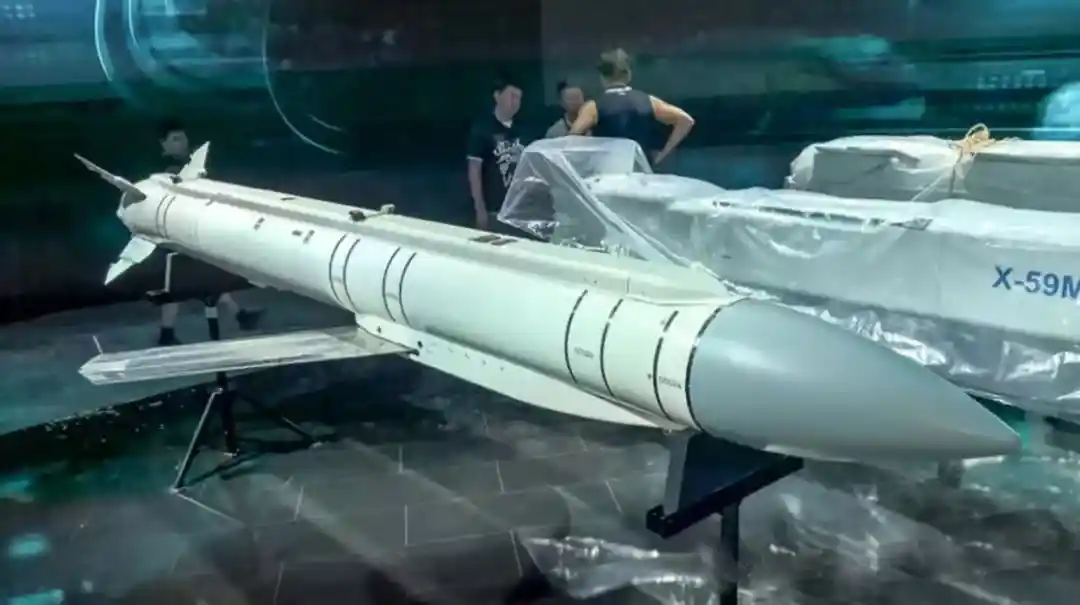
The Grom-E1 variant is the workhorse in today’s deep-strike role. Its specifications are formidable:
- Launch mass: 594 kg
- Length: 4.2 m
- Body diameter: 0.31 m
- Wingspan (deployed): 1.9 m
- Warhead: 315 kg high-explosive fragmentation, with impact fuze
- Propulsion: Two-stage solid-fuel rocket (booster + sustainer)
- Flight envelope: operable between 500 m and 12,000 m altitude, at speeds 140–445 m/s
- Range: 10–120 km, depending on launch conditions
- Guidance: INS (inertial navigation system) augmented by GLONASS updates
- Maneuverability: Up to 4 g, with possibility of approach from ±80° relative to launch vector
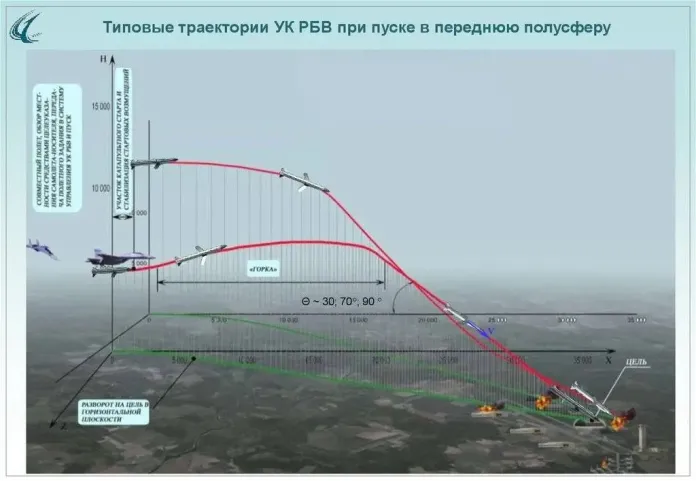
Under optimal conditions — for instance, a high-altitude launch at 12,000 m with 445 m/s initial velocity towards a distant target — Grom-E1 can travel as far as 120 km at an average cruise speed of ~300 m/s. That reach, coupled with wing-generated lift, enables the weapon to approach the target from unexpected azimuths, complicating defensive interception.
However, its guidance suite restricts its use to static, pre-coordinated targets. The weapon cannot autonomously engage moving or relocatable targets because it lacks seekers like thermal imaging or semi-active laser heads (capabilities found in modular versions of the Kh-38 family). The Grom-E1 relies on precise coordinates fed before release — making it ideal for hardened infrastructure, command posts, logistics hubs, and urban facilities.
Grom-E2: Heavier Warhead, Shortened Range
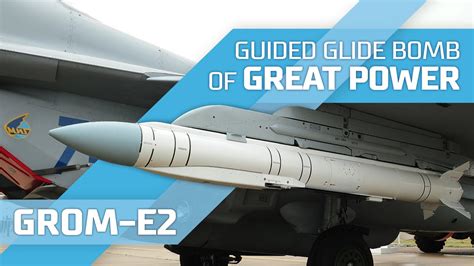
The Grom-E2 trades range for destructive power. With a slightly higher launch mass of 598 kg, it sacrifices the sustainer motor to accommodate dual warheads — a 315 kg fragmenting warhead in the nose and an additional 165 kg warhead in the rear fuselage. That increases total explosive mass to 480 kg, significantly enhancing blast effects.
The performance envelope of the Grom-E2 remains similar to E1: launch altitudes between 500 and 12,000 m, speeds of 140–445 m/s, but the range is curtailed to 10–50 km due to the absence of a sustainer stage. Because the Dnipro strike occurred ~120 km from the frontline, analysts unanimously reject use of the Grom-E2 and attribute the strike to Grom-E1 instead.
Operational History and Russian Strategy
Russia’s initial deployment of the Grom-E1 was reported in early September 2024, during strikes on Kharkiv. Strikes hit the Trade Center and the Sports Palace (allegedly repurposed for military use). Subsequent deployments struck Mirnograd, Kherson, and other high-value urban nodes. These operations illustrate a consistent pattern: Russia employs Grom missiles to target hardened infrastructure deep within Ukrainian territory.
The Grom series fills a gap in Russia’s arsenal: previously, Russia relied on UMPK glide bombs (e.g., FAB-250, FAB-500) with maximum ranges around 80 km, or Geran-2 kamikaze drones that carry relatively light warheads (~90 kg). The Grom-E1 unifies extended reach, heavier payload, and pinpoint accuracy — thus expanding Russia’s precision-strike envelope substantially. Despite its advantages, its inability to engage mobile targets means it complements, rather than replaces, missile systems like Kh-38 variants equipped with seekers (thermal, SALH, radar).
Deep Strike at Dnipro: Implications and Tactical Significance
The strike on Dnipro — 120 km from frontline — is not simply an instance of long-range strike. It is a strategic probe into the air defense vacuum in Ukraine’s interior. That a Russian jet could approach within gliding range to deliver a high-precision weapon implies either suppression or collapse of local short-to-medium range air defense systems.
The launching platform—likely a Su-34, Su-35S, or Su-30SM—would have had to approach or cross into contested airspace, dependent on advance suppression of enemy air defenses (SEAD) or simply exploiting gaps in Ukraine’s defense perimeter. The absence of credible resistance suggests erosion in Ukraine’s defensive network around Zaporizhzhia.
Russia’s use of Geran-2 drones in recent months underscores this broader strategy. Enhanced warheads (~90 kg vs. earlier micro-drones), forward-looking electro-optical sensors, mesh-network communications enabling real-time remote piloting, and mass production for scale — these features collectively magnify the psychological and material costs of Ukraine’s interior being vulnerable to repeated, deep penetration strikes.
Russia’s tactical objectives here appear threefold: degrade Ukrainian morale, obliterate command/logistics nodes, and bleed the air defense architecture. Every successful deep strike like Dnipro challenges Ukraine to patch critical gaps, or risk allowing further surgical penetrations.
Why the Strike Signals a Decline in Air Defense Integrity
The Dnipro strike reveals systemic vulnerabilities in Ukraine’s layered air defense. Several hypotheses emerge:
- Coverage gaps: Ukraine’s anti-air assets may be concentrated near the front, leaving rear sectors exposed.
- Resource attrition: sustained attrition and ammunition constraints may have degraded effective air defense density.
- SEAD success: Russian electronic warfare, drone diversion, and suppression tactics may have neutralized systems ahead of time.
- Intelligence failure: Russian planning may exploit known sensor blindspots or telemetry gaps in Ukrainian surveillance.
Regardless of the mechanism, the result is the same: Russia can now exploit stand-off weapons to strike deep, steadily weakening Ukraine’s interior sanctuaries, command nodes, and logistics chains with reduced fear of interception.
Countermeasures and Defensive Options
To resist these threats, Ukraine must adjust strategy: redeploy mobile air-defense assets deeper inland; invest in counter-rocket, missile, and artillery (C-RAM) systems tailored to glide bomb interception; expand electronic warfare and signal denial capabilities; and prioritize sensor overlap to detect low-glide, near-silent targets before terminal dive. Integrating multi-sensor fusion (acoustic, radar, optical) and leveraging allied systems (Patriot, IRIS-T SLM, NASAMS) in depth may help reestablish overlapping defensive buffers.
But such adjustments demand time, resources, and political will — luxuries in a conflict of attrition.
Strategic Outlook: Russia’s Growing Strike Depth
The Dnipro incident is not an anomaly — it is a harbinger. The capability to launch precision weapons from fighter jets, glide them deep into enemy territory, and strike with impunity raises Russia’s strategic ceiling. As Ukraine’s air defense shell thins, Russia’s options for high-lethality, low-risk deep strikes multiply.
Ukraine’s challenge now is to rebuild its depth — not merely the frontlines, but the interior — so that any deep strike draws immediate retaliation or interception. Until then, weapons like Grom-E1 will serve as instruments not merely of destruction, but of psychological intimidation, pressure, and erosion of Ukrainian strategic flexibility.