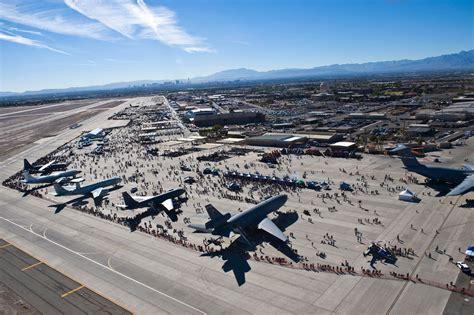
The modern United States Air Force is not defined solely by the sophistication of its aircraft, but by how those aircraft are concentrated, sustained, trained, and projected from a small number of enormously capable air bases. In 2026, a handful of installations stand apart as true fighter jet fortresses, places where flight lines stretch for miles, hangars resemble small cities, and the daily rhythm of operations quietly underwrites American air dominance.
Across the Air Force, Navy, and Marine Corps, the United States fields over 2,000 fighter jets, a number that exceeds the combined fighter strength of most near-peer competitors. These aircraft are not evenly distributed. Instead, they cluster around bases designed to absorb massive numbers of jets, pilots, maintainers, and support crews while sustaining constant readiness. Some of these bases can temporarily host more fighters during major exercises than entire national air forces possess.
What follows is a deep look at the five largest U.S. Air Force bases by number of fighter jets in 2026, ranked by their typical on-site fighter inventory. Each base tells a different story about how American airpower is trained, tested, deployed, and prepared for conflict in a rapidly evolving global security environment.
How Fighter Concentration Shapes U.S. Airpower Strategy
Before diving into individual bases, it is important to understand why fighter concentration matters. Large fighter hubs enable economies of scale in training, maintenance, logistics, and command and control. They allow the Air Force to rapidly surge combat power, integrate new aircraft types, and rehearse complex joint operations under realistic conditions.
These bases are also strategic signals. Their existence, and the aircraft parked on their ramps, send unmistakable messages to allies and adversaries alike. Whether in the deserts of Nevada, the skies over Japan, or the ranges of Arizona, these installations function as physical expressions of deterrence.
By 2026, the transition to fifth-generation fighters like the F-35 and the modernization of legacy platforms such as the F-15EX have further amplified the importance of these hubs. They are no longer just places where jets live; they are ecosystems of air combat power.
Hill Air Force Base: The Quiet Backbone Of Fighter Sustainment
Hill Air Force Base in northern Utah ranks fifth, yet its influence on U.S. fighter readiness far exceeds its raw aircraft count. With 78 F-35A Lightning II fighters, Hill AFB serves as both an operational fighter base and one of the most important sustainment centers in the Air Force.
The base hosts the active-duty 388th Fighter Wing and the Air Force Reserve’s 419th Fighter Wing, making it one of the earliest homes of the F-35A as a fully combat-capable aircraft. These units routinely deploy overseas, participate in large-scale exercises, and maintain a high operational tempo that reflects the Air Force’s reliance on the F-35 as its future cornerstone.
Hill AFB’s importance is magnified by the Ogden Air Logistics Complex, a sprawling maintenance and modernization hub that quietly keeps large portions of the fighter fleet viable. While F-16s and A-10s may no longer be permanently based here, they cycle through Hill for deep maintenance, structural upgrades, and life-extension programs that keep them combat-relevant.
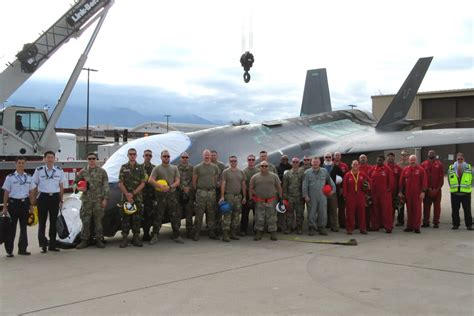
The base is also central to the A-10 Thunderbolt II program, serving as the primary depot repair facility for the entire fleet. Major structural initiatives, including wing replacements on more than 170 aircraft, have extended the A-10’s service life well into the 2030s. In this way, Hill AFB quietly underpins both present and legacy fighter capability, making it one of the Air Force’s most strategically indispensable installations.
Eglin Air Force Base: America’s Fighter Testing And Training Nexus
Eglin Air Force Base in Florida defies easy categorization. With 90 to 100 fighter jets typically on site, Eglin is not a classic combat-coded base. Instead, it is the beating heart of fighter testing, weapons development, and multi-service training, making its fighter density uniquely dynamic.
The 33rd Fighter Wing alone operates dozens of F-35s across the A, B, and C variants, training pilots from the Air Force, Marine Corps, Navy, and allied nations. Few places on Earth expose new fighter pilots to such a wide spectrum of operational concepts, tactics, and mission profiles.
Eglin is also where the Air Force tests its future. The base supports early operational work on the F-15EX Eagle II, a heavily modernized air superiority platform designed to carry large payloads, integrate advanced sensors, and complement stealth fighters. Alongside it, F-16s and F-22s operate as testbeds for next-generation weapons, avionics, and artificial intelligence-driven combat systems.
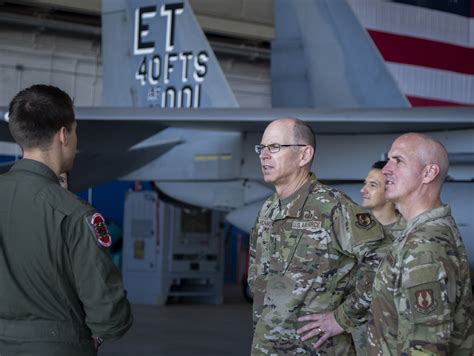
One of the most telling examples of Eglin’s role came in 2025, when an F-22 operating from the base set a record for the longest known AMRAAM air-to-air missile shot by a fifth-generation fighter. The test was not a publicity stunt; it was a direct response to the growing range of Chinese and Russian air-to-air missiles. By stretching the envelope of existing weapons, the Air Force ensured continued dominance while the AIM-260 Joint Advanced Tactical Missile moves toward operational status.
Eglin’s fighter count fluctuates, but its impact is constant. It is where theory meets practice, and where future air wars are quietly rehearsed long before they ever begin.
Kadena Air Force Base: The Keystone Of Indo-Pacific Airpower
Kadena Air Force Base in Okinawa, Japan, occupies one of the most strategically sensitive locations on the planet. With an average of 80 or more fighter jets on site through a mix of permanent assignments and rotational deployments, Kadena is the forward edge of American airpower in the Indo-Pacific.
Historically home to F-15C/D Eagles, Kadena is undergoing a profound transformation. Aging legacy fighters are being phased out in favor of rotational deployments of F-35As, F-22 Raptors, F-16s, and F-15Es, ensuring that advanced aircraft are always present even during transition periods. This approach preserves readiness while introducing new capabilities into the region.
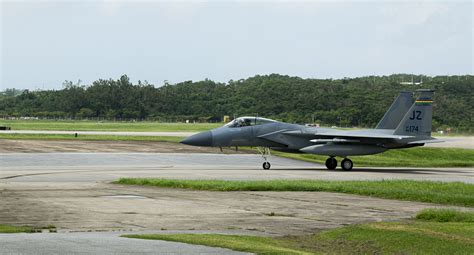
The arrival of the F-15EX Eagle II marks a new chapter for Kadena. Designed to replace the older Eagles, the F-15EX combines large payload capacity with modern sensors and open-architecture systems. Early deployments to Kadena have allowed pilots and maintainers to familiarize themselves with the aircraft in its most likely operational environment.
Kadena’s fighter presence serves multiple purposes. It deters regional adversaries, reassures allies, and provides a rapid response platform for contingencies across East Asia. In an era defined by rising tensions and long-range precision weapons, Kadena remains a linchpin of forward-deployed air dominance.
Nellis Air Force Base: The World’s Most Intense Fighter Training Environment
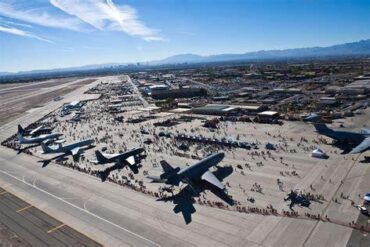
Few places on Earth see as many fighter jets in the sky as Nellis Air Force Base in Nevada. With 100 to 150 fighters routinely present and even more during major exercises, Nellis is the epicenter of advanced air combat training and tactical innovation.
The base is home to the USAF Weapons School, where experienced pilots learn to become tactical experts and instructors. These aviators fly F-35s, F-22s, F-16s, and F-15Es, refining tactics that will eventually shape how the entire Air Force fights.
Aggressor squadrons play a crucial role at Nellis. Flying specially modified aircraft painted in adversary schemes, these units replicate the tactics, sensors, and weapons of potential opponents. The result is a training environment that is deliberately uncomfortable, unpredictable, and brutally realistic.
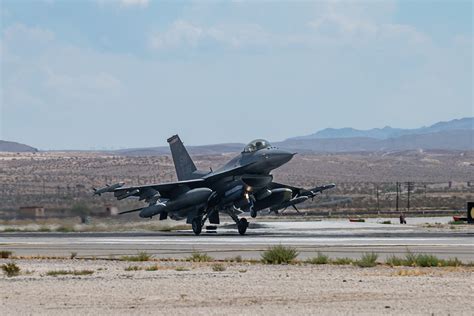
Large-scale exercises such as Red Flag and Bamboo Eagle regularly push Nellis’ fighter count well beyond its baseline. During these events, aircraft from across the United States and allied nations converge on the base, creating a dense, contested battlespace that mirrors modern warfare.
Nellis is not just a training base; it is a laboratory for air combat evolution. Lessons learned here ripple outward, influencing doctrine, procurement decisions, and operational planning across the entire U.S. military.
Luke Air Force Base: The Global Factory Of F-35 Pilots
At the top of the list sits Luke Air Force Base in Arizona, the single largest concentration of fighter jets in the U.S. Air Force in 2026. With more than 150 fighters, including over 120 F-35A Lightning IIs and a growing inventory approaching 144 aircraft, Luke is the undisputed center of F-35 pilot training.
Approximately 75 percent of all F-35 pilots worldwide pass through Luke at some point in their careers. The base trains U.S. Air Force aviators, international partners, and exchange pilots, making it one of the most globally integrated fighter training hubs in existence.
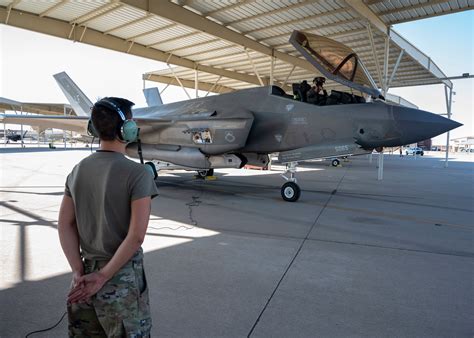
Luke’s importance is amplified by its proximity to the Barry M. Goldwater Range, a vast expanse of airspace equipped with advanced threat simulators, electronic warfare systems, and live-fire ranges. This environment allows pilots to train against realistic threats while exploiting the F-35’s sensor fusion and stealth characteristics.
While most legacy F-16s have been divested, Luke still hosts foreign training detachments and private adversary air providers, ensuring students face a diverse array of simulated threats. Large-scale events such as Instructor Pilot War Day turn the base into a hive of coordinated air operations, reinforcing Luke’s role as the industrial engine of fifth-generation airpower.
Why These Bases Define Air Superiority In 2026
Together, these five bases illustrate how American airpower is structured for the modern era. Each serves a distinct function, from sustainment and testing to forward deterrence and mass pilot production. Their fighter counts are impressive, but their real value lies in how they integrate people, technology, and doctrine at scale.
In 2026, air superiority is no longer just about having the most jets. It is about having the right jets, in the right places, supported by infrastructure capable of sustaining high-intensity operations. These bases embody that philosophy, standing as quiet but formidable pillars of global stability.
As long as their runways remain active and their squadrons ready, they ensure that American fighters are not just numerous, but decisively dominant wherever they are called to fly.