The composition of the United States Air Force (USAF) in 2026 reveals a reality that often surprises even seasoned aviation observers. While stealth fighters and cutting-edge bombers dominate headlines, the actual backbone of American airpower is defined by something far less glamorous yet infinitely more consequential: fleet size, operational endurance, and mission sustainability.
Numbers tell a strategic story. They expose not just what an air force values, but how it intends to fight, sustain, and project power across continents. The USAF, more than any other air arm, is built around global reach, requiring a delicate balance between combat capability, training throughput, and logistical support. The result is a fleet structure where trainers and tankers stand shoulder-to-shoulder with frontline fighters in terms of importance.
What emerges from the latest fleet data is a clear hierarchy—one that underscores how wars are not won by cutting-edge platforms alone, but by the ecosystem that keeps them flying, fueled, and crewed.
5. Fairchild Republic A-10C Thunderbolt II – The Enduring Close Air Support Specialist
The A-10C Thunderbolt II, affectionately known as the “Warthog,” remains one of the most iconic and battle-proven aircraft in the USAF inventory. With 261 airframes still in operation, it secures its position as the fifth-largest fleet—an impressive feat for an aircraft whose origins trace back to the Cold War.
Designed with a singular purpose, the A-10 was built around the devastating GAU-8/A Avenger 30mm cannon, a weapon capable of shredding armored vehicles with ruthless efficiency. Unlike multirole fighters that juggle mission sets, the Warthog excels in low-altitude close air support (CAS), where precision, survivability, and persistence matter more than speed or stealth.
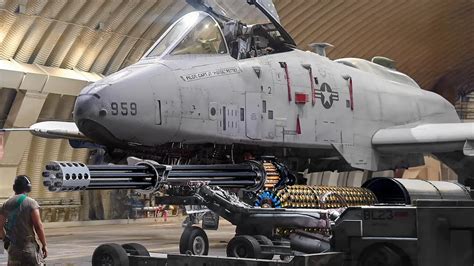
Operational history reinforces its value. During Operation Desert Storm, A-10s flew more than 8,000 sorties, eliminating hundreds of tanks and thousands of vehicles. Decades later, in Iraq and Afghanistan, the aircraft proved equally indispensable. Its ability to loiter over battlefields for extended periods—often exceeding 90 minutes without refueling— made it a trusted ally for ground troops in high-risk situations.
Despite its age, averaging over four decades per airframe, the A-10C has evolved. The C-variant upgrade introduced a digital cockpit, advanced targeting systems, and compatibility with precision-guided munitions. Yet, the debate over its retirement continues to stall. The reason is simple: no aircraft currently replicates its unique blend of firepower, endurance, and battlefield resilience.
4. Lockheed Martin F-35A Lightning II – The Rapidly Expanding Fifth-Generation Force
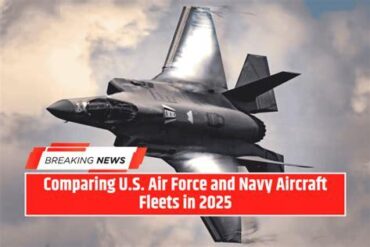
The F-35A Lightning II represents the future of tactical aviation, and with 302 aircraft already in service, it is the fastest-growing fleet in the USAF inventory. Unlike legacy fighters, the F-35A is not just a platform—it is a networked combat system, redefining how air warfare is conducted.
From its first flight in 2006 to operational deployment in 2016, the program advanced rapidly. Today, the aircraft is forward-deployed across Europe and the Indo-Pacific, playing a central role in deterrence and coalition operations.
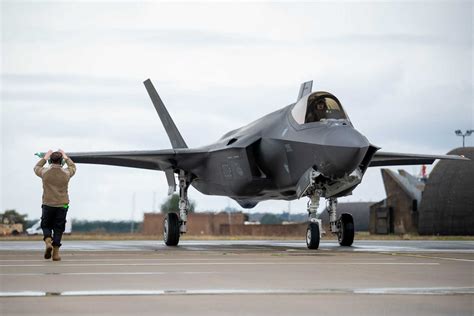
What sets the F-35A apart is its fusion of technologies. Its low-observable stealth design allows it to penetrate heavily defended airspace, while the AN/APG-81 AESA radar and Distributed Aperture System (DAS) provide unmatched situational awareness. The pilot, rather than managing isolated systems, operates within a fully integrated data environment, turning the aircraft into a flying command node.
The scale of the program is staggering. The USAF plans to acquire 1,763 F-35As, meaning the current fleet represents only a fraction of its eventual size. As production accelerates, the Lightning II is on track to surpass legacy platforms, fundamentally reshaping the force structure.
Yet, growth brings complexity. Sustainment costs, software updates, and logistics chains must evolve alongside the fleet. Even so, the trajectory is unmistakable: the F-35A is not just expanding—it is redefining the very concept of air dominance.
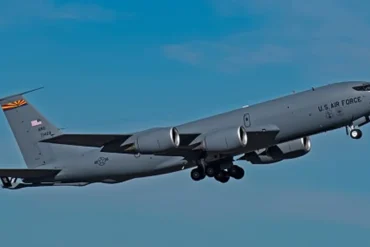
3. Boeing KC-135R/T Stratotanker – The Quiet Enabler of Global Reach
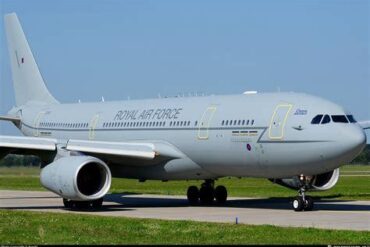
At first glance, the KC-135 Stratotanker lacks the visual drama of fighters or bombers. Yet with 376 aircraft in service, it stands as one of the most critical assets in the entire USAF inventory. Without it, the concept of global airpower projection collapses almost instantly.
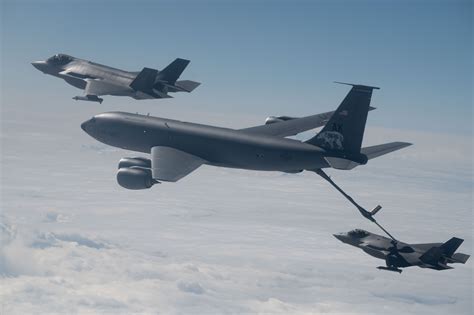
Introduced in the 1950s, the KC-135 has undergone extensive modernization to remain operationally relevant. The R and T variants, equipped with CFM56 turbofan engines, deliver significant performance improvements, including greater fuel efficiency, increased offload capacity, and reduced operational costs.
Its mission is deceptively simple: refuel other aircraft in flight. In practice, this capability enables fighters, bombers, and reconnaissance aircraft to operate far beyond their unrefueled range. A fighter taking off from the continental United States can reach Europe or the Indo-Pacific with the help of a carefully coordinated chain of tankers.
The KC-135’s importance becomes even clearer when considering modern warfare’s tempo. Sustained operations require continuous air presence, and that presence depends on aerial refueling cycles that only large tanker fleets can support.
Although the KC-46 Pegasus is gradually entering service, the transition is measured. Structural assessments suggest many KC-135s could remain operational until 2040, giving the aircraft an extraordinary lifespan approaching nine decades. It is not merely a legacy platform—it is a linchpin of American military strategy.
2. Northrop T-38 Talon – The Relentless Engine of Pilot Production
With 495 airframes, the T-38 Talon ranks as the second-largest fleet in the USAF—a striking reminder that pilot training is as vital as combat capability.
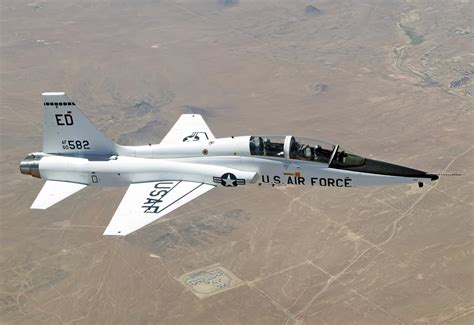
First flown in 1959, the T-38 remains the gateway for pilots transitioning to high-performance aircraft. Every future F-22, B-2, or F-15 pilot begins their journey in this supersonic trainer, mastering the fundamentals of speed, formation flying, and advanced maneuvering.
The fleet is divided into several variants, each serving a distinct role. The T-38C, with its upgraded avionics and digital cockpit, prepares pilots for modern combat aircraft, while specialized versions support niche missions, including adversary training and light attack roles.
Beyond initial training, the Talon plays a crucial secondary role. Fifth-generation aircraft like the F-22 and B-2 are expensive to operate and fly relatively few hours. The T-38 fills the gap, allowing pilots to maintain proficiency without incurring the high costs of frontline platforms.
Its eventual successor, the T-7A Red Hawk, promises a new era of training efficiency. However, with nearly 500 Talons still active, the transition will take years. Until then, the T-38 continues to prove that longevity in aviation is not just about durability—it is about unmatched utility and adaptability.
1. Lockheed Martin F-16C Fighting Falcon – The Undisputed Workhorse
At the top of the list sits the F-16C Fighting Falcon, with a commanding 762 aircraft in service—more than the next two fleets combined. This is not just numerical dominance; it is a testament to decades of strategic reliance on a platform that has consistently delivered across mission sets.
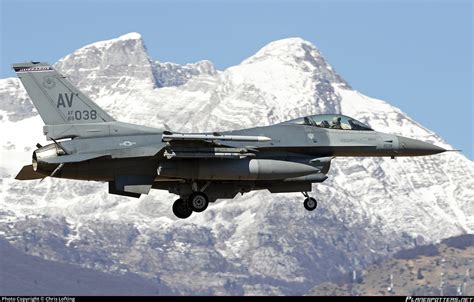
Originally conceived as a lightweight fighter, the F-16 evolved into a true multirole powerhouse. Across its various blocks—40, 42, 50, and 52—it has absorbed continuous upgrades, expanding its capabilities to include air superiority, suppression of enemy air defenses (SEAD), close air support, and precision strike missions.
Its widespread deployment amplifies its impact. The F-16C operates across active-duty units, Air National Guard squadrons, Air Force Reserve commands, and adversary training units. This broad distribution ensures not only combat readiness but also homeland defense and pilot training.
Despite an average age of over 30 years, the aircraft remains highly relevant. Modernization programs, including the integration of the AN/APG-83 SABR AESA radar, have significantly enhanced its combat effectiveness. These upgrades ensure that the Fighting Falcon can operate effectively alongside newer platforms like the F-35.
The scale of the fleet reflects a bygone era of procurement, when Cold War demands drove mass production. Replicating such numbers today is unlikely, making the F-16C’s dominance both unique and historically significant.
Why Fleet Size Reveals the Real Strategy of the U.S. Air Force
Looking across these five fleets, a pattern emerges that challenges conventional assumptions. The largest fleets are not dominated by the newest or most technologically advanced aircraft. Instead, they reflect a balanced architecture built on sustainability, training, and reach.
Fighters like the F-16C and F-35A deliver combat power, but they rely heavily on support systems. Tankers like the KC-135 extend their range, while trainers like the T-38 ensure a continuous pipeline of skilled pilots. Even specialized platforms like the A-10 fulfill critical roles that cannot be easily replaced.
This layered approach highlights a central truth: air superiority is not achieved by individual aircraft, but by an integrated system working in harmony.
The future will undoubtedly bring shifts. The F-35A will continue to expand, the KC-46 will gradually replace older tankers, and the T-7A will redefine pilot training. Yet, the underlying philosophy is unlikely to change. The USAF will remain focused on maintaining a force that is not only powerful, but also resilient, scalable, and globally deployable.
In that sense, these five fleets are more than just numbers. They are a blueprint—one that explains how the United States projects airpower across the world with unmatched consistency and reach.