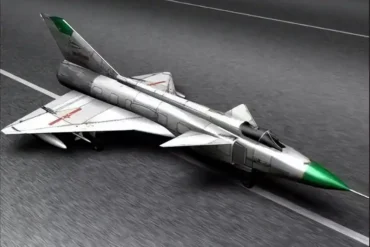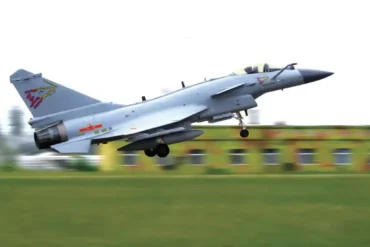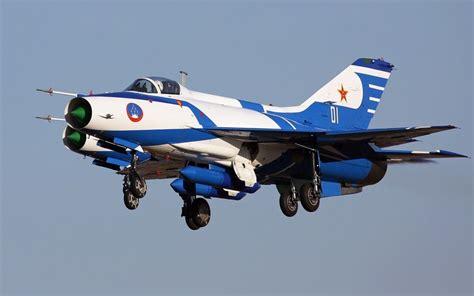
The Chengdu J-7, known by NATO as “Fishcan,” is one of the most prolific third-generation fighter jets ever produced, not merely for its quantity but for the symbolic and strategic role it played in shaping China’s aviation industry. Derived from the Soviet MiG-21, the J-7 evolved into a platform that saw extensive operational service across Asia, Africa, and the Middle East. From a reversed-engineering triumph to a globally exported workhorse, the J-7’s journey is steeped in geopolitical nuance, technical ingenuity, and battlefield pragmatism.
Origins: A Fighter Born from Fracture and Opportunity
In the wake of the Sino-Soviet split in the early 1960s, diplomatic relations between Beijing and Moscow deteriorated swiftly. The Soviet Union withdrew its technical advisers from China, leaving several defense projects in limbo. Ironically, it was in this fractured context that the MiG-21, the Soviet Union’s most advanced interceptor at the time, was offered to China in a gesture of renewed cooperation in 1962. Under Premier Khrushchev’s directive, a Chinese delegation led by PLAAF Commander Liu Yalou visited Soviet facilities and finalized the technology transfer by March of the same year.
China received the MiG-21 kits with incomplete technical documents, sparking a massive reverse-engineering initiative. Chinese engineers resolved 249 critical issues and reproduced eight major technical documents, laying the foundation for what would become the Chengdu J-7.
Domestic Production: Innovation Under Constraints
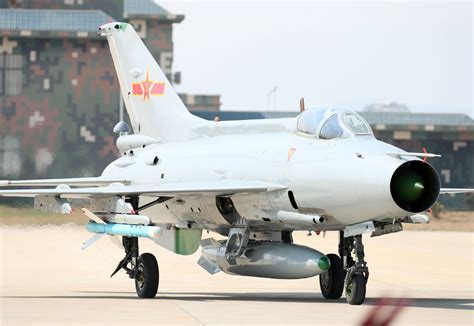
Production began at the Shenyang Aircraft Factory in March 1964. However, the Cultural Revolution soon disrupted industrial and scientific progress, delaying large-scale production until the 1980s. Even as the world moved toward multirole fourth-generation fighters like the F-16, China pressed ahead with the J-7 due to its cost-effectiveness and reliability.
Major design changes included the reconfiguration of the hydraulic system—a notorious weak point that grounded up to 70% of operational squadrons—and a redesigned fuel distribution system to stabilize the aircraft’s center of gravity during prolonged flight. The cockpit canopy was altered from a Soviet forward-opening model to a rear-hinged design, which ejected cleanly during pilot ejection.
These modifications made the J-7 a more robust and safer airframe, uniquely suited to China’s doctrine of high-tempo, massed aerial defense.
J-7E and the Birth of True Domestic Advancement
The watershed moment came in 1987 with the introduction of the J-7E, featuring a double-delta wing that increased maneuverability by 45%. It offered significant upgrades, including HOTAS (Hands On Throttle-And-Stick) controls, helmet-mounted sights, and British-supplied avionics. These improvements brought the J-7 close to parity with late-model Soviet MiG-21s and even allowed for compatibility with PL-8 missiles, reverse-engineered from Israel’s Python-3.
Adaptation for Export: The F-7 Legacy
China quickly realized the global demand for affordable jet fighters and created over 20 export variants under the F-7 designation. These variants were tailored with Western-compatible systems, including French R.550 Magic missiles and Italian FIAR Grifo-7 radars, significantly extending radar range and detection envelope.
Pakistan was a key collaborator, especially in the 1980s when their experience with F-16s helped China integrate radar-guided ground-attack capabilities into the J-7M. Pakistan also became the largest foreign operator of the type and played a central role in its eventual evolution into the JF-17 Thunder, replacing the F-7 fleet entirely.
Operational Footprint: A Fighter Without Borders
The J-7’s global footprint is expansive. In Africa, countries like Namibia, Nigeria, Sudan, and Tanzania operated various F-7 models. Notably, Tanzania deployed them successfully in the Uganda–Tanzania War, while Zimbabwe used them for political signaling, including the airlift to Kinshasa for Kabila’s funeral.
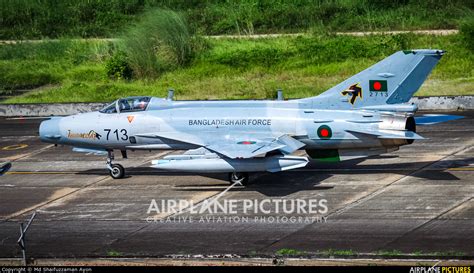
In South Asia, the Bangladesh Air Force employed modern F-7BGI interceptors, the final evolution of the airframe. Sri Lanka leveraged the platform for both interception and ground attack roles during its civil war, including successful air engagements against LTTE assets in 2008.
In Iran, the F-7 became a testbed for indigenous technologies and saw its combat roles reduced due to part shortages. Nevertheless, it was still flying in 2022. The North Korean Air Force, with up to 180 units at its peak, maintained one of the largest J-7 fleets, although readiness was below 50%.
Modernization and the Last Flight
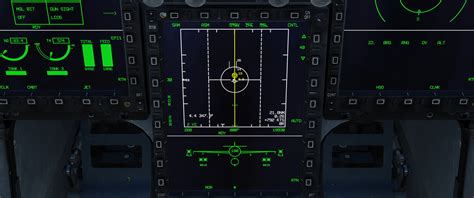
By the 1990s and 2000s, the J-7 underwent continual evolution, resulting in the J-7G, which introduced the KLJ-6E radar, digital displays, and compatibility with advanced PL-9 missiles. Yet, by the 2010s, the aging platform was increasingly overshadowed by 4th and 5th generation aircraft like the J-10, J-20, and J-16.
In 2018, the PLAAF began retiring the J-7 en masse, with decommissioning concluding by 2023. Some units have been considered for conversion into unmanned combat air vehicles (UCAVs) for training or decoy missions.
Design Characteristics and Performance Profile
The J-7MG variant encapsulates the apex of the platform’s capability. With a Liyang Wopen-13F afterburning turbojet, it reaches Mach 2, a ceiling of 17,500 meters, and a combat range of 850 km. Its five hardpoints support an array of weapons, including PL-2 to PL-9 missiles, rocket pods, and unguided bombs.
Its avionics suite features the FIAR Grifo-7 radar, vastly improving situational awareness. Despite its performance limitations compared to modern jets, the J-7’s speed, climb rate, and cost-efficiency made it a formidable platform for nations needing a reliable, low-cost interceptor.
Tragedies in the Skies: A Record of Incidents
The J-7’s long operational lifespan wasn’t without its share of tragedy. Accidents were often due to engine failures, bird strikes, or aging airframes. Notable incidents include:
- 2008: BAF F-7 crash in Tangail, Bangladesh; ejection seat malfunction led to pilot death.
- 2015: Crash of BAF F-7MB into Bay of Bengal.
- 2022: PLAAF J-7 crashed into a residential area in Hubei, killing one civilian.
- 2025: Zimbabwean Air Force trainer crash claimed Air Lieutenant Nesbert Tambudza’s life.
These incidents underscore both the resilience and risks associated with operating older aircraft platforms in modern theaters.
Legacy and Significance in Aviation History
The Chengdu J-7 stands as a symbol of industrial self-reliance, geopolitical adaptability, and aerospace endurance. More than a relic, it represents China’s transformation from a technology recipient to an aerospace innovator. Its success enabled spin-offs like the Shenyang J-8 and indirectly, the JF-17 Thunder—a multirole platform that is now a mainstay in Pakistan.
Its modular architecture, export-friendly design, and rugged airframe extended its lifespan far beyond expectations. Even in retirement, J-7s may serve new roles—as drones, decoys, or museum pieces—bearing testament to a remarkable journey that began with an incomplete Soviet kit and ended with over 2,400 units produced.