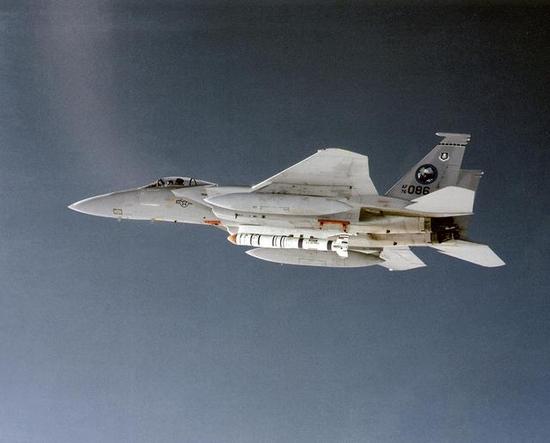
The McDonnell Douglas F-15 Eagle has long been recognized as one of the most dominant air superiority fighters in history. However, beyond its well-documented aerial combat record, the F-15 holds a unique place in space history. During the Cold War, the United States experimented with air-launched anti-satellite (ASAT) weaponry, using a modified F-15A to successfully intercept and destroy a satellite in low Earth orbit. This marked a rare instance of a fighter jet engaging a target beyond Earth’s atmosphere, showcasing the aircraft’s adaptability in space-related operations.
The F-15’s ASAT Capabilities: A Cold War Experiment
The concept of using a fighter jet to destroy satellites originated in the 1980s, as the United States sought countermeasures against Soviet space-based threats. The ASM-135A anti-satellite missile was developed specifically for this purpose, designed to be launched from the F-15A at high altitude. This missile system featured:
- A first-stage booster derived from the AGM-69 SRAM-A, originally a nuclear missile.
- A kinetic kill vehicle, often described as a “tomato can,” housing 56 miniature solid rocket motors to provide precise maneuvering in space.
- An infrared seeker for homing in on its intended target.
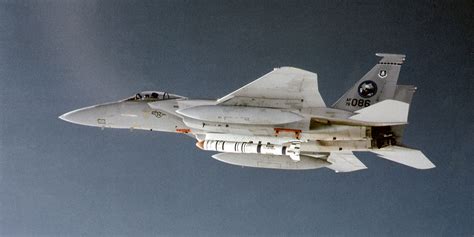
The modified F-15As were equipped with avionics upgrades to interface with the ASAT weapon system and were trained for steep-climb maneuvers that would allow them to launch the missile effectively into orbit.
The 1985 ASAT Test: A Historic Space Kill
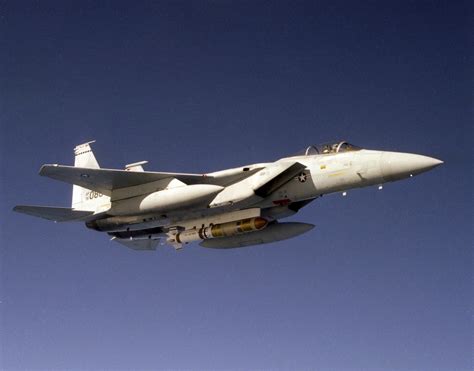
On September 13, 1985, an F-15A piloted by Maj. Wilbert “Doug” Pearson took off from Vandenberg Air Force Base in California. The mission objective was to engage the P78-1 “Solar Wind” satellite, which was orbiting Earth at an altitude of approximately 555 km (345 miles).
Executing a precise steep climb to 24,000 meters (79,000 feet), Pearson positioned the aircraft at the correct launch angle before releasing the ASM-135A missile. The missile’s kinetic kill vehicle successfully intercepted and destroyed the satellite, marking the first—and only—successful air-launched anti-satellite mission in history.
Political Fallout and Program Cancellation
Despite its technical success, the ASAT test faced significant political and scientific criticism:
- Violation of Arms Treaties: The test was perceived as a breach of U.S.-Soviet agreements that discouraged the testing of space-based weapons.
- Scientific Concerns: The P78-1 satellite, though selected as a target, was still actively conducting solar research, raising ethical questions about its destruction.
- Arms Race Fears: The U.S. Congress, wary of escalating tensions with the Soviet Union, swiftly moved to block further ASAT weapon development, effectively terminating the program in 1985.
Plans to equip 20 F-15As with operational ASAT missiles were abandoned, and the technology was never widely deployed.

The Legacy of the F-15’s Space Warfare Experiment
Though the ASAT program was short-lived, its impact on military strategy and aerospace technology endures:
- First Confirmed Air-Launched ASAT Kill: Maj. Wilbert Pearson remains the only U.S. pilot credited with a confirmed space kill, a distinction unmatched in aviation history.
- Proof of Concept for Airborne ASAT Systems: The experiment validated the feasibility of fighter-jet-launched space weapons, an idea that resurfaced in later U.S. military research.
- Influence on Modern Space Warfare: While the F-15 is no longer used for ASAT missions, the concept of counter-satellite warfare has evolved significantly, with modern efforts focusing on ground-based and cyber-based countermeasures.
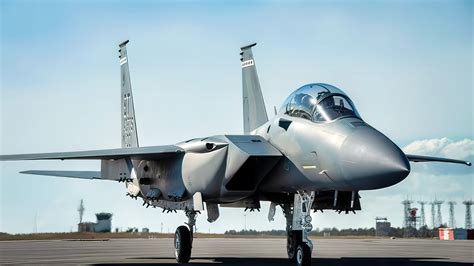
The F-15 Today: From Space Missions to Multirole Dominance
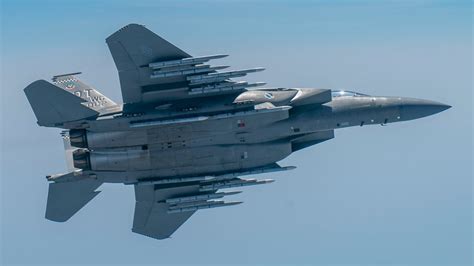
While the ASAT-capable F-15A was retired from this specialized role, the F-15 family continues to evolve. The F-15EX “Eagle II”, the latest variant, is designed for multirole combat, focusing on electronic warfare, networked operations, and long-range strike capabilities. Unlike its predecessor, the Eagle II does not retain any space combat functionality, but its advanced avionics and weapon integration ensure it remains one of the most formidable fighters in service today.
Frequently Asked Questions
1. Could modern F-15s be adapted for ASAT missions again?
While theoretically possible, modern military strategies emphasize non-kinetic counter-satellite technologies, such as cyber warfare and electronic jamming, rather than direct missile-based interception. Additionally, international treaties discourage the deployment of air-launched ASAT weapons.
2. What happened to the ASM-135A missile after the 1985 test?
Following the test, the ASM-135A program was canceled, and no further missiles were produced. Existing units were either dismantled or used for research purposes.
3. How does the F-15EX compare to earlier F-15 variants?
The F-15EX Eagle II incorporates advanced avionics, improved radar systems, increased weapon payload capacity, and a longer operational lifespan compared to earlier F-15 models, ensuring its relevance in modern aerial warfare.