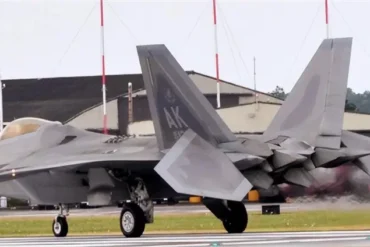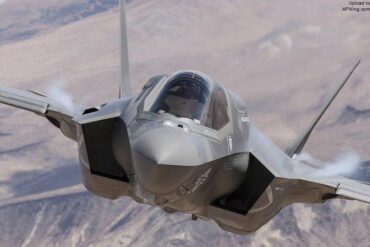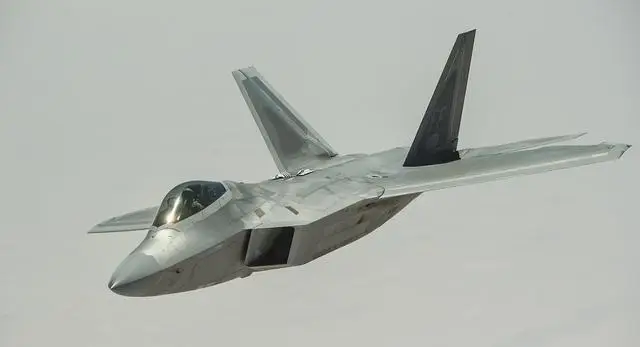
The F-22 Raptor, developed by Lockheed Martin, is one of the most advanced fifth-generation fighter aircraft, designed for air superiority with unmatched stealth, speed, and maneuverability. A crucial component of its aerodynamics is its airfoil design, which integrates multiple advanced technologies to enhance both stealth and performance.
Trapezoidal Wing Design and Integrated Aerodynamics
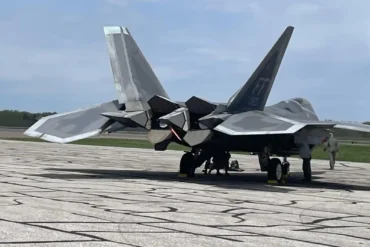
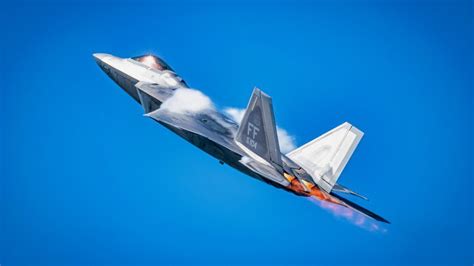
The F-22 features a highly trapezoidal wing configuration, with a sweepback angle of 42 degrees on both the main wing and horizontal stabilizers. The wings have a low aspect ratio of 2.36, creating a compact yet efficient aerodynamic profile. This configuration optimizes the aircraft’s supersonic cruise capability and high-speed maneuverability, while also contributing to a reduced radar cross-section (RCS) by limiting flat reflective surfaces.
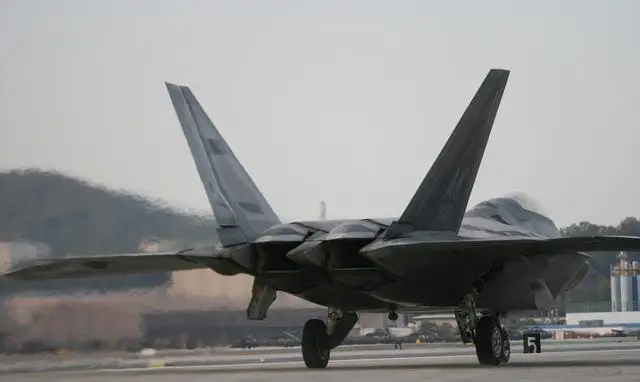
Additionally, the vertically canted tail fins, angled at 27 degrees outward, contribute to both stability and stealth by aligning with the aircraft’s overall stealth geometry. The blended body-wing integration further enhances aerodynamic efficiency, reducing drag and improving overall control.
Stealth Optimization and Material Composition
The F-22’s airfoil design is not only about performance but also about stealth technology. The leading-edge extensions house an S-duct inlet system, which shields engine compressor blades from radar detection. This significantly reduces radar and infrared signature, enhancing the aircraft’s low observability (LO).
To achieve an optimal balance between stealth, durability, and weight, the aircraft employs a high percentage of titanium alloys (36%) and advanced thermoset composites (24%). Key materials include BMI composites and cobalt-62222 alloys, which contribute to both structural integrity and RCS minimization.
Thrust Vectoring and Supersonic Cruise Capabilities
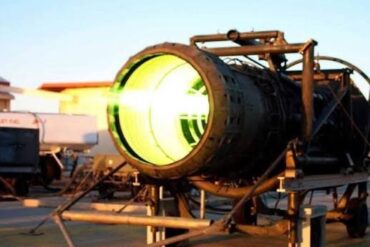
A defining feature of the F-22’s airfoil and aerodynamic layout is its integration with two-dimensional thrust vectoring nozzles, which provide pitch control through ±20° deflection. These work in tandem with the high thrust-to-weight ratio F119-PW-100 engines, enabling the aircraft to achieve sustained supersonic speeds without afterburners (Supercruise at Mach 1.6+).
This capability significantly enhances combat efficiency, allowing for rapid engagement, interception, and maneuverability beyond the reach of conventional fighters that rely on afterburners for supersonic flight.
Balancing Stealth and Aerodynamic Performance
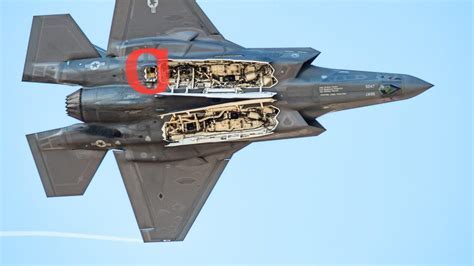
While the F-22 features external hardpoints, they are primarily reserved for non-stealth missions. During combat operations, all weapons are carried internally within the main and side weapon bays, ensuring minimal aerodynamic disruption and maximum stealth efficiency.
The compact wing design (wingspan: 13.56m, wing area: 78.04 m²) is fine-tuned to minimize transonic drag, allowing the aircraft to penetrate hostile airspace undetected while maintaining high-speed capabilities. The combination of wing sweep angles and small aspect ratio further ensures superior maneuverability and control.
Upgrades and Aerodynamic Implications
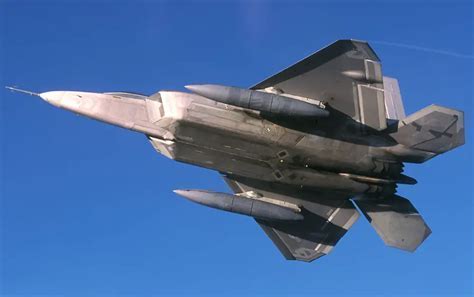
Recent modernization efforts have introduced Low-Drag Tank and Pylon (LDTP) configurations, which provide extended range while maintaining aerodynamic efficiency. Unlike traditional external fuel tanks, these low-drag variants are optimized to minimize radar reflections, ensuring that stealth remains uncompromised even with external loadouts.
Additionally, the integration of the Scorpion Helmet-Mounted Display (HMD) has improved situational awareness for pilots. While this upgrade is primarily avionics-based, it indirectly impacts flight dynamics by reducing pilot workload during high-G maneuvers.
Conclusion
The F-22 Raptor’s airfoil design is a masterclass in balancing stealth, aerodynamics, and maneuverability. The use of a trapezoidal wing layout, high-strength composite materials, and thrust-vectoring integration makes it an unparalleled fifth-generation fighter. Future enhancements are expected to focus on avionics and sensor upgrades, rather than radical aerodynamic redesigns, solidifying the F-22’s dominance in air superiority.
FAQ
1. How does the F-22’s airfoil contribute to stealth?
The trapezoidal wing shape, high sweep angles, and low aspect ratio reduce radar reflections. Additionally, the S-duct inlets and composite materials minimize the aircraft’s radar cross-section (RCS).
2. What materials are used in the F-22’s wing construction?
The wings incorporate 36% titanium alloys, 24% advanced thermoset composites (such as BMI composites), and cobalt-62222 alloys, ensuring a lightweight yet highly durable structure that enhances both performance and stealth.
3. How do the F-22’s thrust vectoring nozzles affect its maneuverability?
The two-dimensional thrust vectoring nozzles provide +/- 20° pitch control, allowing the F-22 to perform high-angle-of-attack maneuvers, such as the Cobra maneuver and post-stall turns, which significantly enhance dogfighting capabilities.
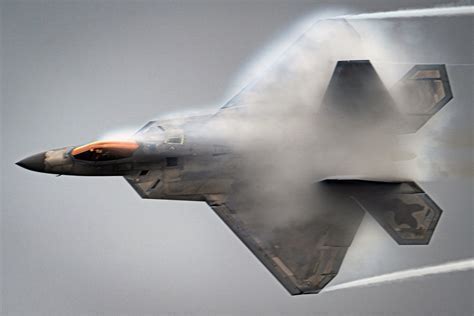
The F-22 Raptor’s airfoil and wing design remain a benchmark in fighter jet engineering, seamlessly integrating speed, agility, and stealth into a single lethal platform.