The Douglas DC-8 was born in an era when the jet engine still felt like a dare. Airlines were trading polished pistons for turbines that screamed at 35,000 feet, and passengers were discovering that crossing oceans could be measured in hours instead of days. Nearly seven decades after its first flight, only two of these long, narrow, four-engine pioneers remain airworthy. Their survival is not nostalgia. It is engineering stubbornness made visible in aluminum and rivets.
The Douglas Aircraft Company, founded in 1921 by Donald Wills Douglas Sr., had already carved its name into aviation history long before the DC-8 appeared. The firm built aircraft that circumnavigated the globe, carried paratroopers over Europe as the C-47 Skytrain, and supported Allied forces with rugged designs like the A-26 Invader. After World War II, commercial aviation became the new frontier. Douglas answered with piston-engine airliners such as the DC-4, DC-6, and DC-7, reliable machines that bridged continents in the propeller age.
Then the jet age detonated. Britain’s de Havilland Comet briefly seized the spotlight as the world’s first commercial jetliner, only to be grounded by catastrophic metal fatigue failures. Those tragedies were brutal lessons in pressurization physics and structural stress. While the Comet faltered, Douglas and Boeing studied, recalculated, and prepared their own entries into the jet era. The result would be two icons: the Boeing 707 and the Douglas DC-8.
The Birth of the Douglas DC-8 in the Jet Age
The DC-8 did not begin as a passenger aircraft. In the early 1950s, both Douglas and Boeing pursued a U.S. Air Force requirement for a jet-powered aerial refueling tanker. Boeing ultimately won with what became the KC-135 Stratotanker, but Douglas emerged from the competition with something powerful: a large, swept-wing jet platform that could be reshaped for airlines hungry for speed.
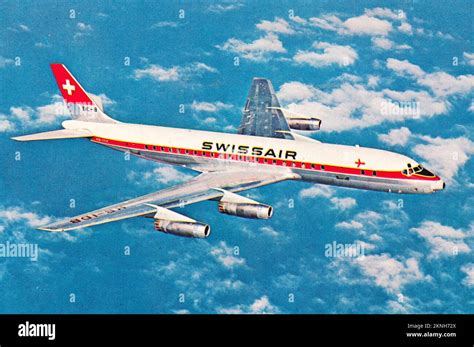
In 1955, Douglas formally launched the DC-8 jetliner program. That same year, Pan American World Airways placed simultaneous orders for 20 Boeing 707s and 25 DC-8s, hedging its bets on the future of transcontinental and transatlantic travel. Other carriers followed quickly. United Airlines, National Airlines, KLM, Eastern Air Lines, Japan Airlines, and Scandinavian Airlines (SAS) recognized that jet propulsion was not a novelty; it was inevitability.
The first DC-8 took to the skies in May 1958. Certification followed in 1959, and in September of that year, Delta Air Lines and United Airlines introduced the type into service. Passengers accustomed to the vibration of piston engines now experienced smooth, high-altitude cruising at nearly 500 knots. The future had a new sound: the howl of turbojets at takeoff and the hush of thin air at cruise.
Engineering a Transcontinental Thoroughbred
Douglas approached the DC-8 with a clear commercial objective. Airlines wanted efficiency, capacity, and range. After consulting with customers, Douglas widened the fuselage to accommodate six seats per row, a choice that would shape narrowbody cabin standards for decades. The aircraft featured a swept wing optimized for high-subsonic cruise and a tall vertical stabilizer to manage the yaw authority required by four underwing engines.
The original DC-8 Series 10 carried the following core specifications:
- Length: 150.7 feet
- Wingspan: 142.4 feet
- Height: 42.3 feet
- Maximum takeoff weight: 273,000 pounds
- Typical cruise speed: 483 knots
- Range: 3,760 nautical miles
Powered initially by the Pratt & Whitney JT3C turbojet, the early DC-8 could seat up to 177 passengers. It was not merely fast; it was structurally robust. Douglas engineers designed the airframe with significant strength margins, an attribute that would later become central to the aircraft’s remarkable longevity.
From Series 10 to Super 70: The Evolution of a Classic Jetliner
Unlike Boeing, which offered multiple fuselage lengths for the 707 from early on, Douglas initially fielded a single fuselage length. Market realities forced adaptation. Sales pressure in the early 1960s, combined with the merger that created McDonnell Douglas, pushed the company to diversify the DC-8 line.
The result was a family of progressively refined variants. The Series 20 introduced new engines. The Series 30 added fuel capacity and aerodynamic improvements for extended range. The Series 40 adopted Rolls-Royce Conway engines, while the Series 50 increased maximum takeoff weight.
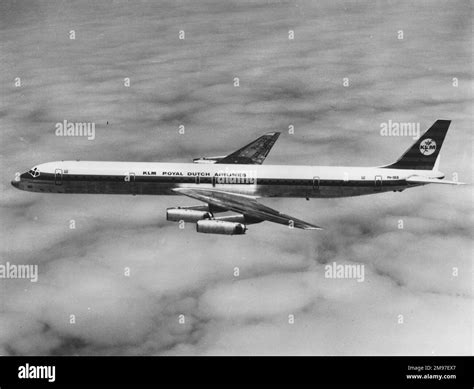
The most dramatic transformation arrived with the Super 60 Series in 1967. These stretched models significantly increased passenger capacity, in some configurations accommodating up to 259 travelers. The fuselage extension altered the aircraft’s proportions, giving it a distinctly elongated profile that aviation enthusiasts still recognize instantly.
In 1982, the Super 70 Series emerged with modern CFM International CFM56 turbofan engines. This re-engining program reduced noise and fuel burn while extending operational life. It was a technical resurrection. A jet conceived in the 1950s adapted to meet late-20th-century environmental standards. Few aircraft types have demonstrated such evolutionary elasticity.
Between 1958 and 1972, more than 550 DC-8s were produced. They served airlines across North America, Europe, Asia, Africa, and Latin America. For a time, the DC-8 was not a relic. It was a backbone.
A Global Workhorse Across Decades
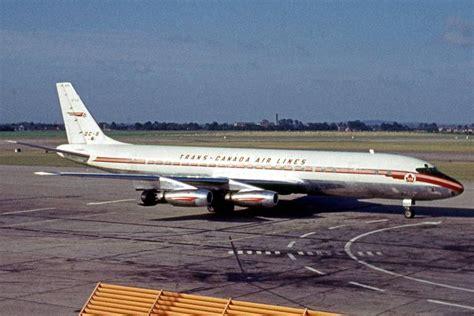
The DC-8’s commercial ascent accelerated after its 1959 service debut. United Airlines became one of its largest operators, flying the aircraft on both domestic trunk routes and international services. Eastern Air Lines, National Airlines, Braniff International, and Trans International integrated it into fleets that defined American aviation in the 1960s and 1970s.
International carriers embraced the type as well. Air France, KLM, Japan Airlines, and SAS deployed DC-8s on long-haul routes linking continents. In Latin America and Africa, airlines such as Avianca, VARIG, and South African Airways used the aircraft to bridge vast geographies where reliability and range were paramount.
As widebody aircraft like the Boeing 747 and later twin-engine jets reshaped long-haul economics, many DC-8s migrated to secondary roles. Charter operators configured them for high-density seating. Cargo carriers discovered that the aircraft’s strong floor and generous fuselage cross-section made it an ideal freighter. Companies such as Flying Tigers, UPS, DHL, and Airborne Express operated DC-8 freighters well into the 2000s.
The DC-8 refused to retire quietly.
Why Most DC-8s Disappeared from Passenger Skies
Time, however, is undefeated. By the 1990s and early 2000s, many DC-8s had surpassed thirty years of service. Even a robust airframe faces fatigue, corrosion, and escalating inspection requirements after decades of pressurization cycles. Maintenance costs rise not linearly but exponentially as structural inspections deepen and component obsolescence complicates supply chains.
Noise regulations tightened as well. Stage 3 standards in the 1990s already challenged older turbojets. The CFM56-powered Super 70 conversions allowed some DC-8s to comply, but later Stage 4 and Stage 5 noise regulations rendered continued operation increasingly impractical. Fuel efficiency became decisive. Twin-engine widebodies and advanced narrowbodies delivered superior payload-to-fuel ratios and reduced crew costs.
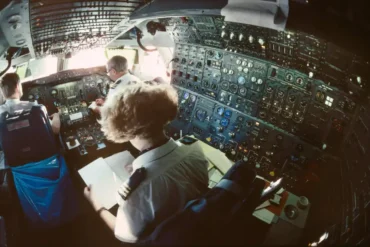
The industry evolved toward quieter, lighter, and more automated aircraft. The DC-8, magnificent as it was, belonged to a different engineering philosophy: four engines, analog cockpits, and design margins forged in the early jet age.
Yet two examples still fly.
OB-2231P: A 56-Year-Old Cargo Veteran Still in Motion
According to fleet tracking data and industry registries, one of the last airworthy DC-8s carries the registration OB-2231P. Delivered to Air Canada in February 1970, it began life transporting passengers across North America. In April 1982, the aircraft transitioned to cargo operations, a common second act for aging jetliners.
Over the decades, it passed through operators including Astar Air Cargo before being acquired by SkyBus Cargo Charters in December 2017. At 56 years old, OB-2231P continues to operate primarily out of Miami International Airport (MIA), serving short-haul routes to Port-au-Prince (PAP) in Haiti and Santo Domingo (SDQ) in the Dominican Republic.
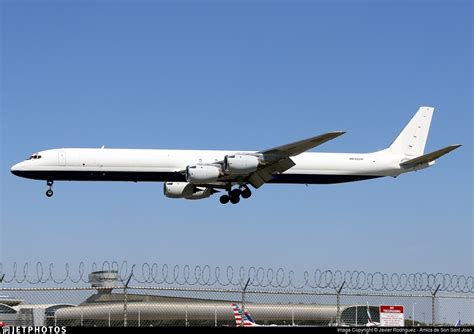
Recent tracking data shows round trips from Miami to Port-au-Prince lasting just under two hours each way. There is something quietly astonishing about that fact. A jet conceived during the Eisenhower administration still climbs into tropical skies, delivering freight on modern schedules, tracked in real time by satellites and smartphone apps.
This is not sentiment. It is operational utility sustained by disciplined maintenance and careful oversight.
9S-AJO: The Congo-Based Survivor
The second remaining airworthy DC-8 is registered 9S-AJO. Delivered in March 1971 to World Airways as N801WA, it has flown for multiple carriers over its lifetime, including Capitol International Airways, Viasa, Emery Worldwide, and Gestair Cargo. Since November 2011, it has operated with Trans Air Cargo Service, based in the Democratic Republic of the Congo.
Operating primarily out of Kinshasa (FIH), 9S-AJO represents the DC-8’s long association with cargo operations in regions where rugged reliability and payload flexibility remain valuable. Trans Air Cargo Service has historically operated other classic Douglas aircraft, including the DC-6, reinforcing a lineage that stretches back to the piston era.
The aircraft’s survival underscores a broader truth about aviation economics. In certain markets, the acquisition cost of a fully depreciated aircraft, combined with in-house maintenance expertise, can outweigh the theoretical efficiency gains of newer jets. Airworthiness, in regulatory terms, is binary: either the aircraft meets standards or it does not. Age alone is not disqualifying.
Structural Strength and the Science of Longevity
The DC-8’s persistence is not mystical. It is structural mathematics. Aircraft fatigue is governed by stress cycles, material properties, and inspection regimes. Douglas engineers designed the DC-8 with substantial structural margins. Over time, operators incorporated modifications, reinforcements, and, in some cases, re-engining programs that extended operational viability.
Re-engining with the CFM56 turbofan dramatically reduced fuel burn and noise while improving reliability. Turbofans, unlike early turbojets, mix bypass air with core exhaust, increasing efficiency and lowering acoustic intensity. That technological leap allowed certain DC-8s to comply with later noise standards and remain commercially relevant longer than many contemporaries.
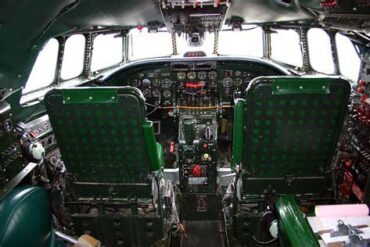
Even so, regulatory evolution continues. Modern aircraft are designed with digital avionics, advanced composites, and optimized aerodynamics informed by computational fluid dynamics unavailable in the 1950s. The DC-8’s analog cockpit and aluminum airframe reflect a different design epoch.
Yet here is the paradox: durability often correlates with conservative design. In an age before lightweight composites and hyper-optimized structures, engineers built with generous tolerances. Those choices, expensive at the time, became longevity dividends decades later.
The Legacy of the Last Airworthy DC-8s
The final two airworthy Douglas DC-8s are not merely aircraft. They are living artifacts of the first great jet revolution. They connect the era of slide rules and drafting tables to a world of satellite tracking and global logistics networks. Each takeoff is a reminder that technology does not vanish overnight; it recedes gradually, leaving behind rare survivors that defy expectation.
When OB-2231P departs Miami or 9S-AJO climbs out of Kinshasa, they carry more than cargo. They carry proof that engineering foresight can stretch across generations. They embody a transitional moment when commercial aviation accelerated into the stratosphere and permanently altered global connectivity.
Eventually, these final DC-8s will retire. Metal fatigues. Regulations tighten. Economics shifts. But their continued flight in the third decade of the 21st century is a testament to a design philosophy rooted in structural integrity and adaptability.
The story of the last Douglas DC-8s still airworthy is not a footnote. It is a case study in aerospace durability, market evolution, and the long arc of technological change. In a sky dominated by composite wings and whisper-quiet turbofans, the faint echo of four classic engines still rises from select runways. That sound is history refusing to be entirely silent.