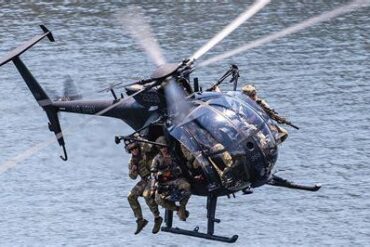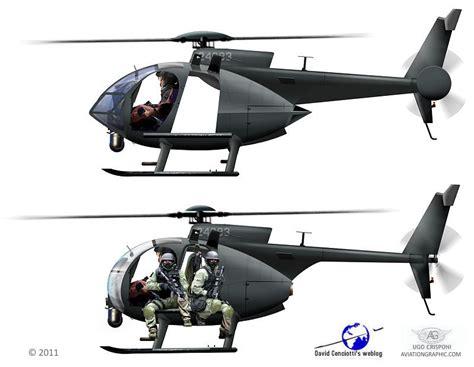
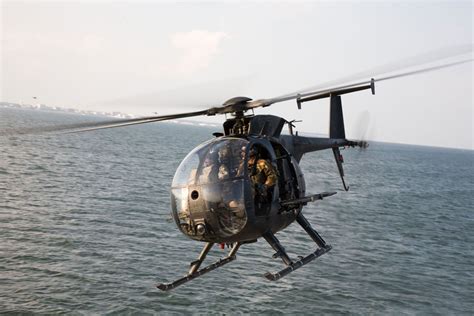
The MH-6 Little Bird, often dubbed the “Killer Egg”, stands as a symbol of tactical excellence and aerodynamic agility in U.S. Army special operations aviation. Derived from the Hughes OH-6 Cayuse, the MH-6 and its attack counterpart AH-6 are meticulously engineered for missions that demand stealth, speed, and surgical precision. From urban rooftops to tight jungle clearings, the Little Bird excels in environments where other helicopters can’t operate, thanks to its nimble design and elite pilots.
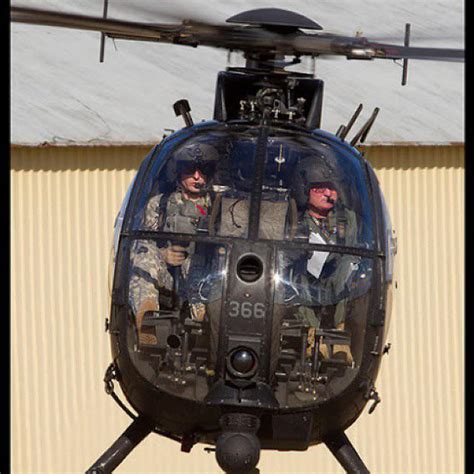
The modern MH-6M variant features a six-bladed main rotor and four-bladed tail rotor, evolved from the MD 530F airframe, enhancing lift capacity and reducing acoustic signature. This sleek aircraft, refined over decades, continues to serve as the linchpin of light insertion, extraction, and close air support operations across the globe.
Origins: A Response to the Battlefield’s Smallest Gaps
The MH-6 Little Bird’s roots trace back to 1960, when the U.S. Army sought a Light Observation Helicopter (LOH) capable of performing a wide range of tasks — from transport and escort to reconnaissance and medical evacuation. Hughes’ Model 369, powered by a 252 shp Allison T63-A-5A engine, emerged victorious from a rigorous testing and evaluation phase, receiving an initial order of 714 units in 1965, which eventually ballooned to over 1,300.
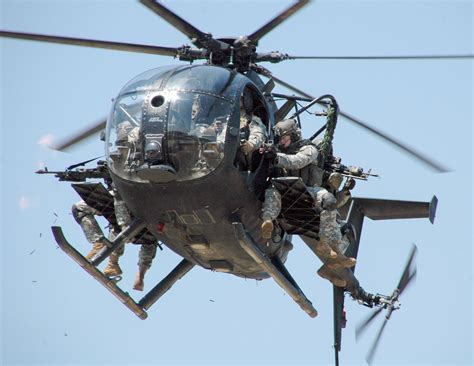
It wasn’t long before the nimble OH-6A would be modified for special operations, accommodating outboard benches that could carry up to three operatives per side, making it the ideal aircraft for clandestine troop insertion. The armed AH-6 gunship variant soon followed, offering night-optimized support through its matte-black finish and precision armament.
A New Doctrine: Task Force 160 and the Rise of the Little Bird
After the disaster of Operation Eagle Claw in April 1980, which highlighted the limitations of the U.S. military’s aviation capabilities in special operations, a dedicated unit was born: Task Force 158, later known as Task Force 160 or the 160th Special Operations Aviation Regiment (Airborne) – the “Night Stalkers.”
Pilots began training with unarmed and armed OH-6As, honing tactics that would allow them to fly low, fast, and invisible under radar coverage. With time, the MH-6 became the centerpiece of the Light Assault Company, while the AH-6 formed the Light Attack Company. The regiment became an essential part of nearly every major U.S. special operations campaign in the decades to follow.
First Blood: From Grenada to Panama
Operation Urgent Fury (Grenada, 1983)
The MH-6 saw combat deployment during Operation Urgent Fury. Six MH-6s and two AH-6s were transported via C-130 aircraft, playing critical roles in reconnaissance, casualty evacuation, and search-and-rescue missions after intense fighting. Their agility allowed them to ferry wounded personnel to nearby Navy vessels and locate downed Black Hawk crews, though their presence became public when civilians documented the helicopters in action.
Operation Just Cause (Panama, 1989)
During the invasion of Panama, Little Birds played an indispensable role. On December 19, two MH-6s and two AH-6s inserted beacon teams at Torrijos-Tocumen Airport. The aircraft launched pre-assault strikes on key targets like La Comandancia, and even executed one of the most daring helicopter insertions in history during Operation Acid Gambit, rescuing American Kurt Muse from Cárcel Modelo under heavy fire. Despite one MH-6 crash-landing during the exfil, the team accomplished its mission without loss of life.
In the Shadows: Covert Operations in Nicaragua and the Middle East
Throughout the 1980s, Little Birds operated in the gray zones of geopolitics. Deployed to Honduras, MH-6 helicopters ran night missions into Nicaragua in civilian garb. These operations were so secretive that pilots were prepared to destroy their aircraft if downed in enemy territory. Meanwhile, during Operation Prime Chance in the Persian Gulf (1987–1988), AH-6 and MH-6 aircraft launched from Navy barges, intercepting Iranian minelayers and patrol boats with pinpoint precision.
Black Hawk Down: The Battle of Mogadishu, 1993
The MH-6’s legendary status was cemented during the infamous Battle of Mogadishu. On October 3, 1993, MH-6s inserted Delta Force operators on rooftops in the Bakara Market. When Super Six-One was shot down by an RPG, MH-6 “Star Four-One” landed under heavy fire to rescue survivors, its crew braving bullets to evacuate two Rangers.
AH-6Js provided relentless cover fire throughout the night, holding the perimeter in one of the most intense urban battles fought by U.S. forces since Vietnam. The mission, dramatized in Black Hawk Down, underscored the courage and capability of Little Bird crews.
Terror War Vanguard: Iraq, Afghanistan, and Beyond
As the Global War on Terror unfolded, MH-6 and AH-6 helicopters were deployed across Iraq and Afghanistan, supporting raids, hostage rescues, and counterinsurgency operations. In April 2003, they provided crucial air support during the seizure of the Haditha Dam, backed the rescue of PFC Jessica Lynch, and executed high-value target raids.
In Somalia (2009), they supported Navy SEALs in eliminating terrorist Saleh Ali Saleh Nabhan during Operation Celestial Balance, showing their continuing utility in precision strikes against asymmetric threats.
Evolution in Airframe and Firepower
The MH-6’s design has continually evolved to meet modern combat requirements. Early variants like the AH-6C and MH-6E gave way to the AH/MH-6J, with upgraded FLIR systems and GPS-inertial navigation. The current MH-6M Mission Enhanced Little Bird (MELB) features FRIES (Fast Rope Insertion Extraction System), advanced avionics, and modular mission capabilities.
An unmanned prototype, the A/MH-6X, was tested for autonomous reconnaissance and strike missions, with South Korea developing its own unmanned version, the KUS-VH, capable of teaming with AH-64Es for integrated combat.
Technical Specifications: MH-6M at a Glance
- Crew: 2 (pilot and co-pilot)
- Passenger Capacity: Up to 6 troops or 684 kg of cargo
- Length (with rotors): 32 ft 7.2 in (9.936 m)
- Empty Weight: 1,591 lb (722 kg)
- Max Takeoff Weight: 3,100 lb (1,406 kg)
- Fuel Capacity: 62 US gal (403 lb / 183 kg)
- Engine: 1 × Allison T63-A-700 turboshaft, 425 hp
- Max Speed: 152 knots (175 mph / 282 km/h)
- Cruise Speed: 135 knots (155 mph / 250 km/h)
- Service Ceiling: 18,700 ft (5,700 m)
- Rate of Climb: 2,061 ft/min (10.47 m/s)
Armament Options:
- Guns: 2 × GAU-19 .50 cal or 2 × M134 Miniguns (7.62 mm)
- Rockets: 2 × LAU-68D/A pods (Hydra 70, 2.75″)
- Missiles: Up to 4 × AGM-114 Hellfire or 4 × FIM-92 Stingers
Global Reach: Operators and Future Use
While the U.S. Army remains the principal operator, the Royal Thai Army and Republic of Korea Army also utilize the MH-6. With over 150 aircraft in the ROK arsenal, and plans for full unmanned integration, the Little Bird remains not only a cornerstone of American special operations but a global benchmark in light helicopter warfare.
From jungle raids to rooftop extractions, from covert border crossings to high-profile hostage rescues, the MH-6 Little Bird has proven itself a lethal and indispensable tool in the arsenal of modern special forces. More than just a helicopter, it is a symbol of precision warfare, fearless aviation, and unwavering mission focus.