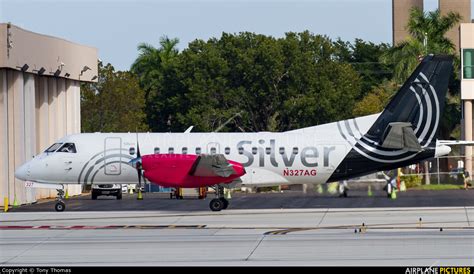
In the aftermath of Gulfstream International Airlines’ Chapter 11 bankruptcy filing in November 2010, a new opportunity emerged for regional aviation in the United States. On May 21, 2011, Silver Airways was founded, utilizing the assets and infrastructure of its predecessor. With financial backing from Victory Park Capital, the airline inherited a fleet of 21 Beechcraft 1900D aircraft and began building toward a renewed future. By December 15, 2011, the newly branded Silver Airways took flight with its first Saab 340 aircraft, positioning itself as a regional connector primarily for underserved markets in the southeastern U.S. and the Caribbean.
During its initial operations, the airline functioned as United Express following Continental Airlines’ merger with United on April 1, 2012. However, this affiliation ended in July 2013, prompting Silver to establish itself as a fully independent regional carrier. This transition coincided with a strategic push into Essential Air Service (EAS) routes, which provided federal subsidies to airlines serving rural communities. By 2013, Silver Airways was receiving over $20.5 million in annual subsidies to support these critical routes.
Strategic Expansion and Operational Milestones (2012–2015)
Silver’s formative years were marked by calculated expansion and logistical enhancements. In 2012, the airline shifted its maintenance operations from Fort Lauderdale to Gainesville Regional Airport, occupying a former Eclipse Aviation facility. It quickly scaled up its Saab 340 fleet to 12, enabling the launch of new routes in Florida and the Bahamas. Soon after, Silver added service from Gainesville to Orlando and Tampa, and later connected Washington Dulles International Airport to several cities across Pennsylvania, West Virginia, and Virginia.
Despite operational growth, the airline encountered a media hiccup when one of its aircraft mistakenly landed at the wrong airport on August 7, 2012—an error that temporarily marred its growing reputation.
In late 2011, Silver also ventured into Montana, launching EAS flights from a new hub in Billings. While initially servicing eight rural cities, declining federal support forced the airline to cease Montana operations by mid-2013. That same year, Dave Pflieger, a seasoned industry executive, was appointed CEO to steer the airline through its next growth phase. Under his leadership, Silver was honored by Condé Nast Traveler as one of the Top 10 Best U.S. Airlines in 2013.
Financial Realignment and Partnership Strategy
Silver Airways’ ambition required not only route expansion but also financial restructuring. In early 2014, the airline exited Cleveland’s EAS network and downsized operations in Atlanta, reallocating resources to more profitable markets. In February 2014, the airline secured up to $73 million in financing from GB Credit Partners and Crystal Financial, reinforcing its commitment to its Saab 340B+ fleet.
That same year, Silver achieved its first IATA Operational Safety Audit (IOSA) certification and forged a partnership with JetBlue, increasing interline connectivity and enhancing passenger convenience. The airline also deployed its own reservation system in May 2014, allowing for complete operational independence. Silver’s business model evolved into a hybrid carrier—part start-up, part legacy carrier—balancing autonomy with partnerships for long-term scalability.
In 2015, Silver added service to Panama City, Florida, and constructed a new 38,000 sq ft maintenance facility at Orlando International Airport. This investment reflected long-term confidence, though Silver would later shutter its Gainesville service due to missed payments on its local hangar.
Market Diversification, Ownership Changes, and Caribbean Focus
By 2016, Silver pursued permission from the U.S. Department of Transportation to begin flights between Florida and Cuba. While it gained access to nine cities, the airline was denied coveted rights to Havana. During this time, Silver collaborated with Frontier Airlines and Great Lakes Airlines to create a pilot recruitment pipeline. Later that year, a pivotal change occurred when Versa Capital Management, a Philadelphia-based private equity firm, acquired a majority stake in the airline.
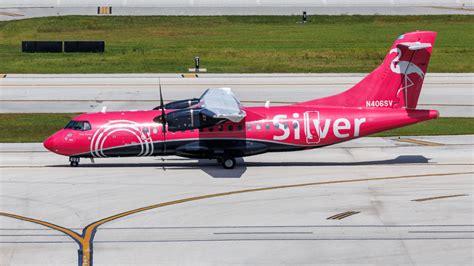
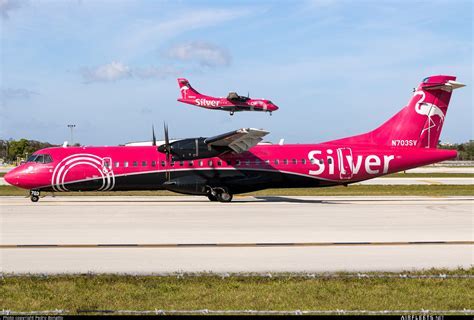
On August 1, 2017, Silver announced a large order for 20 ATR 42-600 aircraft, modernizing its fleet and moving away from aging turboprops. In April 2018, Silver expanded its Caribbean footprint by acquiring Seaborne Airlines, a San Juan–based operator serving islands across the region. By November 2019, Silver had formed codeshare agreements with both Delta Air Lines and American Airlines, enabling streamlined bookings and baggage transfers to various Caribbean destinations.
Pandemic Disruption and Operational Retooling (2020–2021)
Silver Airways announced expanded services to Charleston International Airport in early 2020, but the COVID-19 pandemic delayed these plans until November of that year. Simultaneously, the airline launched Silver-branded flights from its San Juan base, rolling out services between March and July 2020 as more ATR aircraft arrived. This dual-brand approach allowed Silver to tap into leisure and regional travel needs across the Caribbean basin.
On November 9, 2021, the airline diversified further by entering the cargo space, operating freight flights for Amazon Air using ATR 72-500 freighters. These feeder routes connected Albuquerque and Des Moines to Amazon’s hub at Fort Worth Alliance Airport, with aircraft branded in Amazon’s “Prime Air” livery. This venture, however, would be short-lived.
Decline, Bankruptcy, and Final Descent (2023–2025)
By mid-2023, Amazon terminated its cargo contract, effectively ending Silver’s freight operations. The airline’s financial difficulties compounded when, in April 2023, Fort Lauderdale–Hollywood International Airport initiated eviction proceedings due to non-payment of rent dating back to 2021.
On December 30, 2024, Silver filed for Chapter 11 bankruptcy, aiming to restructure while continuing limited operations. But the downturn accelerated. On March 2, 2025, the airline abruptly ceased flying from Orlando, and its aircraft began leaving the fleet—some routed to Coeur d’Alene, others to Ontario, Canada, and Denmark.
By April 2025, the possibility of a Chapter 7 liquidation loomed as financial rescue options dwindled. On June 11, 2025, Wexford Capital acquired the airline’s assets through a no-contest bid but opted not to continue flight operations. Silver Airways shut down completely on that date. Its final flight, operated by aircraft N706SV, flew from Tampa to Fort Lauderdale, landing at 11:51 p.m. EDT on June 10, 2025.
Operational Infrastructure and Headquarters
Silver Airways maintained its headquarters at 2850 Greene Street, located in unincorporated Broward County, Florida. Prior to that, it was based in Dania Beach, also near Fort Lauderdale. Its maintenance operations were conducted out of Orlando International Airport, utilizing a former Comair hangar. The Orlando facility was part of a 30-year lease agreement, signifying long-term investment intentions that would ultimately fall short amid the carrier’s financial collapse.
Destinations and Market Footprint
At its peak, Silver Airways operated across a broad swath of domestic and international routes. Domestically, the airline served Florida, Georgia, Montana, Massachusetts, Pennsylvania, and numerous other states through its three main hubs: Fort Lauderdale, Tampa, and San Juan. Its EAS contracts extended reach into rural communities, including underserved regions of Montana, Ohio, and West Virginia.
Internationally, Silver connected Florida and San Juan to destinations across the Bahamas, Dominican Republic, British Virgin Islands, Saint Kitts, Saint Maarten, Dominica, and Turks and Caicos. The acquisition of Seaborne Airlines enhanced Silver’s dominance in the Caribbean, though many of these routes were eventually terminated as financial pressures mounted.
Partnerships and Airline Alliances
Although not a member of a major global alliance, Silver maintained interline and codeshare agreements with key airlines, including:
- JetBlue Airways
- Delta Air Lines
- American Airlines
- United Airlines
- Air Canada
- Emirates
- Copa Airlines
- Azul Brazilian Airlines
- Bahamasair
- Avianca
- All Nippon Airways (ANA)
- Alaska Airlines
These relationships allowed for seamless connectivity between Silver’s regional operations and international long-haul services.
Fleet Composition and Evolution
Silver Airways’ final operating fleet in June 2025 consisted of:
- 3 ATR 42-600 (46 seats)
- 5 ATR 72-600 (70 seats)
Previously, the airline operated:
- 21 Beechcraft 1900D (inherited in 2011, retired in 2014)
- 28 Saab 340 (retired by 2022)
- 5 ATR 72-500F freighters (used for Amazon, retired in 2023)
This shift reflected a deliberate modernization strategy, yet high operating costs, route volatility, and external shocks ultimately derailed its long-term ambitions.
Legacy of Silver Airways
Though its lifespan was relatively short, Silver Airways left a tangible mark on regional aviation in the United States and Caribbean. With its commitment to underserved communities, efforts in fleet modernization, and bold acquisitions like Seaborne Airlines, Silver represented the tenacity and turbulence inherent in mid-sized aviation.
Its final chapter underscores the financial fragility of regional carriers operating at the intersection of regulation, partnership reliance, and volatile markets—a story as much about promise as it is about precarity.