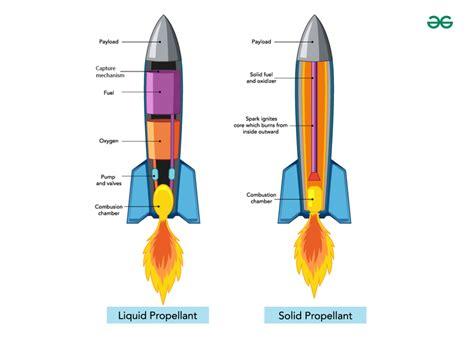
Thermal rocket propulsion stands as one of the most conceptually elegant and potentially transformative technologies in the evolution of spaceflight. Unlike chemical rockets, which rely on exothermic combustion reactions to generate thrust, thermal rockets utilize external heat sources to energize a working fluid before expelling it through a nozzle. This fundamental shift in propulsion philosophy allows for a wide array of design options, each offering unique advantages in terms of efficiency, thrust-to-weight ratio, and mission flexibility.
Understanding Thermal Rocket Efficiency: The Role of Temperature and Molecular Mass
The core performance metric for any rocket engine is specific impulse (Isp), which quantifies the efficiency of propellant use. In thermal rockets, specific impulse is closely tied to two primary factors: the temperature to which the working fluid is heated, and the molecular mass of the exhaust gases. The governing equation, derived from thermodynamics, reveals that:
[ I_{sp} = \frac{1}{g_0} \sqrt{\frac{3k_B T}{m}} ]
Here, (T) is the absolute temperature of the propellant, (m) is its molecular mass, (k_B) is Boltzmann’s constant, and (g_0) represents standard gravity. This means that to achieve high performance, engineers must aim for the highest feasible heating temperatures and opt for light propellants—liquid hydrogen being the optimal choice due to its low molecular weight.
Cold Gas and Steam Rockets: The Simplest Thermal Applications
At the most basic level, thermal propulsion includes cold gas thrusters, where compressed gases are simply released through a nozzle. Though conceptually simple and mechanically robust, these systems offer minimal specific impulse and are primarily used for small-scale attitude adjustments in satellites.
In contrast, steam rockets represent a more dynamic variation. These devices heat water in pressurized tanks until it reaches saturation. When released, the high-pressure steam expands through a nozzle, providing thrust. Despite their rudimentary design, steam rockets have seen practical application in drag racing and stunt propulsion, demonstrating a viable use-case for short bursts of thermal thrust.
Nuclear Thermal Rockets: High-Efficiency Propulsion for Deep Space
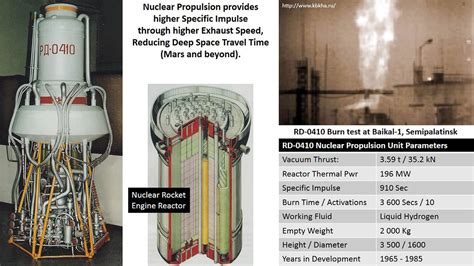
Among all thermal rocket concepts, the nuclear thermal rocket (NTR) is the most extensively researched and developed. In this system, a nuclear reactor heats a lightweight working fluid—most often liquid hydrogen—which then expands and exits through a conventional rocket nozzle. Due to the immense energy density of nuclear fuel (approximately 10 million times greater than chemical fuels), NTRs can achieve specific impulses in the range of 850–950 seconds, more than double those of traditional chemical rockets.

The United States led pioneering efforts in this domain through Project Rover and the NERVA (Nuclear Engine for Rocket Vehicle Application) program between 1955 and 1973. These initiatives produced multiple test reactors—such as Kiwi, Phoebus, Pewee, and NRX/XE—which collectively ran for over 17 hours. The NRX/XE engine, for instance, operated for more than two hours, including 28 minutes at full thrust, and was deemed ready for flight by the Space Nuclear Propulsion Office.
Despite these successes, geopolitical shifts and budgetary constraints halted further development. However, nuclear thermal rockets remain a cornerstone of future mission plans for Mars and beyond due to their superior efficiency and ability to drastically reduce interplanetary travel times.
Soviet Efforts in Nuclear Thermal Propulsion
While the U.S. led extensive testing programs, the Soviet Union pursued similar research in parallel. The RD-0410 nuclear thermal engine was their flagship project, reportedly tested at the Semipalatinsk nuclear range. Though details remain scarce and no flight test was ever conducted, the Soviets aimed to develop upper-stage boosters for their N1 lunar program, mirroring American ambitions.
Radioisotope Thermal Rockets: Compact but Limited Power
A more compact variation of nuclear thermal propulsion is the radioisotope thermal rocket, which substitutes a nuclear reactor with radioactive decay-based heat sources. While the power output is significantly lower, the system benefits from extreme longevity and mechanical simplicity. However, due to the low thrust, such designs are currently limited to niche applications in deep-space exploration, such as slow, long-duration orbital changes or rendezvous maneuvers.
Solar Thermal Rockets: Harnessing the Sun’s Energy Directly
Another promising avenue is the solar thermal rocket, which replaces nuclear heating with concentrated solar radiation. Using mirrors or parabolic collectors, these systems heat a propellant—again preferably hydrogen—and expel it for thrust.
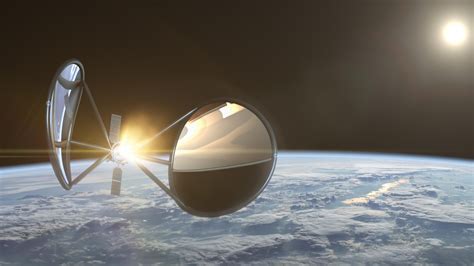
The technology is especially attractive for missions within the inner Solar System, where solar flux is strong and constant. Solar thermal propulsion offers reusability, cryogenic propellant compatibility, and the potential for orbital refueling—making it a strong candidate for reusable inter-orbital tugs and cislunar transport systems. However, its performance is limited by collector area and solar intensity, constraining its usefulness beyond Mars.
Laser Thermal Rockets: Ground-Powered Propulsion
Laser thermal propulsion introduces the concept of beam-powered heating, wherein a high-energy laser targets a heat exchanger on the spacecraft, energizing its onboard propellant. This approach allows for extremely lightweight launch vehicles, as the power source remains on the ground. Theoretically, a laser thermal rocket could achieve specific impulses near 900 seconds while maintaining a thrust-to-weight ratio close to chemical engines.
Practical challenges remain formidable. Atmospheric distortion, laser tracking precision, and heat exchanger durability are key obstacles. Nonetheless, this concept holds significant promise for repetitive low-Earth orbit launches, enabling inexpensive, high-cadence deployment of orbital infrastructure.
Microwave Thermal Rockets: Affordable Beam Propulsion Alternative
Similar in concept to laser thermal systems, microwave thermal rockets use microwave energy—often from ground-based phased arrays—to heat the onboard propellant. Compared to lasers, microwaves offer a more cost-effective source of energy, potentially reducing launch infrastructure investment by one to three orders of magnitude.
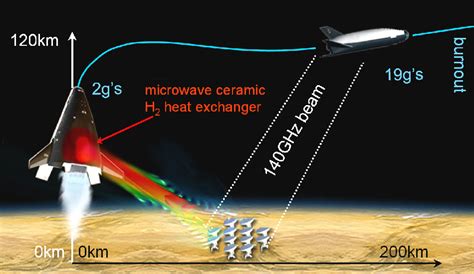
First proposed by Kevin L.G. Parkin in 2002, the concept led to experimental efforts like the DARPA/NASA Millimeter-wave Thermal Launch System (MTLS). Although multiple launch attempts occurred between 2012 and 2014, unresolved beam alignment issues and funding limitations suspended the project. Still, the groundwork laid by these tests continues to inform next-generation beam propulsion research.
Engineering Constraints and Future Prospects
Despite the theoretical benefits and historical testing, thermal rockets face critical engineering hurdles:
- Material limits: High-temperature operation strains structural integrity, demanding materials capable of withstanding extreme thermal stresses.
- Heat exchanger efficiency: For beam-powered systems, efficient and lightweight exchangers are essential for converting beamed energy into propellant heating.
- Environmental and regulatory concerns: Especially for nuclear systems, radiological safety and launch approvals remain politically sensitive.
Nevertheless, the resurgence of interest in long-duration deep space missions, orbital infrastructure, and interplanetary cargo transport is rekindling development efforts. NASA, DARPA, and several private aerospace firms are revisiting thermal propulsion as a core element of next-generation mission architectures.
Conclusion: The Inevitable Rise of Thermal Propulsion
As humanity transitions from exploratory to operational space activity, propulsion technologies must evolve to match new demands. Thermal rocket engines—ranging from nuclear to solar and beam-powered variants—offer a scalable path forward. Their high efficiency, refueling potential, and compatibility with reusable systems make them essential for a sustainable space economy.
While chemical propulsion may remain dominant in the near term, the thermal rocket stands poised to power the next era of human and robotic exploration, unlocking not just the Moon and Mars, but the vast frontier beyond.