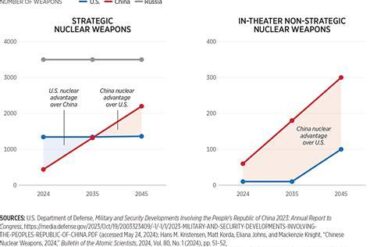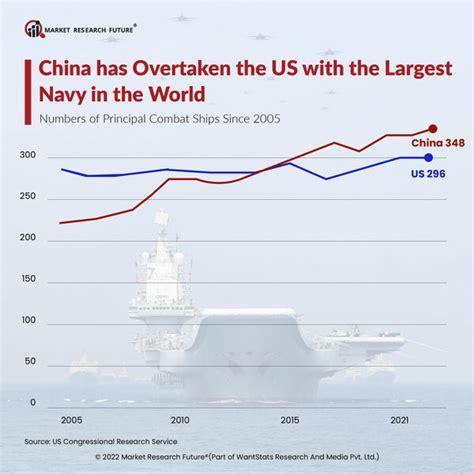
China’s military modernization has accelerated at a pace that has reshaped the balance of power across the Indo-Pacific. With the world’s second-largest defense budget and a laser-focused regional strategy, Beijing has invested heavily in systems tailored to contest nearby seas, skies, and borders. While the United States maintains overwhelming global power projection capabilities, there are specific categories of weapons China operates today that the U.S. does not field in equivalent form.
These differences are not technological shortcomings on Washington’s part. They are strategic divergences. The United States built a force optimized for worldwide deployment, sustained expeditionary operations, and global deterrence. China, by contrast, has engineered a military architecture designed to dominate its immediate periphery — from the East China Sea and South China Sea to the Western Pacific and contested Himalayan frontiers.
That divergence has produced three highly consequential capabilities unique to the People’s Liberation Army (PLA): operational anti-ship ballistic missiles (ASBMs), a vast arsenal of land-based intermediate-range ballistic missiles (IRBMs), and a mature land-based coastal anti-ship missile defense network. Each of these systems reflects a deliberate attempt to restrict U.S. freedom of maneuver near China’s shores.
Anti-Ship Ballistic Missiles: The Carrier Threat From the Mainland
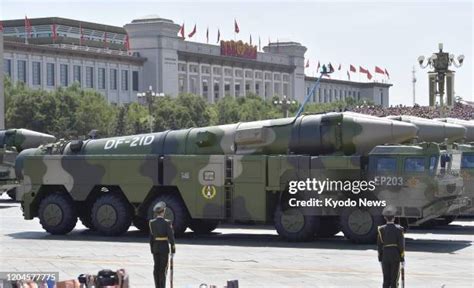
China is the only major military power to field multiple operational anti-ship ballistic missiles designed specifically to strike moving naval vessels at long range. This is not merely a missile category; it represents a conceptual shift in naval warfare.
Traditional anti-ship weapons are cruise missiles that fly low and horizontally toward their target. Ballistic missiles follow a high, arcing trajectory that reenters the atmosphere at hypersonic speed. Marrying that trajectory to the ability to track and hit a moving aircraft carrier requires advanced guidance, satellite support, over-the-horizon radar, and mid-course corrections. China has invested heavily in building precisely that ecosystem.
The most well-known of these systems is the DF-21D, frequently described as a “carrier killer.” With a range of approximately 2,150 kilometers (1,300 miles), it allows the PLA Rocket Force to threaten U.S. carrier strike groups operating far from China’s coastline. The longer-range DF-26D extends that reach to roughly 4,000 kilometers (2,500 miles), placing key regional bases such as Guam within potential engagement distance.
Even more strategically significant is the reported anti-ship variant of the DF-27, with an estimated range of up to 8,000 kilometers (5,000 miles). That theoretical envelope stretches beyond the Western Pacific, raising the possibility of coverage that could reach as far as Hawaii under certain conditions.
China has also introduced the YJ-21, a newer anti-ship ballistic or quasi-ballistic missile believed to possess hypersonic characteristics and a range of around 1,500 kilometers (900 miles). The DF-17, equipped with a hypersonic glide vehicle, adds maneuverability during its terminal phase, complicating interception efforts.
The United States does not deploy any operational anti-ship ballistic missiles. It relies instead on highly capable anti-ship cruise missiles such as the AGM-158C LRASM and the anti-ship variant of the Tomahawk. These weapons are precise and stealthy, but they do not replicate the ballistic missile threat profile.
The reason is geographical reality. The U.S. mainland is buffered by two vast oceans and friendly neighbors. China, however, faces persistent U.S. naval presence in what it considers its near seas. Anti-ship ballistic missiles serve as a deterrent tool designed to push adversary fleets farther from Chinese shores. They are not global dominance weapons. They are regional denial instruments.
Land-Based Intermediate-Range Ballistic Missiles: The Arsenal Built Outside the INF Framework
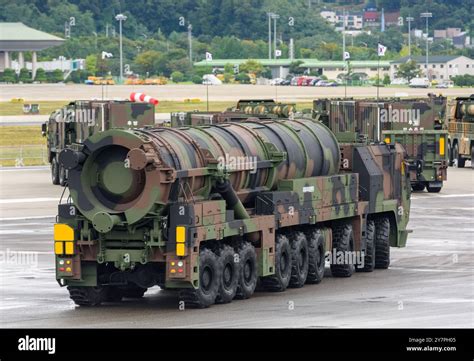
For decades, the United States was constrained by the Intermediate-Range Nuclear Forces (INF) Treaty, which prohibited ground-launched ballistic and cruise missiles with ranges between 500 and 5,500 kilometers. While the treaty applied only to the U.S. and the Soviet Union (later Russia), China was not a party to it.
This asymmetry allowed Beijing to construct one of the world’s largest and most diverse inventories of ground-based short- and intermediate-range ballistic missiles. The PLA Rocket Force now fields a spectrum of systems capable of striking regional targets from land-based mobile launchers.
The DF-21 medium-range ballistic missile family provides flexible options across conventional and nuclear configurations. The DF-26, classified as an intermediate-range ballistic missile, reaches up to 4,000 kilometers, enabling strikes against military installations across the Western Pacific. The DF-17, equipped with a hypersonic glide vehicle, further enhances survivability and penetration capability against missile defenses.
Land-attack cruise missiles such as the CJ-10 and CJ-100 complement the ballistic arsenal, offering lower-altitude, terrain-following strike options that complicate detection and interception.
Until its withdrawal from the INF Treaty in 2019, the United States deliberately avoided building such systems. Instead, it compensated through submarine-launched ballistic missiles (SLBMs), carrier aviation, long-range bombers, and emerging hypersonic weapons programs. Even after leaving the treaty, the U.S. remains years away from deploying a mature, large-scale ground-based intermediate-range missile force comparable to China’s.
This gap is not technological incapacity. It reflects historical arms control commitments and a strategic model rooted in forward-deployed naval and air power. China’s missile-centric structure, by contrast, emphasizes rapid, land-based strike options that can saturate regional defenses in the early stages of a conflict.
In practical terms, China can launch substantial missile salvos from its own territory without relying on overseas basing. That structural advantage reduces vulnerability and simplifies logistics within its primary theater of operations.
A Nationwide Land-Based Coastal Anti-Ship Missile Network
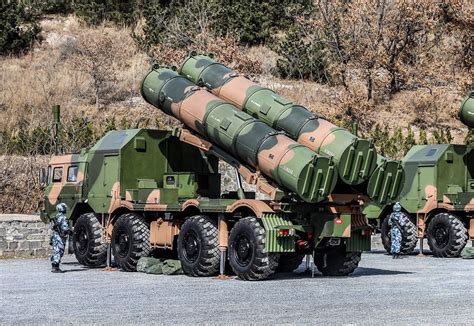
Beyond ballistic missiles, China has constructed an extensive land-based coastal anti-ship missile network that forms a layered defensive shield along its maritime approaches.
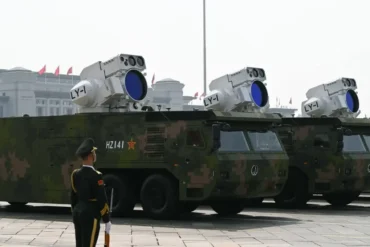
These systems primarily employ anti-ship cruise missiles (ASCMs) mounted on highly mobile transporter-erector-launchers. Missiles such as the YJ-62 and YJ-12B can be deployed along coastal highways, concealed in hardened positions, or positioned on island outposts throughout the South China Sea.
While their range is shorter than ballistic systems — typically several hundred miles — their mobility and dispersal complicate targeting efforts. They can relocate rapidly, fire from unexpected positions, and integrate with radar and surveillance assets to create overlapping coverage zones.
China’s Northern Theater Command, including units like the 333rd Coastal Defense Brigade, has demonstrated operational readiness with these systems in exercises that simulate real-world deployment conditions. The network is not theoretical. It is practiced and integrated.
The United States does not maintain a permanent, nationwide coastal anti-ship missile grid along its shores. Recent U.S. Marine Corps initiatives have experimented with mobile Naval Strike Missile units mounted on trucks, but these are expeditionary tools designed for overseas operations, not homeland coastal defense.
Once again, geography explains much of the divergence. The continental United States does not face adversarial fleets stationed off its coasts in the same manner that China perceives U.S. naval forces operating near its maritime boundaries. As a result, Washington has prioritized forward defense rather than coastal missile fortification.
China’s coastal missile network, combined with its anti-ship ballistic missiles and intermediate-range strike systems, creates what analysts often describe as an anti-access/area-denial (A2/AD) architecture. The objective is straightforward: raise the cost and risk of operating military forces within the First and Second Island Chains.
Strategic Context: Capability Reflects Intent
These three capabilities share a common thread. They are optimized for regional denial, layered defense, and mainland-based strike power. They do not project force globally in the way U.S. carrier strike groups or overseas bases do. Instead, they fortify China’s immediate sphere of influence.
The United States maintains unmatched experience in sustained expeditionary warfare, global logistics, joint operations, and alliance integration. China, however, has concentrated on systems that exploit geography, shorten supply lines, and leverage interior positioning.
Military capability is never created in a vacuum. It is engineered to serve political objectives and geographic realities. China’s anti-ship ballistic missiles, land-based intermediate-range arsenal, and coastal missile grid are not accidental developments. They are deliberate investments aligned with a strategy focused on deterring intervention and asserting dominance within its near seas.
As modernization continues, the significance of these systems lies not only in their technical specifications but in the operational concepts behind them. They signal a military posture designed to complicate U.S. planning in the Indo-Pacific and to reshape the risk calculus of any force operating close to Chinese territory.
In the evolving landscape of great-power competition, differences in capability reveal differences in ambition. China has built tools the United States chose not to prioritize — tools tailored to a specific regional contest that may define the strategic balance of the coming decades.