The Second World War transformed military aviation on an extraordinary scale. Aircraft became larger, faster, more heavily armed, and capable of carrying enormous quantities of troops, equipment, fuel, and bombs across previously difficult distances. The war also created an urgent demand for aircraft that could operate as strategic bombers, heavy transports, flying boats, and long-range logistical platforms.
Size alone did not determine an aircraft’s usefulness. Some enormous designs became important operational weapons, while others remained prototypes whose technology arrived too late to influence the conflict. Nevertheless, these aircraft demonstrate just how quickly aviation engineering advanced between 1939 and 1945.
When we examine the largest military aircraft associated with the Second World War, several remarkable machines stand out. Their dimensions reveal the enormous ambitions of wartime aircraft designers, from German assault transports and flying boats to American strategic bombers and the extraordinary Hughes Hercules.
1. Hughes H-4 Hercules: The 319-Foot Giant
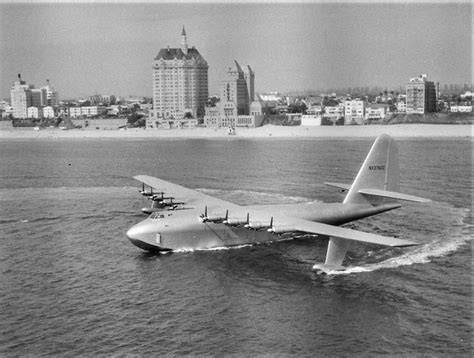
The Hughes H-4 Hercules, better known as the Spruce Goose, was by far the largest aircraft on this list when measured by wingspan. Its enormous 319-foot wingspan made it one of the largest aircraft ever constructed, and its empty weight reached approximately 250,000 pounds. Although it did not fly until November 2, 1947, its origins were firmly rooted in wartime requirements.
The United States Department of War commissioned the project in 1942, when German U-boats were creating serious difficulties for Allied shipping in the Atlantic. The basic idea was compelling: instead of moving huge quantities of troops and equipment across submarine-infested waters, an enormous flying boat could potentially transport them over the ocean.
The aircraft was powered by eight Pratt & Whitney R-4360 Wasp Major radial engines. Wartime restrictions on aluminum encouraged the use of laminated birch construction, producing the aircraft’s famous nickname. Despite its gigantic proportions, the Hercules made only one brief flight, on November 2, 1947. The war had ended years earlier, and the strategic requirement that had inspired it had largely disappeared.
2. Douglas XB-19: America’s 212-Foot Experimental Bomber
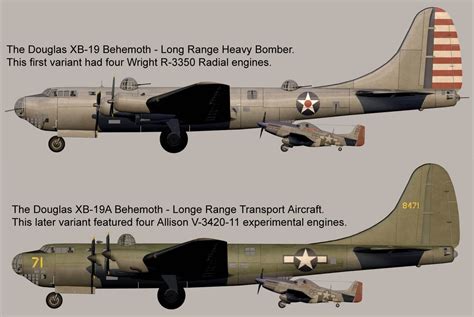
The Douglas XB-19 represented another enormous American wartime aircraft. With a 212-foot wingspan and a maximum takeoff weight of approximately 162,000 pounds, it was the largest bomber built for the United States Army Air Forces until the later Convair B-36.
The XB-19 was an experimental heavy bomber, rather than a mass-produced combat aircraft. Only one prototype was completed. It used four Wright R-3350-5 Duplex Cyclone radial engines, the same broad engine family that would later power some of America’s most important heavy aircraft.
The timing of the program worked against it. Aviation technology was advancing so quickly that the XB-19 was already approaching obsolescence before it was completed. Nevertheless, the aircraft provided valuable experience with extremely large structures, long-range operations, and heavy aircraft systems. Plans were eventually made to convert it into a cargo aircraft, but the modifications were never completed. The XB-19 made its final flight on August 17, 1946, and was ultimately scrapped in 1949.
3. Blohm & Voss BV 238: Germany’s Massive Flying Boat
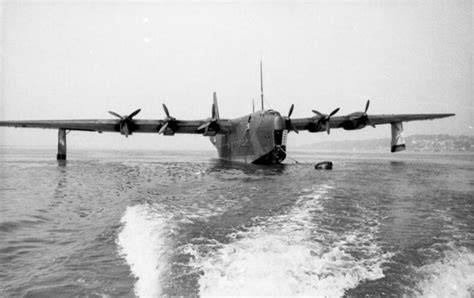
The Blohm & Voss BV 238 was one of Nazi Germany’s most ambitious aircraft projects and is generally regarded as the largest aircraft produced by the Axis powers during the Second World War. Its wingspan measured approximately 197 feet, while its maximum weight reached around 220,462 pounds.
The BV 238 was conceived as a huge flying-boat bomber capable of carrying substantial weapons loads over long distances. Six Daimler-Benz DB 603G piston engines provided propulsion. Its range was projected to exceed 6,000 miles, giving the aircraft the potential to operate over vast distances.
When it first flew in 1944, the BV 238 was reportedly the heaviest aircraft ever built. Yet its size could not compensate for Germany’s increasingly desperate strategic position. Only one prototype was completed, while two additional airframes remained unfinished. Allied aircraft eventually attacked the prototype near Lübeck, strafing it and causing substantial damage that left the giant aircraft partially submerged.
4. Messerschmitt Me 323 Gigant: Germany’s Heavy Transport
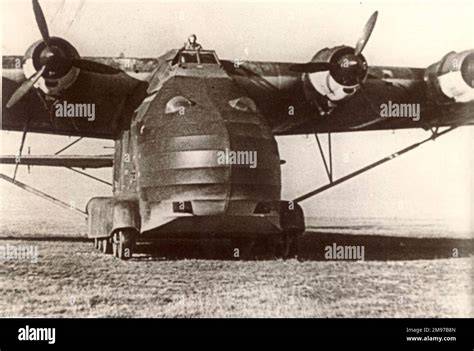
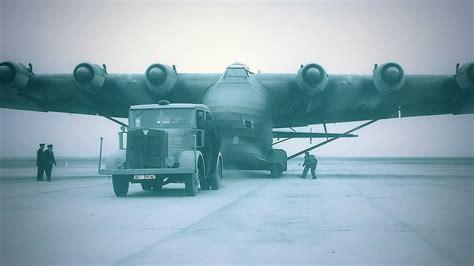
The Messerschmitt Me 323 Gigant was considerably more practical than the BV 238. With a 181-foot wingspan and a maximum takeoff weight of approximately 94,799 pounds, it became the largest land-based transport aircraft operated by Germany during the war.
The aircraft evolved from the Me 321 military glider, which had been developed for Germany’s planned invasion of Britain, known as Operation Sea Lion. Once that invasion was abandoned, the huge glider concept still had military value. Engineers added six Gnome-Rhône air-cooled radial piston engines, creating the powered Me 323.
The Gigant could carry roughly 100 fully equipped troops or substantial military equipment and vehicles. It subsequently served in the Invasion of Crete, the invasion of the Soviet Union, and the North African campaign. Its size made it valuable for logistics, but it was also a vulnerable target. Allied fighters and bombers repeatedly attacked Me 323 formations, and many aircraft were lost while attempting to sustain German operations across the Mediterranean and Eastern Front.
Approximately 213 Me 323s were built, including 15 conversions from Me 321 gliders. That production figure made the Gigant far more operationally significant than many larger wartime prototypes.
5. Boeing B-29 Superfortress: America’s Strategic Giant
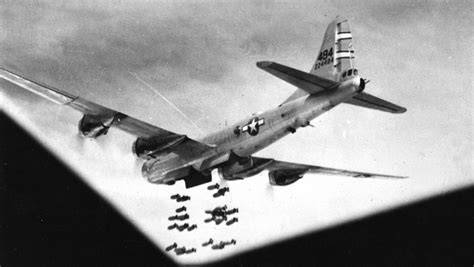
The Boeing B-29 Superfortress had a comparatively modest 141-foot wingspan, but its importance to the Second World War was enormous. With a maximum takeoff weight of approximately 133,500 pounds, it became the most successful large combat aircraft among the machines examined here.
Powered by four Wright R-3350-23 Duplex Cyclone radial engines, the B-29 represented a major technological leap beyond the B-17 Flying Fortress. It introduced features such as a pressurized crew cabin, dual-wheel tricycle landing gear, and an advanced analog-computer-controlled fire-control system.
Approximately 3,970 B-29s were produced, primarily for the war against Japan. They conducted devastating conventional bombing campaigns, including large-scale incendiary raids against Japanese cities. Most historically significant, B-29s were used to drop the atomic bombs on Hiroshima and Nagasaki in August 1945.
The program was extraordinarily expensive. The B-29 reportedly cost around $3 billion, exceeding the approximately $1.9 billion spent on the Manhattan Project. Its service life also extended well beyond 1945, with B-29s seeing combat during the Korean War and remaining in service into the 1950s.
What These Giant Aircraft Revealed
These five aircraft illustrate different solutions to the same wartime demand: move more material farther and faster. The H-4 Hercules pursued massive transoceanic airlift, the XB-19 explored the possibilities of enormous strategic bombers, and the BV 238 represented Germany’s attempt to combine long range with exceptional size.
The Me 323 demonstrated that giant transports could have genuine battlefield value, even when they were exposed to enemy attack. The B-29 ultimately proved the most consequential, because its size was combined with advanced systems, long range, substantial production, and a strategic mission that directly matched America’s industrial capabilities.
The Second World War therefore produced more than simply large aircraft. It produced a new philosophy of strategic aviation, in which aircraft became essential tools for transporting armies, destroying industrial targets, projecting power across oceans, and reshaping the geography of warfare. Some giants flew only once, while others became legends. Together, they mark one of the most dramatic periods of growth in aviation history.