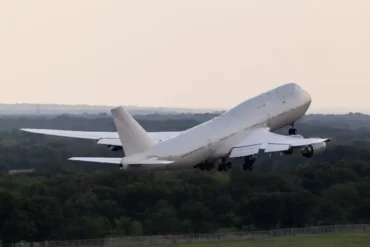
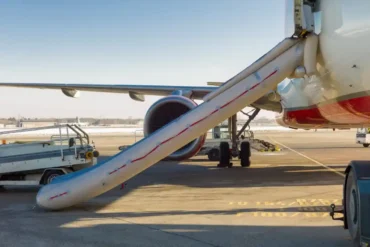
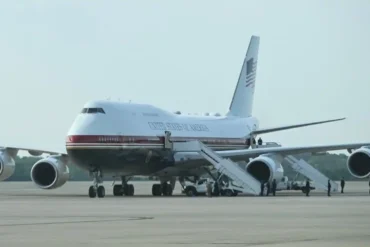
President Donald Trump’s departure from Joint Base Andrews was briefly interrupted on September 9 when an inflatable emergency evacuation slide deployed from the Boeing 747-8 that was preparing to carry him to Dallas. The unexpected deployment occurred just before Trump was scheduled to board, creating a striking scene around an aircraft that has already attracted unusual attention.
Trump arrived at Joint Base Andrews aboard Marine One at about 2:02 p.m. ET and remained on the helicopter for more than 20 minutes while ground crews dealt with the deployed slide. Reuters reported that the slide was fully inflated on the far side of the presidential aircraft as Trump approached the departure area.
The incident caused only a short delay, but its timing made it particularly notable. The Boeing 747-8 is equipped with 12 inflatable evacuation slides, which provide a rapid escape route from doors positioned roughly 30 feet above the ground. The slide appeared to have deployed accidentally, although Trump characterized the crew’s activity as an inspection of the emergency system. Asked whether he was confident the aircraft was safe to fly, Trump indicated that he was, adding that he would not have boarded if he had concerns.

Emergency Slide Deployment Delays Trump’s Air Force One Departure
An emergency slide deployment does not necessarily indicate that an aircraft has suffered a serious mechanical failure. Determining exactly what happened requires inspection of the slide, its deployment mechanism, associated sensors, and the aircraft’s operating procedures. In this case, neither the White House nor the US Air Force immediately offered a detailed public explanation for the activation.
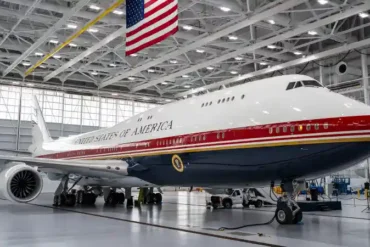
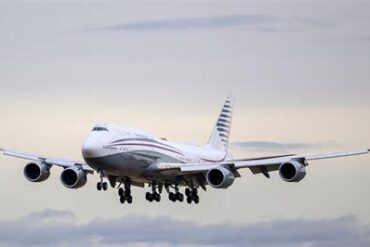
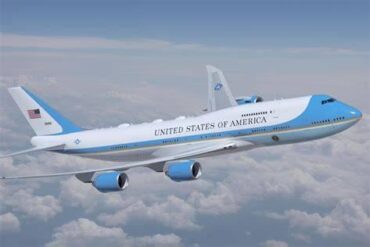
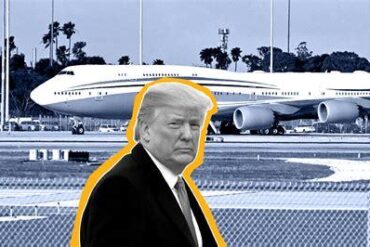
The aircraft’s identity is what gives the relatively contained technical incident greater significance. Qatar gifted the 747-8 to the United States, after which officials accelerated efforts to modify it for presidential transportation. Trump began flying aboard the aircraft on July 1, making it an unusually visible symbol of an interim solution to the long-running delays surrounding the next generation of US presidential aircraft.
Qatari 747-8 Faces Continued Security Scrutiny
The former Qatari aircraft has already faced questions about how quickly it could be transformed from a government widebody into a presidential transport. They must support secure communications, specialized defensive and operational systems, protected passenger areas, extensive redundancy, and strict procedures intended to keep the president safe under a wide range of circumstances.
CNN previously reported that security concerns surrounding the rapidly retrofitted aircraft contributed to Trump using the older Air Force One during part of a July trip as tensions with Iran increased. That decision illustrated the difference between putting a large aircraft into presidential service and completing the far more demanding process of preparing it for the role on a sustained basis.
Wednesday’s slide deployment therefore arrives against a backdrop of continuing modifications rather than as an isolated aviation curiosity. Trump said the aircraft is expected to leave service in October for roughly 60 days for unspecified security upgrades.
Trump’s Dallas Trip Continues After Brief Aircraft Delay
The timing was also significant because Trump was scheduled to travel to Dallas for the Republican National Midterm Convention, where he was expected to deliver a keynote address. Despite the disruption at Andrews, the aircraft ultimately departed with Trump aboard after the slide was removed. The episode did not prevent the planned journey, but it provided another reminder of the intense operational scrutiny surrounding presidential aviation.
For passengers on an ordinary commercial aircraft, an emergency slide deployment might become a maintenance event largely invisible to the public. Around Air Force One, even a short delay can attract immediate attention because every component is connected to an exceptionally demanding mission. The aircraft must be ready to move the president safely and efficiently, while its crews operate under procedures that leave little room for uncertainty.
Interim Air Force One Remains a Work in Progress
The Qatari 747-8 has given the White House an unusual bridge between the existing presidential fleet and future aircraft plans. Its arrival allowed Trump to use a newer widebody platform, but the accelerated conversion has also ensured that virtually every technical development receives scrutiny. The emergency slide deployment is not, by itself, evidence of a broader safety problem, particularly because crews inspected the aircraft before departure.
Still, the episode underscores why presidential aircraft cannot be treated simply as upgraded versions of commercial jets. Every emergency system, security feature, communication capability, and maintenance procedure carries greater importance when the aircraft is responsible for transporting the president. The brief delay at Joint Base Andrews was ultimately contained, but the incident adds another unusual chapter to the rapidly evolving story of Trump’s interim Air Force One.