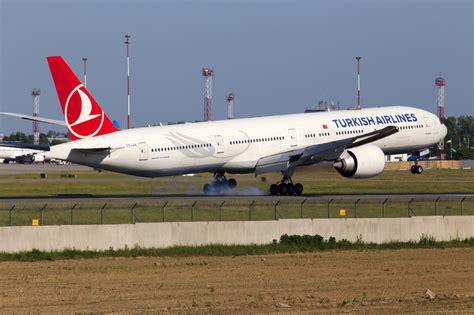
Passengers aboard a Turkish Airlines Boeing 777-300ER experienced a dramatic end to their journey after the aircraft collided with a radar mast while taxiing at Antalya Airport, leaving the widebody jet with significant structural damage and triggering an emergency evacuation.
The incident occurred on the evening of June 11 when Turkish Airlines flight TK2430 completed a routine domestic service from Istanbul Airport to Antalya. After a normal landing, the aircraft was taxiing toward its assigned parking position when it struck a ground radar antenna structure. The impact was severe enough to topple the mast, which subsequently penetrated the aircraft’s fuselage and caused damage to both the cabin and wing.
Initial reports indicate that at least one passenger sustained injuries, although some local sources suggested the number may have been as high as three. None of the injuries were reported to be life-threatening. Cabin crew and emergency responders quickly evacuated all 267 passengers, preventing the situation from escalating into a more serious disaster.
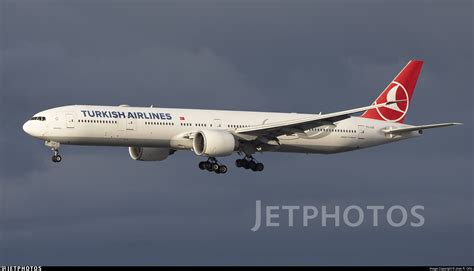
The aircraft involved was a Boeing 777-300ER, one of the largest twin-engine passenger jets in commercial service. Designed for long-haul operations, the aircraft’s enormous wingspan and overall dimensions require strict adherence to airport taxiway restrictions and clearance procedures. Even a minor navigation error on the ground can have serious consequences when operating an aircraft of this size.
Witness photographs from Antalya Airport showed extensive damage to the aircraft’s right side. The radar mast pierced the fuselage skin, tearing through structural sections of the cabin and causing an overhead luggage compartment to become dislodged. The force of the impact also triggered the deployment of passenger oxygen masks, creating a scene more commonly associated with in-flight emergencies than ground incidents.
The damaged aircraft, registered TC-LKD, has a lengthy operational history. The 17-year-old Boeing 777-300ER recently returned to Turkish Airlines after spending several years on lease with another carrier. At the time of the accident, the jet had not yet been fully repainted into the airline’s current corporate colors and remained identifiable by elements of its previous operating appearance.
According to preliminary information released by transportation authorities, the aircraft entered a taxi route that was not intended for a Boeing 777. Officials stated that the jet reportedly accessed the taxiway from an incorrect lane before colliding with the radar installation positioned near the apron area. Investigators are now examining how such a large aircraft ended up on a route that may not have provided sufficient wingtip clearance.
The geometry of the accident highlights the challenges involved. Aviation safety data indicates that the distance between the taxiway centerline and the radar mast’s location was approximately 29 meters. Meanwhile, the Boeing 777-300ER extends roughly 32.4 meters from the centerline to each wingtip. Under normal circumstances, aircraft are routed only through taxiways that provide adequate clearance margins. The apparent mismatch between aircraft dimensions and available space has become a central focus of the investigation.
Experts note that pilots have limited visibility of their wingtips from the flight deck, particularly on large widebody aircraft. Ground navigation therefore relies heavily on airport markings, signage, published procedures, and air traffic control instructions. A misunderstanding, incorrect routing clearance, missed taxiway turn, or airport operational error could all potentially contribute to a situation where an aircraft enters an unsuitable taxi path.
Investigators are expected to review cockpit communications, airport surveillance footage, taxiway charts, and air traffic control recordings to determine the precise sequence of events. The inquiry will seek to establish whether the aircraft crew misunderstood instructions, whether controllers issued an inappropriate routing clearance, or whether other operational factors played a role.
The damage assessment facing Turkish Airlines is substantial. Structural engineers must inspect not only the visible fuselage breach but also any hidden damage to internal aircraft systems. Wiring harnesses, environmental control systems, insulation materials, and cabin equipment located near the impact area will require detailed examination.
Particular attention will focus on the right wing, which reportedly sustained impact damage during the collision. Aircraft wings contain critical structural components and fuel systems that must meet rigorous safety standards. Engineers will conduct extensive inspections to verify that no hidden cracks, deformations, or fatigue-related issues developed as a result of the accident.
Repairing the fuselage will involve removing damaged sections and installing replacement structural components certified to restore the aircraft’s pressurization integrity. Cabin fixtures, oxygen systems, overhead bins, and associated electrical infrastructure will also need replacement before the aircraft can return to passenger service.
Given the scale of the damage, industry observers expect the Boeing 777 to remain out of operation for several weeks and potentially much longer. While the evacuation’s success ensured passenger safety, the incident serves as a reminder that significant aviation accidents can occur even after a flight has landed safely. As investigators work to determine exactly how the aircraft came into contact with the radar mast, the findings may lead to procedural changes designed to prevent similar ground collisions at busy international airports in the future.