The Second World War littered the oceans with steel graves. More than 1,100 German U-boats slipped beneath the Atlantic and Arctic waters during the conflict, hunting convoys and strangling supply lines in a brutal maritime chess match. Of the 785 that never returned, most vanished as silent relics of industrialized warfare. Yet one wreck, resting 490 feet below the surface off the coast of Fedje, Norway, refuses to fade quietly into history. U-864 is not merely a war grave. It is an environmental time bomb.
In the winter of 1945, the submarine was no ordinary patrol craft. Commissioned on December 9, 1943, and commanded by Korvettenkapitän Ralf-Reimar Wolfram, U-864 embarked on a mission shrouded in secrecy: Operation Caesar. Its objective was to deliver advanced technology and strategic materials from Nazi Germany to Imperial Japan. Tucked inside its hull were precision parts, aircraft engine components, and, most dangerously, 65 tons of metallic mercury stored in steel flasks. This cargo would never reach Asia. Instead, it would settle into the seabed, where it remains a toxic legacy of global war.
The submarine’s final hours unfolded in a manner unprecedented in naval warfare. On February 9, 1945, the British submarine HMS Venturer, under the command of Lt. Jimmy S. Launders, detected U-864 beneath the waves. Mechanical trouble aboard the German vessel created an acoustic signature that betrayed its position. For three tense hours, the Venturer calculated firing solutions in three dimensions—predicting not only direction and speed, but depth. When Launders ordered four torpedoes launched in sequence, he committed to a gamble that left his submarine temporarily defenseless. The fourth torpedo struck its mark. U-864 broke apart and sank with all 73 men aboard. It became the only confirmed instance in history of one submerged submarine destroying another while both were underwater.
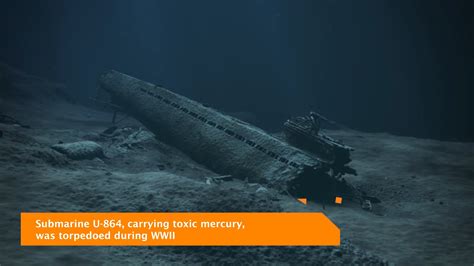
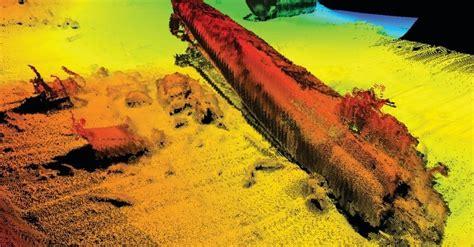
The war ended months later, but U-864’s story did not. For nearly six decades, the wreck lay undiscovered. It was finally located in 2003, fractured into two main sections and scattered debris across the seabed. What investigators found transformed a historical curiosity into an ecological crisis.
Mercury on the Seafloor: A Slow-Burning Environmental Disaster
Mercury is not just another heavy metal. In its organic form—methylmercury—it becomes a potent neurotoxin that accumulates in living tissue. Small organisms absorb it from sediment. Fish consume those organisms. Larger predators consume the fish. With each step up the food chain, the concentration intensifies in a process known as biomagnification. By the time mercury reaches seafood served on a dinner plate, its levels can be dangerously high.
The steel canisters aboard U-864 were never designed to endure eight decades of saltwater corrosion. Over time, seawater gnawed at their seams. Studies conducted by Norwegian authorities revealed mercury contamination in nearby sediment at levels far above normal background concentrations. Though the annual leakage—estimated at roughly nine pounds per year—may sound modest, mercury’s persistence means that even small releases accumulate in the ecosystem.
The Norwegian government responded by establishing a strict no-fishing zone around the wreck site. Seafood from the region underwent heightened monitoring. The fear was not theatrical; mercury exposure can impair cognitive development in children and damage the nervous system in adults. An invisible toxin drifting upward through marine life is the sort of threat that does not explode dramatically—it seeps, concentrates, and lingers.
Why Recovery Was Deemed Too Dangerous
Raising a shattered submarine loaded with unstable toxic cargo from nearly 500 feet below the surface is not a cinematic salvage adventure. It is a logistical and environmental nightmare. The hull lies broken, its mercury flasks scattered in sediment. Disturbing the wreck risks releasing far more contamination than leaving it undisturbed. Engineers and environmental scientists faced an unenviable dilemma: extract and risk catastrophe, or entomb and contain.
After years of debate, Norway chose containment. Drawing conceptual inspiration from the layered sarcophagus built over the Chernobyl reactor, authorities designed a massive underwater cap. The plan called for covering a 500-foot diameter area with approximately 40 feet of layered sand, rock, and specialized material. The goal was simple in principle but immense in execution: isolate the mercury from currents, stabilize the seabed, and prevent further spread.
Work began in 2018, with an estimated cost of $32 million. The scale of the engineering effort underscores the gravity of the threat. Barges, remotely operated vehicles, and precision dumping systems worked in concert to layer material carefully over the contaminated zone. By 2024, Norwegian officials began evaluating whether portions of the mercury could be safely retrieved while the remainder stayed sealed. A partial recovery operation is expected to move forward in 2026, reflecting advances in subsea technology and environmental remediation techniques.
A War Relic With Modern Consequences
It is tempting to view World War II wrecks as static monuments, their stories fixed in archival photographs. U-864 defies that assumption. It demonstrates that history can leak—chemically, physically, and politically—into the present. The submarine’s mercury cargo was intended to fuel explosives in a distant theater of war. Instead, it now threatens marine ecosystems in peacetime Norway.
The case also highlights the evolving relationship between warfare and environmental stewardship. Twentieth-century militaries did not calculate ecological externalities. The ocean was vast, and what sank was presumed lost. Modern science has dismantled that illusion. Sonar mapping, sediment sampling, and toxicology studies reveal that the sea remembers everything we discard into it.
U-864 is not the deepest wreck of the war, nor the most famous. Yet it stands as one of the most consequential. It represents the intersection of naval innovation, cryptographic intelligence, and environmental science. The torpedoes fired by HMS Venturer ended one chapter of history. The mercury beneath the seabed continues another.
Beneath the cold North Sea, steel decays and chemistry persists. The wreck of U-864 reminds us that the aftershocks of global conflict are not always explosive. Sometimes they are silent, incremental, and measured in micrograms per kilogram of sediment. War may conclude with signatures on paper, but its material footprint can endure for generations, reshaping ecosystems long after the guns fall quiet.