The U.S. Army has approved a $73.5 million Foreign Military Sales (FMS) contract to sustain the propulsion backbone of Israel’s Merkava main battle tank fleet through the end of 2032. The award, granted to Rolls-Royce Solutions America Inc., secures the delivery of Merkava power-pack kits, metal transport containers, and contractor engineering services, reinforcing long-term readiness for one of the world’s most battle-tested armored forces.
Rather than a routine spare-parts purchase, the contract reflects a deliberate, multi-year sustainment strategy designed to keep Israel’s heavy armored formations operational under high-intensity conditions. Valued precisely at $73,528,916, the firm-fixed-price agreement is managed by the U.S. Army Contracting Command under contract W912CH-26-C-0019, with performance extending through December 31, 2032. Work is centered in Graniteville, South Carolina, forming a stable industrial node within a broader program whose cumulative value approaches $462.9 million.
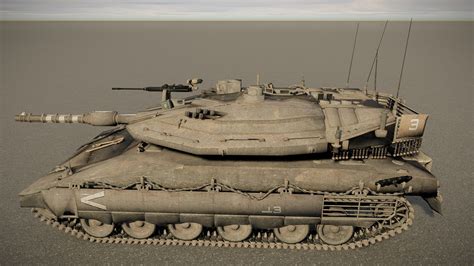
Sustaining the Engine That Sustains the Fleet
In armored warfare, mobility is not a luxury—it is survival. A tank that cannot maneuver is merely reinforced steel. For Israel’s ground forces, the power pack is the pacing item that determines how many tanks can deploy at short notice, how long they can remain forward, and how rapidly damaged vehicles can return to service.
A modern tank power pack is far more than an engine. It is a modular propulsion unit built around a high-output diesel engine integrated with cooling assemblies, filtration systems, electronic controls, wiring harnesses, and auxiliary components. The defining feature is modularity: the entire assembly can be removed and replaced as a single unit, compressing downtime from days to hours. In high-tempo operations, that time difference can reshape a campaign.
The Merkava Mk4 and related heavy platforms are widely associated with the MT883-class 1,500-horsepower V12 diesel engine, a turbocharged configuration engineered for sustained heavy loads and military adaptability. At this output level, propulsion underwrites acceleration, obstacle negotiation, and tactical repositioning in environments that range from dense urban zones to open desert maneuver corridors.
Full and Lite Kits: Two Rhythms of Readiness
The Army contract distinguishes between “full” and “lite” power-pack kits, a detail that signals a structured maintenance philosophy rather than ad hoc procurement.
Full kits typically align with depot-level resets and major overhauls, where propulsion modules undergo comprehensive refurbishment. Lite kits support field-level maintenance, enabling rapid replacement of high-wear components and ensuring configuration consistency across fleet sub-variants. This dual approach creates overlapping sustainment cycles: one strategic, one tactical.
The inclusion of metal containers may appear logistical, but it is operationally consequential. Containerized power packs can be prepositioned, protected against corrosion, and transported predictably across maritime or land corridors. In practice, this transforms high-value propulsion systems into surge-capable inventory that can flow toward brigade repair areas or rear-echelon hubs as operational tempo demands.
Graniteville, South Carolina, functions as the geographic anchor for this pipeline. By consolidating assembly, engineering oversight, and export preparation within a single U.S. industrial location, the program reinforces supply-chain transparency and lifecycle management discipline.
Synchronizing Tank and Armored Vehicle Sustainment
The February 17 award follows closely behind a separate Defense Security Cooperation Agency notification of a potential $740 million sale of power packs for Israel’s Namer armored personnel carriers. Both programs center on propulsion modules “less transmission,” with transmissions handled on parallel tracks.
This parallelism suggests a synchronized sustainment architecture across Israel’s heaviest armored platforms. The Merkava main battle tank and the Namer heavy APC share propulsion lineage, and their operational doctrine frequently intertwines in combined-arms formations. Aligning sustainment pipelines reduces logistical friction and preserves maneuver coherence.
In mechanized warfare, synchronization matters. If tanks outpace infantry carriers—or vice versa—the formation fractures. Propulsion commonality and aligned maintenance cycles help preserve tactical integrity.
The Merkava Design Philosophy: Protection First
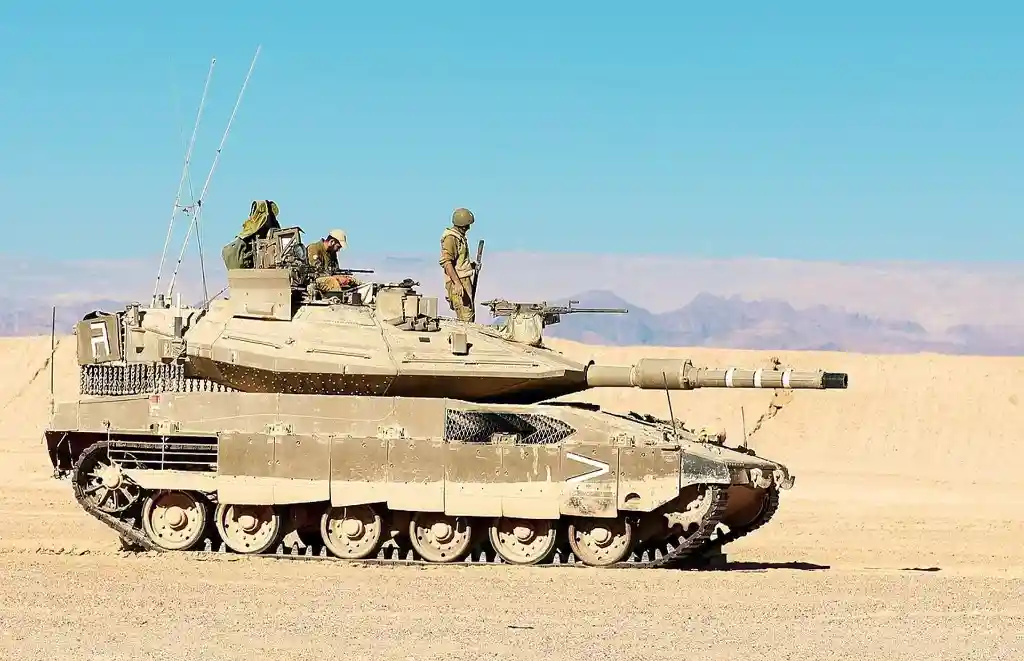
The propulsion deal matters because of the vehicle it sustains. The Merkava family, developed under the authority of the Israel Ministry of Defense, reflects uniquely Israeli battlefield assumptions.
Unlike many Western tanks, the Merkava employs a front-engine layout, positioning the power pack ahead of the crew compartment. This configuration adds mass between the crew and frontal threats while enabling a rear compartment and ramp. That rear access supports emergency evacuation, protected resupply, and limited troop carriage in specific missions.
In dense urban environments—where Israeli armored formations have frequently operated—this design enhances tactical flexibility. Tanks can coordinate closely with infantry, engineers, and unmanned systems while retaining the ability to extract wounded personnel under armor. Survivability is not abstract; it shapes morale and tempo in close terrain.
Firepower, Protection, and Active Defense
The Merkava Mk4 centers on a 120 mm smoothbore main gun, optimized for armored engagements and fortified targets. Secondary armaments support suppression of anti-tank teams at close range, and an internal mortar capability addresses high-angle fire requirements in urban canyons where indirect fire support may be constrained.
Protection is layered. Heavy passive armor integrates with active defense technologies such as the Trophy system, a radar-guided countermeasure suite designed to intercept incoming anti-armor threats before impact. The integration of such systems reflects a philosophy that modern battlefields are saturated with guided munitions, and survivability requires preemptive disruption rather than mere absorption.
The Mk4 Barak Modernization and the Logistics Equation
Israel’s most recent modernization of the platform, the Merkava Mk4 Barak, introduces AI-assisted mission management, advanced sensors, and helmet-mounted visualization systems that allow crews to perceive the external environment from within the armored hull. Official profiles describe endurance improvements enabling missions up to 30 percent longer than previous configurations.
Such endurance gains are meaningful only if propulsion reliability keeps pace. Extending mission duration increases thermal stress, mechanical wear, and maintenance complexity. A sustained supply of refreshed power packs ensures that digital modernization does not outstrip mechanical resilience.
In other words, artificial intelligence may refine decision-making, but diesel horsepower still decides whether a tank can move.
Industrial Interdependence and Strategic Calculus
The Merkava is often described as a national tank, yet its propulsion architecture illustrates measured interdependence. The diesel engine lineage is linked to industrial partners outside Israel, and the current contract explicitly excludes transmissions, indicating segmented sourcing arrangements.
This structure carries strategic implications. Utilizing U.S. Foreign Military Sales channels integrates financing, contracting oversight, and export compliance within a unified framework. It embeds the propulsion supply chain inside a stable bilateral defense relationship.
Benefits include access to a mature industrial base, quality assurance regimes, and predictable delivery mechanisms that can outlast short-term budget turbulence. Risks revolve around dependency—export controls, political shifts, or supply disruptions could ripple into readiness metrics. The containerized, modular nature of the power pack mitigates some vulnerability by enabling stockpiling and rotational management.
A Long-Horizon Investment in Armored Readiness
The 2032 completion horizon signals confidence in the Merkava’s continued frontline role. Armored warfare is evolving—drones proliferate, precision munitions saturate the battlespace, and sensor networks tighten engagement cycles. Yet heavy armor remains indispensable for breakthrough, urban penetration, and protected maneuver under fire.
The U.S. Army’s $73.5 million award is therefore less about engines in crates and more about strategic plumbing. It sustains the mechanical heartbeat of a fleet designed around survivability, adaptability, and high-tempo operations. Through synchronized sustainment with companion vehicles and deliberate industrial partnerships, Israel positions its armored corps to remain mobile and mission-ready in an increasingly volatile security environment.
In modern conflict, symbolism does not deter. Mobility does. The propulsion modules funded under this agreement ensure that when orders are issued, steel and horsepower will translate doctrine into movement—and movement into operational effect.