The United States Navy has committed to extending one of its most quietly essential surveillance systems, awarding Raytheon a contract valued at up to $212.12 million to sustain the AN/TPS-71 Relocatable Over-the-Horizon Radar (ROTHR) through 2031. At first glance, this is a maintenance contract. In reality, it is a strategic decision to preserve a rare capability: persistent, wide-area detection across vast oceanic approaches where traditional radar simply cannot see.
This agreement ensures that ROTHR continues to monitor the Caribbean, Gulf of Mexico, and southern approaches to the United States, a region that defense planners often describe as both operationally complex and persistently under-sensed. The contract begins with a $40.25 million base year, with options that extend performance into the next decade, reinforcing the system’s role as a cornerstone of U.S. homeland security and counter-trafficking operations.
What makes this story interesting is not just the funding, but the technology itself. ROTHR operates in a way that feels almost counterintuitive in the age of satellites and stealth jets. It relies on physics that sounds like science fiction: bouncing radio waves off the sky.
The Science Behind ROTHR: Bending Radio Waves Beyond the Horizon
Traditional radar systems are limited by the curvature of the Earth. Once a target dips below the horizon, it effectively vanishes. ROTHR sidesteps this limitation by using high-frequency (HF) skywave propagation, transmitting signals in the 5 to 28 MHz range that refract off the ionosphere and return to Earth hundreds or even thousands of miles away.
This allows ROTHR to detect objects at distances of roughly 500 to 1,600 nautical miles, covering an enormous surveillance arc. Instead of peering over the horizon, it essentially uses the atmosphere as a mirror, illuminating regions far beyond the reach of conventional systems.
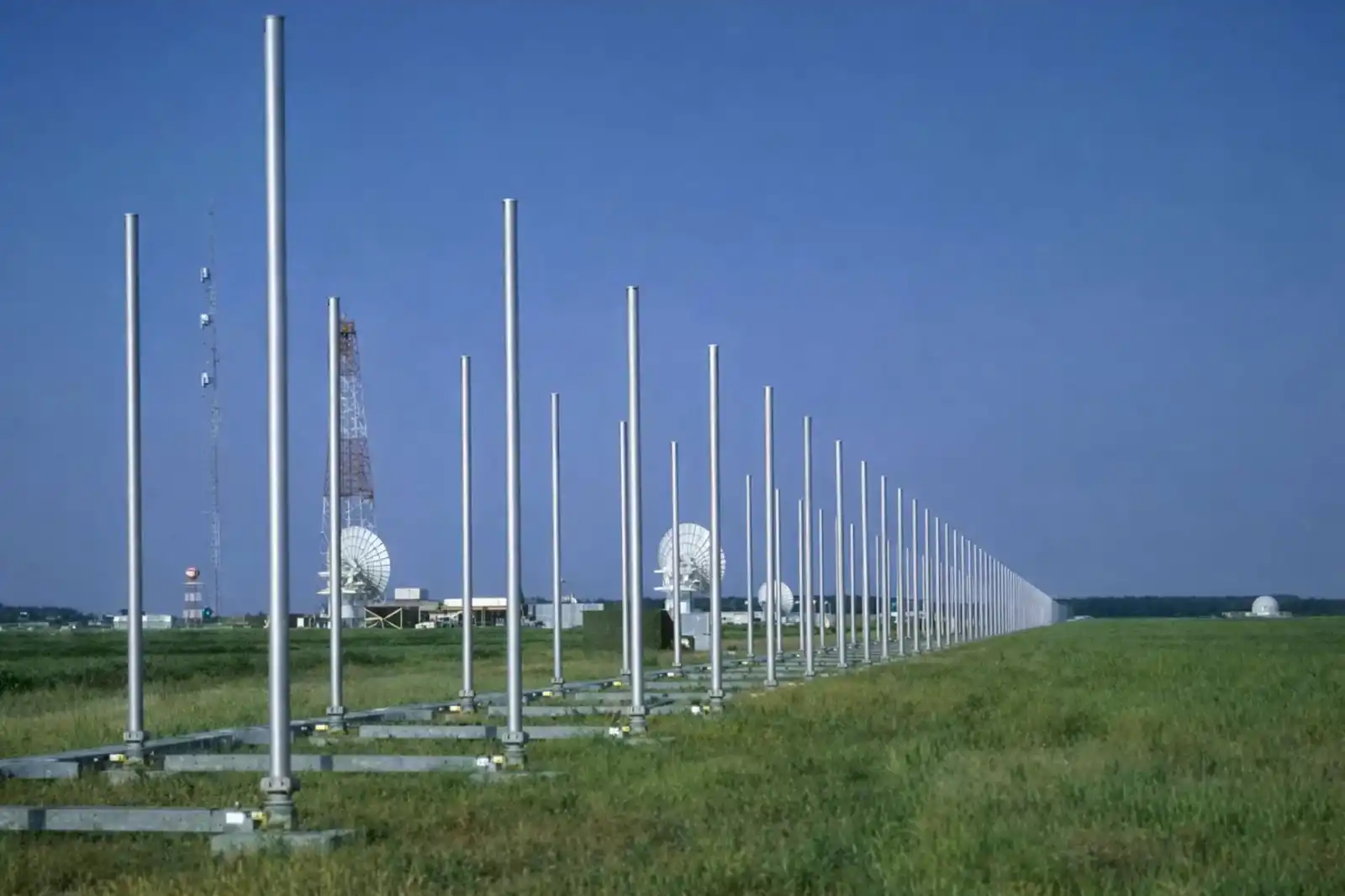
The system is not a single radar but a network. It includes an operations control center in Chesapeake, Virginia, and multiple radar sectors in Virginia, Texas, and Puerto Rico. Each sector uses a bistatic configuration, meaning transmitters and receivers are located separately, increasing resilience and coverage flexibility.
The scale is staggering. The Virginia sector alone monitors more than 2.2 million square miles. That is not surveillance—it is environmental awareness on a continental scale.
Engineering a Wide-Area Sensor: Precision Through Scale
ROTHR’s architecture reveals why it remains relevant decades after its conceptual origins. Each receiver site features a 2.58-kilometer linear phased array composed of hundreds of antenna elements. These arrays feed into digital beamforming systems that generate multiple simultaneous beams—18 in total—allowing the radar to scan wide مناطق efficiently.
The system uses Doppler processing, a method that distinguishes moving targets from background clutter by analyzing frequency shifts. This is crucial when scanning environments filled with noise from waves, weather, and terrain. Without Doppler filtering, the radar would drown in its own data.
Still, ROTHR is not designed for pinpoint accuracy. Its resolution—approximately 6 kilometers in range and 15 kilometers in azimuth—means it cannot provide exact target coordinates or altitude. That limitation is not a flaw; it is a design choice. ROTHR is a detection and cueing system, not a targeting radar.
It answers a fundamental question: Where should we look next?
Operational Value: Turning Vast Unknowns into Actionable Intelligence
In practice, ROTHR functions as a strategic tripwire. It identifies suspicious air and maritime activity early, allowing other assets—patrol aircraft, Coast Guard cutters, or allied forces—to intercept or investigate.
This is especially critical for Joint Interagency Task Force South (JIATF-S), which coordinates multinational efforts to combat illicit trafficking. The challenge in such missions is not always interception; it is detection. The ocean is vast, and targets are sparse.
ROTHR reduces that problem dramatically. Instead of searching blindly, operators can focus on high-probability مناطق, conserving fuel, time, and operational bandwidth.
There is a philosophical elegance here. Rather than trying to watch everything in detail, ROTHR watches everything just enough to know where detail is needed. It is the difference between scanning a forest for movement versus inspecting every leaf.
Strategic Importance Beyond Counter-Trafficking
Although often associated with counterdrug missions, ROTHR’s value extends into broader national defense strategy. The southern approaches to the United States represent a complex threat البيئة, including potential low-altitude aircraft, maritime intrusions, and emerging asymmetric threats.
Maintaining persistent airborne surveillance over such regions would require enormous resources—continuous sorties, maintenance cycles, and personnel. ROTHR offers a different equation: continuous coverage at a fraction of the cost.
The Naval Research Laboratory (NRL) has described HF over-the-horizon radar as one of the most cost-effective wide-area sensors available. Its lineage traces back to early Cold War experiments like the MADRE system, where scientists first explored ionospheric propagation as a tool for long-range detection.
That legacy now feeds into modern الدفاع architectures. Raytheon’s ongoing work suggests that experience gained from ROTHR could inform next-generation over-the-horizon radar systems, potentially focused on cruise missile detection and broader homeland defense.
Sustainment as Strategy: Keeping a Rare Capability Alive
The contract itself focuses on operations and maintenance, but the scope is far from routine. Sustaining ROTHR involves a complex ecosystem of technical and logistical tasks.
These include maintaining the operations control center, repairing and upgrading transmit and receive antenna arrays, and ensuring the reliability of supporting infrastructure such as power systems, cooling units, and fire suppression mechanisms. Even specialized components like cesium tubes and uninterruptible power supplies (UPS) require regular replacement.
This is not just maintenance—it is continuous regeneration of a highly specialized system.
Alongside this effort, a separate Navy contract awarded in 2023 supports software modernization, including system re-hosting, integration, and testing. Together, these initiatives indicate that the Navy is not merely preserving ROTHR but actively evolving it.
Industrial Reality: A Niche Capability with Few Competitors
One detail stands out in the Pentagon’s announcement: the contract competition attracted only one bidder. That is not a coincidence. Over-the-horizon radar sits at the intersection of HF engineering, large-scale infrastructure, and specialized operational expertise.
Few organizations possess the experience required to manage such systems. Raytheon, with more than 30 years of OTH radar involvement, represents a rare concentration of knowledge in this domain.
This creates an interesting dynamic. The system is strategically valuable, but the صنعتی base capable of supporting it is narrow. Maintaining ROTHR is therefore not just about hardware; it is about preserving institutional knowledge.
There is also a subtle environmental constraint. The effectiveness of HF radar depends on relatively low electromagnetic interference environments. Encroachment from infrastructure such as wind farms can degrade performance, adding another layer of complexity to long-term sustainment.
A Quiet Backbone of Maritime Domain Awareness
ROTHR does not capture headlines like stealth fighters or hypersonic missiles. It does not project power; it enables it. Yet its contribution is foundational. Without early detection, even the most advanced response systems operate blindly.
By extending this contract through 2031, the U.S. Navy is effectively reinforcing a persistent sensing layer across a strategically exposed region. It is a reminder that in modern defense, information precedes action.
The system’s limitations—lack of precise localization, dependence on ionospheric conditions—are real. But they are balanced by its strengths: scale, persistence, and cost efficiency.
In a world increasingly defined by distributed threats and विशाल operational spaces, those strengths matter more than ever.
There is a quiet lesson embedded here. Not every technological advantage comes from something new. Sometimes, it comes from understanding an old idea deeply enough to keep it relevant—and then refusing to let it fade.