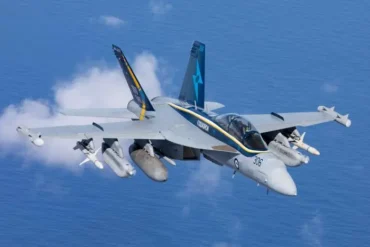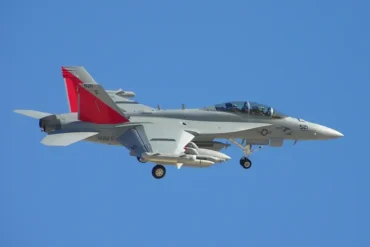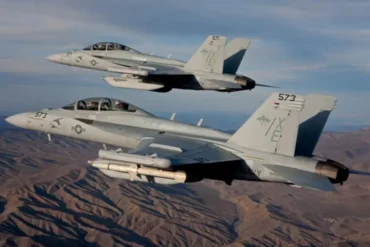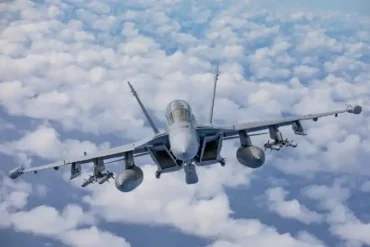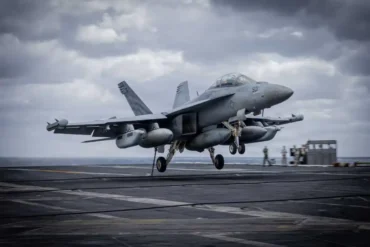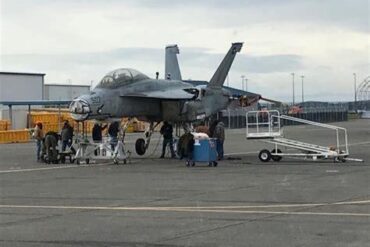
The U.S. Central Command (CENTCOM) has pulled back the curtain on one of its most closely guarded operational details, releasing imagery of an EA-18G Growler configured for a high-intensity suppression of enemy air defenses (SEAD) mission during Operation Epic Fury. At first glance, the image appears routine—another carrier-based launch from the USS Abraham Lincoln—but a closer inspection reveals a carefully balanced loadout that speaks volumes about how the United States is prosecuting modern electronic warfare against a sophisticated adversary.
Operation Epic Fury, launched on February 28, 2026, is not a limited strike campaign. It is a methodical effort targeting Iranian command networks, integrated air defense systems (IADS), missile launch infrastructure, and military airfields. Within this context, the Growler’s configuration is not incidental—it is a deliberate signal of how the U.S. is blending electronic attack, kinetic strike capability, and operational endurance into a single, highly adaptable platform.
What makes this particular disclosure so significant is its rarity. The U.S. military seldom provides such a clear look at real-world combat loadouts, especially for platforms operating at the intersection of electronic warfare and direct strike. This is not a training configuration or a theoretical setup; it is a combat-proven arrangement designed to survive and dominate in contested airspace.
A Hybrid Loadout Built for Modern Air Defense Suppression
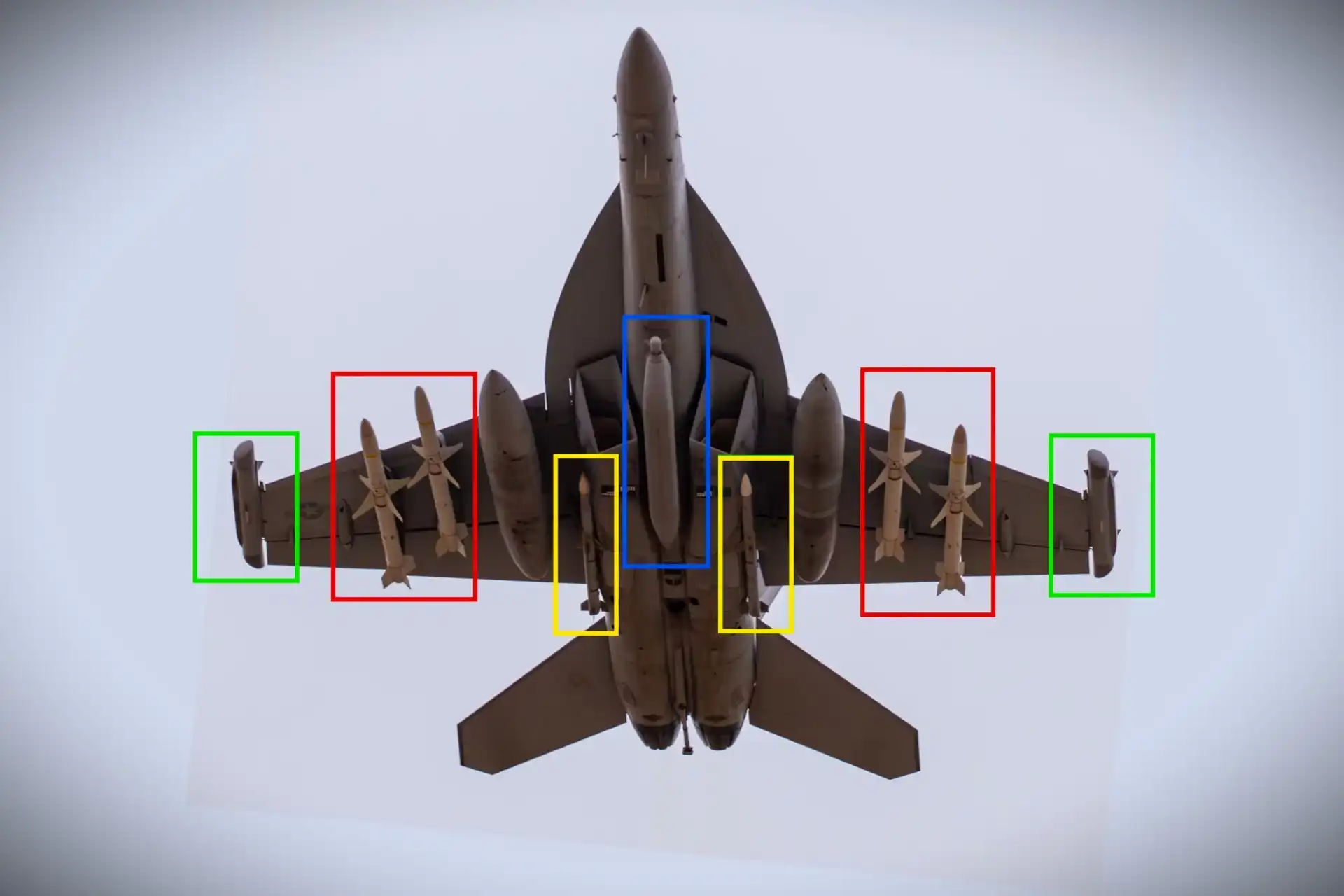
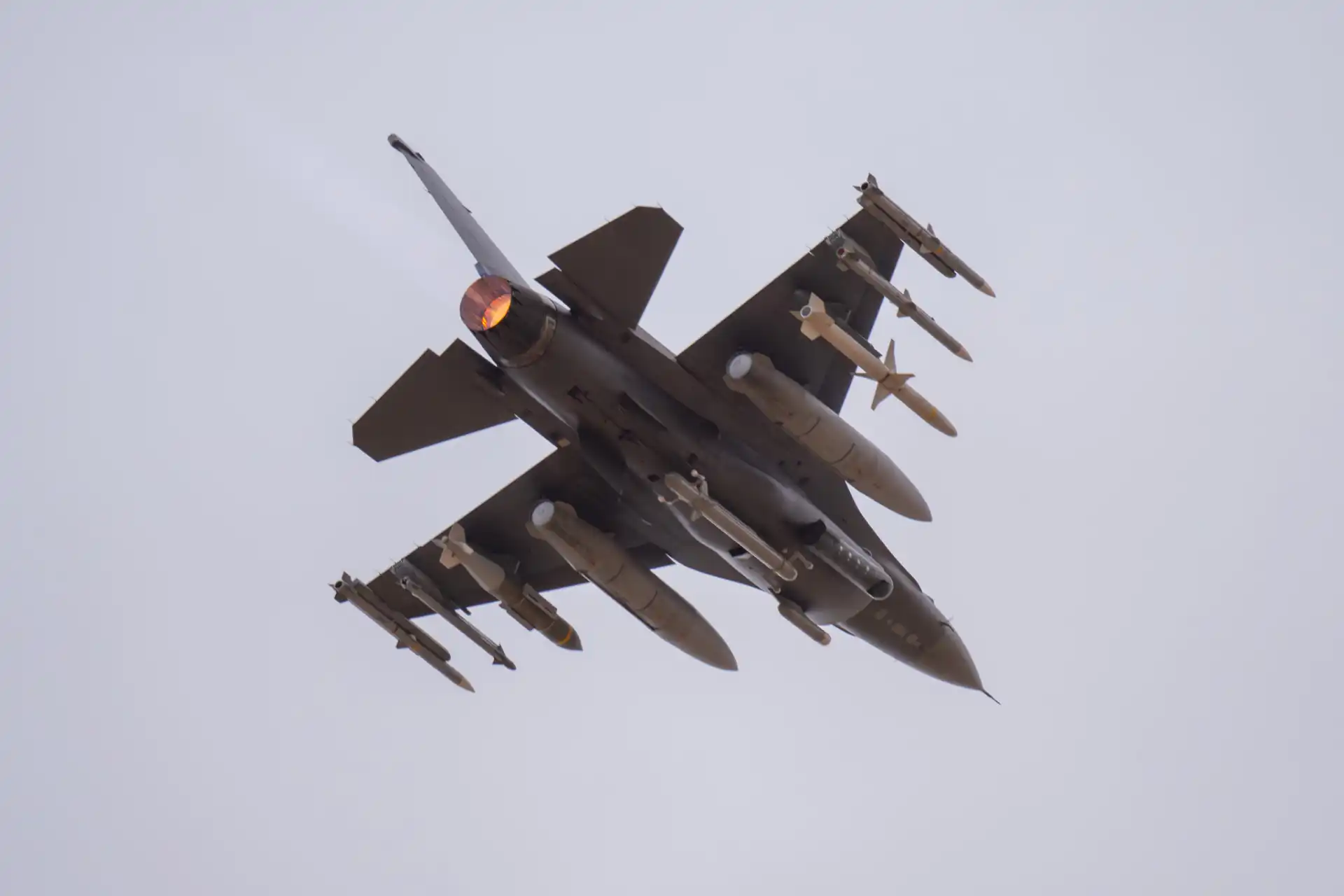
The EA-18G Growler shown in the released imagery carries a mixed and highly specialized payload that diverges from standard peacetime configurations. Instead of prioritizing pure stand-off jamming, this aircraft integrates multiple mission roles into a single sortie profile, effectively transforming it into a forward-operating electronic attack shooter.
The loadout includes:
- Four AGM-88-series anti-radiation missiles
- Two AIM-120 AMRAAM air-to-air missiles
- Two 480-gallon external fuel tanks
- One AN/ALQ-99 Tactical Jamming System pod
- One AN/ALQ-249 Next Generation Jammer (Mid-Band) pod
This combination is not accidental. It reflects a deliberate tradeoff between electronic attack power, missile capacity, and endurance, enabling the Growler to operate not just as a support aircraft, but as an active participant in the destruction of enemy defenses.
The presence of both legacy and next-generation jamming pods is particularly telling. It suggests a layered approach to electromagnetic spectrum dominance, where different frequency bands are targeted simultaneously to overwhelm and confuse enemy radar systems.
AGM-88 Missiles: The Core of SEAD and DEAD Operations
At the heart of this configuration are the AGM-88 family of anti-radiation missiles, widely regarded as the backbone of U.S. SEAD and destruction of enemy air defenses (DEAD) missions. Whether the load includes legacy HARM missiles or the more advanced AARGM (Advanced Anti-Radiation Guided Missile) variants, their role remains consistent: detect, track, and eliminate radar emitters.
A four-missile loadout is particularly noteworthy. It allows the Growler to engage multiple targets in a single sortie, including:
- Long-range search radars
- Precision fire-control radars
- Mobile or pop-up surface-to-air missile (SAM) systems
This level of onboard firepower reduces reliance on additional strike aircraft, effectively compressing the kill chain into a single platform. In a dense and layered air defense environment like Iran’s, this capability is not just useful—it is essential.
Modern AARGM variants further enhance this capability by incorporating GPS guidance and advanced seekers, enabling them to strike even if enemy radars shut down to avoid detection. This turns a traditional defensive tactic into a vulnerability, ensuring that once a radar is identified, it remains at risk.
Electronic Warfare Pods: Balancing Legacy and Next-Generation Jamming
The inclusion of both the AN/ALQ-99 Tactical Jamming System and the AN/ALQ-249 Next Generation Jammer (NGJ) Mid-Band pod highlights the evolution of U.S. electronic warfare doctrine. Rather than fully replacing legacy systems, the U.S. Navy is integrating them with newer technologies to create a more flexible and resilient jamming architecture.
The ALQ-99, though older, remains a proven system capable of disrupting radar and communications across multiple frequency ranges. Its continued use in combat scenarios demonstrates its reliability and adaptability.
In contrast, the NGJ Mid-Band represents the future. Built with active electronically scanned array (AESA) technology, it offers:
- Greater power output
- Improved beam steering precision
- Enhanced ability to target modern, frequency-agile radars
By combining these systems, the Growler can simultaneously degrade multiple layers of an adversary’s sensing capabilities, effectively blinding and isolating air defense nodes.
Self-Protection and Air Superiority: The Role of AIM-120 AMRAAM
Despite its primary role in electronic warfare, the Growler is not defenseless. The inclusion of two AIM-120 AMRAAM missiles ensures that the aircraft can engage aerial threats if necessary.
This is a critical consideration in a contested battlespace. Iranian forces, like many modern militaries, field a mix of fighter aircraft, drones, and interceptors capable of threatening high-value assets such as the Growler. By carrying AMRAAMs, the aircraft gains a measure of autonomy, reducing its dependence on dedicated fighter escorts.
More importantly, this capability allows the Growler to operate closer to the front lines, where its jamming and SEAD capabilities are most effective. It transforms the aircraft from a rear-echelon support platform into a forward-deployed enabler of air dominance.
Endurance as a Strategic Advantage
The addition of two 480-gallon external fuel tanks underscores a less glamorous but equally critical aspect of modern air warfare: persistence. In a campaign like Operation Epic Fury, where targets may emerge unpredictably and missions can evolve in real time, time on station becomes a decisive factor.
Extended endurance allows the Growler to:
- Escort strike packages over long distances
- Loiter in contested areas while waiting for radar activation
- Support multiple waves of attacks without immediate refueling
This flexibility is especially important in the geographically complex environment of the Persian Gulf and Strait of Hormuz, where operational distances, maritime threats, and air defense coverage create a constantly shifting tactical landscape.
Sensor Fusion and Passive Detection: The AN/ALQ-218 Advantage
Beyond its visible payload, the Growler’s true strength lies in its sensor suite, particularly the AN/ALQ-218(V)2 electronic support measures (ESM) system. Mounted on the wingtips, this system enables the aircraft to passively detect, identify, and geolocate enemy radar emissions without revealing its own position.
This capability is crucial for modern SEAD operations. Instead of relying solely on active sensors, the Growler can build a detailed picture of the electromagnetic environment, identifying threats before they become visible.
Once a radar is detected, the system feeds targeting data directly to the AGM-88 missiles, enabling rapid engagement. This seamless integration between detection, jamming, and strike is what allows the Growler to operate as a self-contained electronic warfare node.
Operational Implications for Operation Epic Fury
The configuration revealed by CENTCOM strongly suggests a mission profile centered on escort jamming, reactive DEAD, and corridor opening. In practical terms, the Growler would accompany or precede strike aircraft, using its systems to disrupt enemy defenses and create safe passage.
This approach is particularly effective against a layered IADS, where multiple radar systems and missile batteries work together to create overlapping coverage. By targeting key nodes within this network, the Growler can create localized gaps, allowing follow-on forces to exploit these openings.
The implications extend beyond immediate tactical gains. By consistently degrading air defense systems, the U.S. can achieve cumulative effects, gradually eroding the adversary’s ability to contest airspace.
Strategic Messaging and Regional Impact
The decision to publicly release this imagery is as strategic as the loadout itself. It sends a clear message: the United States retains the capability to dominate the electromagnetic spectrum while delivering precise kinetic strikes.
For allies, this serves as reassurance that U.S. forces can secure access to contested regions and maintain operational superiority. For adversaries, it is a warning that even advanced air defense systems are vulnerable to a multi-domain approach combining electronic warfare and precision munitions.
In a region as sensitive as the Middle East, where maritime chokepoints and missile threats play a central role in strategic calculations, this demonstration of capability carries significant weight.
The EA-18G Growler’s Evolving Role in Modern Warfare
Operation Epic Fury highlights a broader تحول in how the EA-18G Growler is employed. No longer confined to a supporting role, the aircraft has evolved into a front-line combat asset capable of shaping the battlespace in real time.
Its ability to jam, detect, and strike within a single sortie represents a shift toward more integrated and agile operational concepts. As adversaries continue to invest in advanced air defenses and electronic warfare capabilities, platforms like the Growler will play an increasingly central role in maintaining air superiority and operational freedom.
The loadout revealed by CENTCOM is more than a snapshot of a single mission—it is a glimpse into the future of warfare, where success depends on the ability to control the spectrum, compress decision cycles, and deliver precise effects across multiple domains simultaneously.