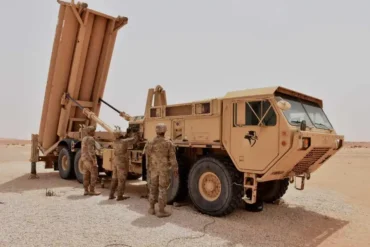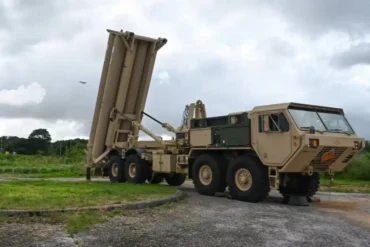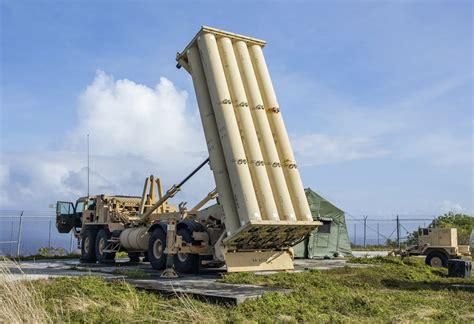
The United States has begun redeploying elements of its Terminal High Altitude Area Defense (THAAD) missile defense system from South Korea to the Middle East, a move that underscores how rapidly shifting security pressures are reshaping American military priorities. The transfer reflects a broader strategic reality: Washington must continuously redistribute a limited pool of high-end missile defense systems to address threats emerging simultaneously across multiple regions.
At its core, the decision highlights the growing concern within U.S. defense circles about Iran’s expanding missile and drone capabilities, which have increasingly threatened American forces and allied infrastructure throughout the Gulf region. While the Indo-Pacific remains central to long-term strategy, the Middle East periodically demands rapid reinforcements when tensions surge and missile threats multiply.
The redeployment does not signal a permanent withdrawal from the Korean Peninsula. Instead, it represents a temporary adjustment in the global positioning of U.S. missile defense assets, one that allows the Pentagon to strengthen defenses in the Middle East without abandoning its security commitments to South Korea.
Strategic Redeployment as Regional Threats Intensify
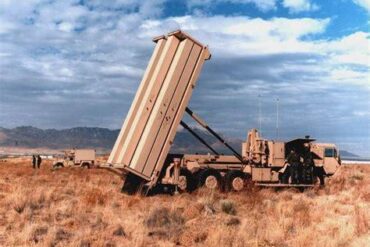
In early March 2026, U.S. defense officials began transferring components of a THAAD battery previously stationed in South Korea to locations in the Middle East. The system had been operating under United States Forces Korea as part of the layered missile defense network protecting the Korean Peninsula from potential ballistic missile attacks by North Korea.
Reports first surfaced through American officials speaking to major media outlets, later echoed by regional coverage in South Korea. According to defense sources, only certain elements of the THAAD architecture are being relocated rather than the complete battery, allowing some defensive capability to remain in place while assets are redirected toward emerging threats elsewhere.
The move arrives amid a period of heightened instability in the Middle East. Iran has continued advancing its ballistic missile arsenal, cruise missile capabilities, and long-range drone technology, tools that provide Tehran with asymmetric power across the region. U.S. bases, shipping routes, and allied infrastructure have increasingly become potential targets during moments of geopolitical friction.
From a strategic planning perspective, missile defense systems function like rare chess pieces. They are powerful, technologically complex, and limited in number. When threats spike in one region, commanders must sometimes shift those pieces across the global board.
South Korea Responds With Reassurance and Caution
South Korean officials reacted carefully to news of the redeployment, aiming to reassure the public that deterrence against North Korea remains intact despite the temporary repositioning of American equipment.
President Lee Jae Myung addressed the issue during a cabinet meeting, emphasizing that the U.S.–South Korea alliance remains fully committed to defending the peninsula. According to Seoul’s leadership, the redeployment does not alter the fundamental security framework that has underpinned regional stability for decades.
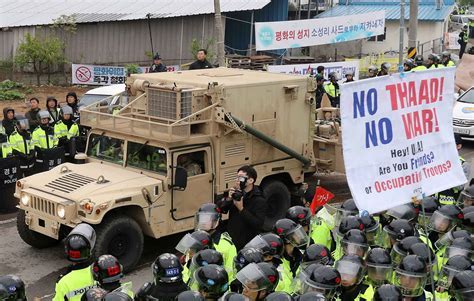
The THAAD system was originally deployed to Seongju County in 2017, a decision made after repeated North Korean missile tests demonstrated Pyongyang’s rapidly improving capabilities. That deployment triggered diplomatic friction with China and Russia, both of which argued the system’s radar could monitor activity far beyond the Korean Peninsula.
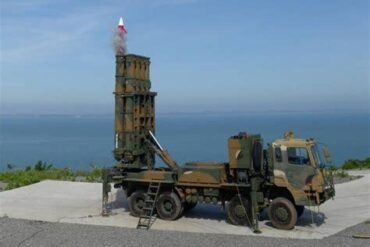
Today, the conversation in Seoul focuses less on geopolitics and more on operational resilience. South Korea’s defense spending has risen significantly in recent years, placing the country among the world’s largest military investors. Seoul has simultaneously expanded domestic missile defense programs and advanced strike capabilities designed to counter North Korean threats independently if required.
Some analysts in the region acknowledge that even a partial redeployment may raise questions about the balance between U.S. commitments in Asia and the Middle East, particularly as Washington confronts simultaneous crises across multiple theaters.
Understanding the Technology Behind THAAD
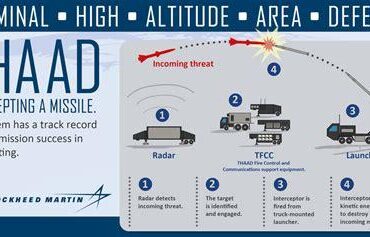
The Terminal High Altitude Area Defense system represents one of the most sophisticated missile interception platforms ever deployed by the United States. Designed specifically to counter short- and intermediate-range ballistic missiles, THAAD intercepts incoming threats during the terminal phase of their flight—when they descend toward their target.
Unlike traditional air defense systems that rely on explosive warheads, THAAD uses a “hit-to-kill” kinetic interceptor. In simple physical terms, the interceptor destroys its target through sheer impact energy rather than detonation. When two objects collide at several kilometers per second, the kinetic energy involved turns both into fragments almost instantly.
The interceptor itself measures roughly 6.17 meters in length and weighs about 900 kilograms at launch. Powered by a solid-fuel rocket motor produced by Pratt & Whitney Rocketdyne, it accelerates rapidly toward its predicted intercept point after launch.
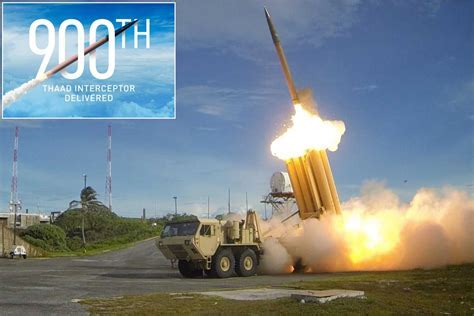
Once airborne, the missile uses onboard sensors and data links connected to the ground fire-control system to refine its trajectory. Terminal guidance relies on an imaging infrared seeker, capable of identifying the heat signature of an incoming warhead against the cold background of space.
This precision allows THAAD to intercept targets at altitudes approaching 150 kilometers and at distances of roughly 150 to 200 kilometers, giving it the ability to destroy missiles both within the upper atmosphere and just beyond it.
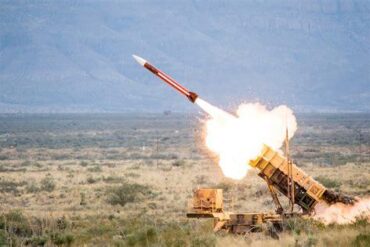
In layered missile defense terminology, THAAD functions as the upper-tier shield, complementing systems such as the Patriot PAC-3 that intercept threats closer to the ground.
The Radar That Sees Almost a Thousand Kilometers
Every missile defense system depends on accurate sensing, and in the case of THAAD the centerpiece is the AN/TPY-2 X-band radar developed by Raytheon.
The radar’s phased-array antenna contains more than 25,000 transmit-receive modules, allowing it to electronically steer its beam without physically rotating the structure. This enables rapid scanning of the sky while maintaining extremely high tracking precision.

Operating in the X-band frequency range, the radar can detect and track ballistic missiles at distances approaching 1,000 kilometers. Its high resolution allows operators to distinguish real warheads from debris or decoys, a capability known as target discrimination.
Once a missile launch is detected, tracking data is fed into the THAAD Fire Control and Communications system (TFCC). This command network calculates intercept trajectories and coordinates with other missile defense assets through the Command and Control Battle Management and Communications (C2BMC) architecture.
In practical terms, that network allows a radar in one location to guide interceptors somewhere else entirely. A ballistic missile launched hundreds of kilometers away might first be detected by an early-warning radar, tracked by another sensor, and ultimately destroyed by a THAAD interceptor positioned near the intended target.
Missile defense, in other words, operates less like a single weapon and more like a distributed nervous system spread across land, sea, and space.
Why the Middle East Now Requires Reinforcement
Iran’s missile program has become one of the most extensive in the world. Over the past two decades, Tehran has developed dozens of ballistic missile variants, ranging from short-range battlefield systems to medium-range weapons capable of striking across the Middle East.
Equally concerning for defense planners is the rapid expansion of drone warfare capabilities. Iran and affiliated groups have increasingly deployed long-range loitering munitions and cruise-missile-like drones capable of saturating air defenses.
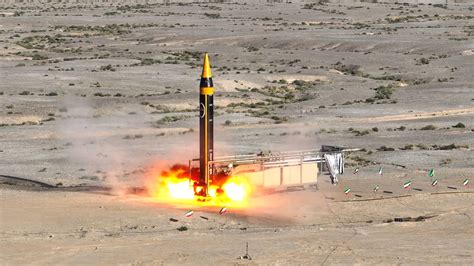
In such environments, missile defense planners must consider not just single launches but complex attack scenarios involving multiple simultaneous threats. Systems like THAAD provide an important upper layer of protection capable of intercepting ballistic missiles before they descend toward critical infrastructure.
Historically, the United States has reinforced Gulf defenses during periods of heightened tension with Iran. Similar deployments have occurred during past crises when intelligence indicated potential missile strikes against American or allied facilities.
The present redeployment follows that pattern, reflecting the flexible but finite nature of U.S. missile defense resources.
Strategic Balancing Across Two Critical Theaters
The redeployment of THAAD components illustrates a persistent challenge for U.S. defense planners: balancing security commitments across regions where ballistic missile proliferation continues to accelerate.
The Indo-Pacific faces threats from North Korea’s expanding missile arsenal, while the Middle East contends with Iran’s growing network of rockets, drones, and precision-guided weapons. Both regions demand high-end defensive systems, yet the global inventory of THAAD batteries remains relatively small.
That scarcity forces strategic trade-offs. Moving even part of a system from one region to another inevitably sparks debate about deterrence credibility and alliance reassurance.
For Washington, however, mobility itself is a strategic tool. The ability to reposition advanced defense systems rapidly allows the United States to respond to emerging crises without permanently committing resources to a single theater.
Viewed through that lens, the THAAD redeployment reflects a broader reality of modern geopolitics: security challenges are no longer confined to one region at a time. Instead, they ripple across continents, forcing military planners to constantly shift defenses in response to a world where missile technology is spreading faster than ever before.