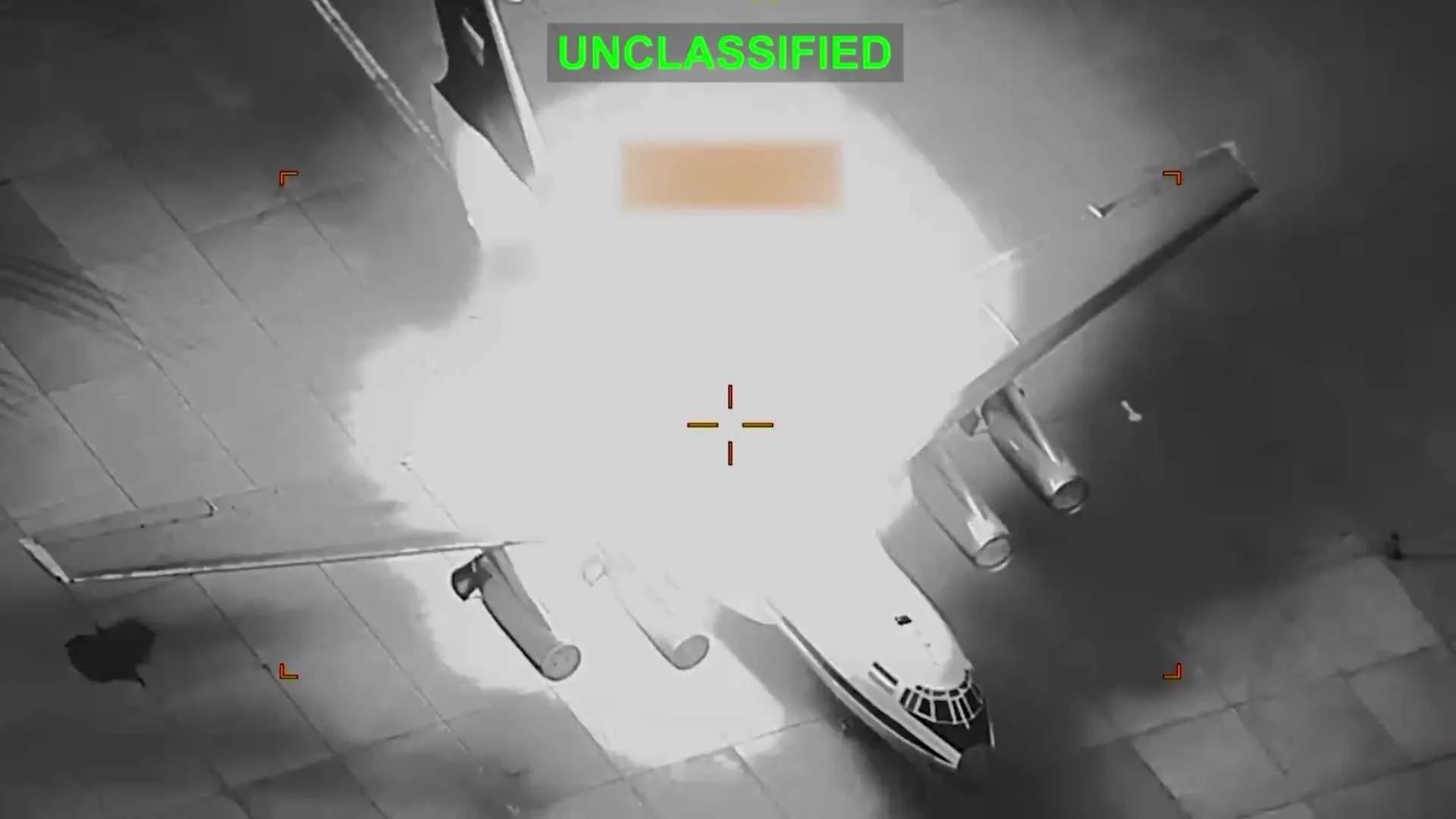
The destruction of a Russian-designed Ilyushin Il-76 heavy transport aircraft at Iran’s Ayatollah Hashemi Rafsanjani Airport in Kerman has drawn international attention after the U.S. Central Command (CENTCOM) released imagery showing the aftermath of the strike. The incident highlights both the strategic role of heavy airlift aircraft in Iran’s military logistics network and the increasing precision of U.S. operations targeting logistical infrastructure rather than frontline combat forces.
Footage released on March 12, 2026 shows several aircraft positioned on the apron at the southeastern Iranian airfield when the strike occurred. Among the visible platforms were a Lockheed C-130 Hercules, an Iranian P-3F Orion maritime patrol aircraft, and the targeted Il-76 strategic airlifter. The attack appears to have focused on aircraft used to support long-range logistics and military transport operations across Iran’s territory and potentially beyond.
Early discussion surrounding the imagery briefly raised speculation about the aircraft’s nationality. Low-resolution frames seemed to display markings resembling the Russian tricolor on the Il-76’s vertical stabilizer. Closer analysis of the paint scheme and cockpit markings confirmed the aircraft carried Iranian national insignia, identifying it as part of Iran’s own transport fleet rather than a Russian asset.
The strike therefore represents the loss of an Iranian-operated heavy strategic transport aircraft, one of the most capable cargo platforms available within the country’s military aviation inventory. Aircraft of this type serve as the backbone of Iran’s long-distance logistics capability, capable of moving large cargo loads that smaller aircraft cannot carry.
The Iranian regime is losing air capability day by day. U.S. forces aren’t just defending against Iranian threats, we are methodically dismantling them. pic.twitter.com/CrJj2nFtHB
— U.S. Central Command (@CENTCOM) March 12, 2026
Strategic Importance of the Il-76 in Iran’s Military Logistics Network
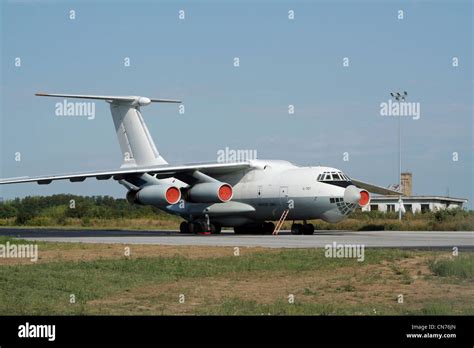
The Ilyushin Il-76 is among the most widely used heavy military transport aircraft ever built. Designed by the Soviet Ilyushin Design Bureau, the aircraft was developed to move massive cargo loads across the vast and often undeveloped regions of the Soviet Union. It first flew on March 25, 1971, and entered operational service with Soviet forces in June 1974.
More than 900 aircraft were produced across numerous variants, primarily at the Tashkent Aviation Production Association in what is now Uzbekistan. The aircraft’s rugged engineering reflects the logistical demands of operating across Siberia, Central Asia, and other remote regions with minimal infrastructure.
The Il-76’s distinctive configuration includes:
- A high-mounted swept wing designed to keep engines away from debris on rough runways
- A T-tail that improves aerodynamic stability and cargo loading clearance
- Four Soloviev D-30KP turbofan engines, each generating roughly 12,000 kgf of thrust
- A rear cargo ramp enabling direct loading of vehicles and oversized equipment
This design allows the aircraft to operate from semi-prepared airfields, making it particularly valuable in regions where modern runways are scarce.
Heavy Airlift Capabilities That Shape Battlefield Logistics
In its common Il-76MD military transport configuration, the aircraft can carry between 40 and 47 tonnes of cargo, depending on fuel load and mission profile. With a maximum takeoff weight approaching 170 tonnes, the Il-76 ranks among the most capable airlift platforms still widely used outside NATO fleets.
The cargo compartment itself is engineered to accommodate equipment that would be impossible to move using smaller aircraft such as the C-130 Hercules. Measuring roughly 24.5 meters long, 3.45 meters wide, and 3.4 meters high, the hold is reinforced with structural tie-down points designed to secure armored vehicles, artillery systems, or engineering machinery.
Integrated loading systems improve efficiency during deployment operations. Internal roller conveyor tracks enable palletized cargo to slide rapidly into position, while overhead hoists allow crews to reposition multi-ton components during loading. These features transform the aircraft into a flying logistics platform capable of moving complex military systems in a single flight.
Cruising speeds generally range between 750 and 800 kilometers per hour, while operational range can approach 5,000 kilometers when carrying heavy cargo. This capability allows the aircraft to link distant airbases or supply forward operating positions without requiring multiple refueling stops.
Why Iran Relies on Soviet-Era Heavy Transport Aircraft
Iran’s reliance on the Il-76 stems largely from international sanctions that restrict access to modern Western airlift aircraft such as the Boeing C-17 Globemaster III or the Airbus A400M Atlas. As a result, the country has maintained a fleet of Soviet- and Russian-origin aircraft capable of transporting large military cargo across long distances.
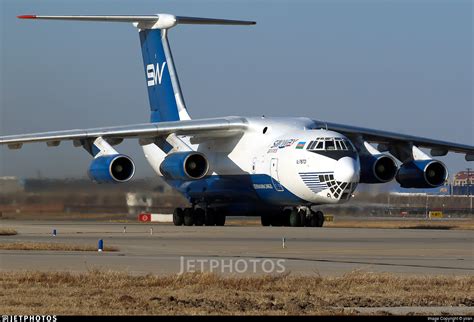
Within Iran’s defense logistics structure, these aircraft perform several critical functions. They transport armored vehicles, missile components, engineering machinery, and bulk military supplies between bases across the country’s mountainous and desert terrain. Their ability to land on relatively short or rough airstrips also allows them to support remote facilities and forward installations.
Many Iranian Il-76 aircraft operate in the Il-76TD cargo configuration, which incorporates extended fuel capacity optimized for long-distance transport missions. These aircraft can carry payloads approaching 48,000 kilograms, with internal cargo volumes of nearly 180 cubic meters.
The landing gear system itself reflects the aircraft’s rugged design philosophy. Multiple wheel bogies distribute weight across uneven surfaces, enabling operations from airfields that would challenge many Western transport aircraft.
Combined with leading-edge slats and double-slotted flaps, the Il-76 can operate from shorter runways while maintaining stable low-speed handling characteristics during takeoff and landing.
The Rare Il-76 Variant Once Used as Iran’s Airborne Radar Platform
One of the most unusual adaptations of the Il-76 airframe in Iranian service emerged from an aircraft originally modified by Iraq during the 1980s Iran-Iraq War. Iraq developed an airborne early warning platform known as Adnan-2, which mounted a radar system within a large dorsal rotodome installed on top of the fuselage.
The radar used in this configuration was the French TRS-2105 Tiger-G, a long-range airborne surveillance system capable of detecting aircraft hundreds of kilometers away.
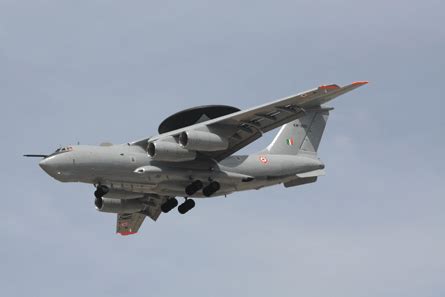
During the 1991 Gulf War, several Iraqi aircraft fled to Iran to avoid destruction by coalition forces. Among them was an Il-76 configured for airborne radar operations. Iranian engineers later modified the aircraft extensively, integrating a domestically developed radar system inside the rotodome structure.
The resulting platform entered service in April 2008 under the name Simorgh, becoming Iran’s first indigenous airborne early warning aircraft. Estimates suggested its radar could detect aerial targets at distances approaching 1,000 kilometers, providing a valuable surveillance capability across the Persian Gulf region.
However, the program proved short-lived. On September 22, 2009, the Simorgh aircraft was destroyed in a mid-air collision with an Iranian fighter jet during a military exercise. The accident eliminated Iran’s only Il-76-based airborne radar platform and forced the country to return its remaining aircraft to purely transport roles.
Aging Aircraft and Maintenance Challenges
Keeping Iran’s Il-76 fleet operational has become increasingly complex. Many airframes currently in service were produced during the 1980s, meaning they have accumulated decades of structural fatigue and require intensive maintenance cycles.
Sanctions further complicate the process by limiting access to manufacturer support, spare parts, and specialized maintenance equipment. As a result, Iran has built a hybrid sustainment system that combines domestic engineering expertise with international procurement channels.
Maintenance operations are conducted primarily at Tehran’s Mehrabad Airport, where civilian cargo airlines linked to the military logistics network operate Il-76TD aircraft. Engineers focus heavily on structural inspections of critical components such as the wing box, a central structural element that bears much of the aircraft’s aerodynamic stress.
The aircraft’s four turbofan engines also require regular overhaul procedures to maintain performance and safety. Iranian technicians have gradually developed the ability to perform many of these procedures domestically, reducing dependence on foreign suppliers.
Despite the challenges, the Il-76 remains Iran’s most capable heavy airlift platform, able to transport equipment that no other aircraft in the country’s fleet can move efficiently.
Strategic Implications of the Kerman Airport Strike
The destruction of an Il-76 at Kerman Airport represents more than the loss of a single aircraft. Heavy airlifters serve as logistical arteries that allow military forces to move equipment rapidly across long distances. Removing even one aircraft from a relatively small fleet can significantly reduce transport capacity.
The strike also reflects a broader operational approach in which logistics infrastructure becomes a primary target. By focusing on transport aircraft and supply networks rather than purely combat units, military planners can disrupt an adversary’s ability to sustain operations over time.
In modern warfare, logistics frequently determines strategic endurance. Tanks, drones, and missiles may dominate headlines, but none of them move without supply chains. Heavy transport aircraft like the Il-76 sit quietly behind the scenes of those systems, hauling the machines, spare parts, and personnel that keep military forces functioning.
When one of those aircraft disappears in a plume of smoke on a distant runway, the shockwave travels far beyond the tarmac. It ripples through supply networks, operational planning, and the fragile mathematics of military logistics—reminding observers that in war, the quiet cargo plane can be as strategically valuable as the fighter jet.