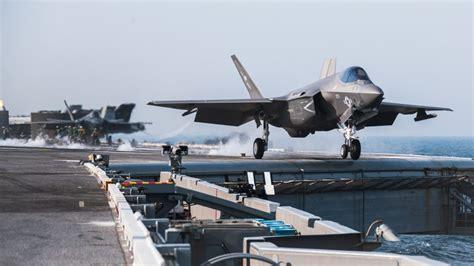
The U.S. Navy has entered a new era of stealth warfare dominance, pushing the boundaries of aerial survivability and lethality by integrating Leonardo’s BriteCloud expendable active decoys (EAD) into its carrier-based F-35C Lightning II fleet. As adversaries like China and Russia deploy increasingly sophisticated air defense networks, the Navy’s move marks a strategic leap, preparing its fifth-generation aircraft for deep penetration strike missions in the world’s most contested airspaces.

BriteCloud EAD: The Next Evolution in Countermeasure Technology
The BriteCloud 218, developed by Leonardo UK, is not a mere enhancement to legacy countermeasures like flares and chaff—it is a transformative force in electronic warfare (EW). Designed for seamless integration with U.S. standard AN/ALE-47 countermeasure dispensers, the BriteCloud decoy uses Digital Radio Frequency Memory (DRFM) technology to deceive advanced radar-guided threats. Its compact 2×1×8-inch design, tailored for the F-35 and F/A-18 fleets, delivers unmatched operational compatibility without major system overhauls.
BriteCloud functions as a self-contained, off-board RF jammer, autonomously identifying, mimicking, and misleading radar-guided missile systems. Once released, it broadcasts a false radar signature that appears more realistic than the aircraft itself, effectively drawing enemy fire away from the actual platform.
Combat-Proven Platform Meets Revolutionary Protection
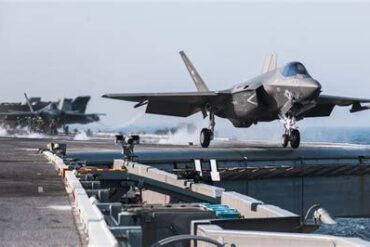
The F-35C, the U.S. Navy’s carrier-optimized variant of the Joint Strike Fighter, has already demonstrated its combat prowess, notably during operations in Yemen in 2024. Despite its inherent stealth capabilities, the jet’s survivability in peer-conflict scenarios remains challenged by radar systems such as Russia’s S-400 or China’s JY-27A VHF radars, which leverage multi-band detection to spot even low-observable platforms.

In such environments, stealth alone may not suffice. This is where the BriteCloud’s full value is realized. Unlike traditional expendables like the GEN-X RT-1489/ALE, which perform best in endgame missile defeat scenarios, BriteCloud disrupts targeting long before the terminal phase, expanding the aircraft’s protective bubble by misleading radar locks and home-on-jam (HOJ) seekers—those specifically designed to hone in on jamming signals.
Exclusive Defense Deal Marks Urgency and Strategic Priority
The Department of Defense (DoD) awarded a sole-source, non-competitive contract to Leonardo UK for an undisclosed number of BriteCloud decoys. This decision, made public on December 23, 2025, underlines both the uniqueness of BriteCloud and the urgency of fielding advanced countermeasures in potential flashpoints like the South China Sea and Baltic regions.
Initial procurement includes:
- BriteCloud 218 expendable active decoys
- Spare impulse cartridges
- Support equipment for deployment readiness
The contract is structured around a base year and optional extensions, enabling flexibility for rapid scale-up. Earlier pre-solicitation notices from mid-2025 suggested targets of 3,000–6,000 units annually, hinting at widespread integration across the F-35 and F/A-18 Super Hornet fleets.
How BriteCloud Defeats Modern Integrated Air Defense Systems (IADS)
Modern integrated air defense systems combine radars, surface-to-air missiles (SAMs), and command-and-control links to form overlapping kill zones. Defeating such systems requires more than stealth or onboard jammers—it requires electronic deception at a tactical distance.
BriteCloud leverages DRFM to receive hostile radar pulses, process them against a preloaded threat library, and rebroadcast manipulated signals. This creates false Doppler shifts and range gates, tricking enemy systems into “seeing” the decoy as the real aircraft. Even advanced ECCM (electronic counter-countermeasures)—built to resist traditional jamming—are bypassed.
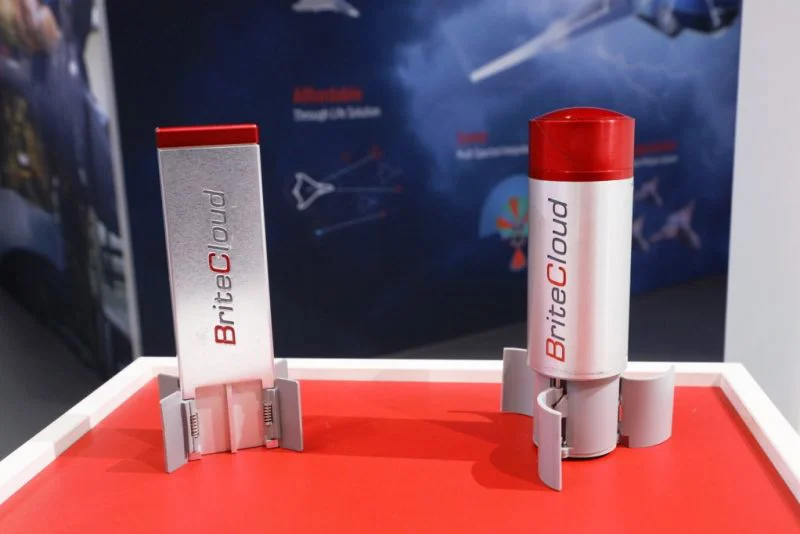
Because BriteCloud is expendable, it allows safe separation between the aircraft and the decoy. In effect, it creates a digital phantom—a moving target indistinguishable from a real jet until it is too late.
Beyond Stealth: Reinventing the F-35’s EW Architecture
The F-35 already features the AN/ASQ-239 Barracuda EW suite and ALE-70 towed decoys, but BriteCloud adds a third layer—a highly autonomous, off-board smart decoy. It does not consume onboard jamming power, nor does it require pilot intervention during threat engagement. This makes it ideal for multi-axis threats and complex strike packages where cognitive overload is a serious concern.
Together, these systems give the F-35C unprecedented multi-layer survivability:
- Stealth shaping reduces detection likelihood
- Onboard jammers confuse tracking radars
- Towed decoys intercept late-stage missiles
- BriteCloud misleads from the outset, triggering premature missile detonation far from the aircraft
In contested battlespaces, particularly against A2/AD (Anti-Access/Area Denial) networks like those deployed in Kaliningrad or the Taiwan Strait, such redundancy may prove mission-critical.
Tactical Impact: Expanding the Strike Envelope
By equipping its carrier strike group aircraft with BriteCloud, the Navy unlocks the ability to project power deeper into enemy territory with reduced attrition risk. Stealth aircraft can now operate with enhanced freedom, confident that their electronic signatures are masked, manipulated, or cloned at will.
This capability supports:
- Long-range maritime interdiction
- Suppression of Enemy Air Defenses (SEAD)
- High-risk intelligence gathering
- Precision strike missions in layered defense zones
With adversaries relying on networked SAM batteries, airborne early warning aircraft, and over-the-horizon radars, traditional suppression tactics may fall short. BriteCloud restores the element of uncertainty, forcing enemy systems to waste resources on ghost targets.
Global Strategic Implications and Future Prospects
The Navy’s integration of BriteCloud also sends a clear signal to rivals and allies: U.S. fifth-gen platforms remain ahead of the curve, not just in stealth but in survivability and combat persistence. As countries like China expand their radar sensor webs and Russia exports S-400 systems globally, the demand for counter-sensor capabilities is at an all-time high.
The BriteCloud’s success on U.S. platforms could soon lead to:
- Expanded use across NATO allies operating F-35s (e.g., UK, Norway, Italy)
- Integration with other U.S. assets like the EA-18G Growler for electronic escort missions
- Potential adaptation into UAVs and Loyal Wingman platforms for distributed EW roles

As multi-domain operations evolve, EW tools like BriteCloud are critical for synchronized air-sea-land campaigns, ensuring U.S. forces retain first-mover advantage in near-peer scenarios.
Conclusion: Turning Stealth Fighters Into Stealth Survivors
While stealth was once seen as the apex of survivability, today’s battlefield demands more. With BriteCloud added to its arsenal, the F-35C transforms from a radar-evading strike jet into a fully survivable deep-strike platform, capable of outpacing the radar-guided threats of tomorrow.
By combining signature reduction, onboard jamming, and now expendable electronic deception, the U.S. Navy isn’t just preparing for the next war—it is reshaping the rules of aerial engagement. In this realm of strategic competition and technological brinkmanship, survival is the ultimate stealth.