During Talisman Sabre 2025, elite UK Special Forces have undertaken high-intensity ship boarding and counterterrorism drills in Australia, showcasing a new level of integrated maritime readiness alongside regional and global allies. The exercise, running from July 13 to August 4, 2025, involved coordinated operations with Australian Commandos, U.S. Naval Special Warfare teams, and Japanese and Singaporean Special Forces, reinforcing collective capabilities in countering maritime threats in the increasingly contested Indo-Pacific region.
UK 42 Commando at the Heart of the Operation
At the forefront of the UK’s participation were the Royal Marines of 42 Commando, an elite maritime strike unit based in Bickleigh. As part of the UK’s Future Commando Force strategy, 42 Commando specializes in littoral strike operations, ship interdiction missions, port seizure, and critical infrastructure protection. These highly trained operators can be rapidly deployed aboard Royal Navy vessels or integrate seamlessly with allied forces, often acting as the spearhead of maritime counterterrorism operations.
In Sydney, 42 Commando carried out fast-roping insertions from helicopters, precision close-quarters ship-clearing drills, and multi-national boarding operations on vessels in highly visible areas, including near the iconic Sydney Opera House. These drills simulated real-world threats such as the hijacking of civilian ferries and terrorist exploitation of commercial vessels, pushing the operators to respond under complex urban-maritime conditions.
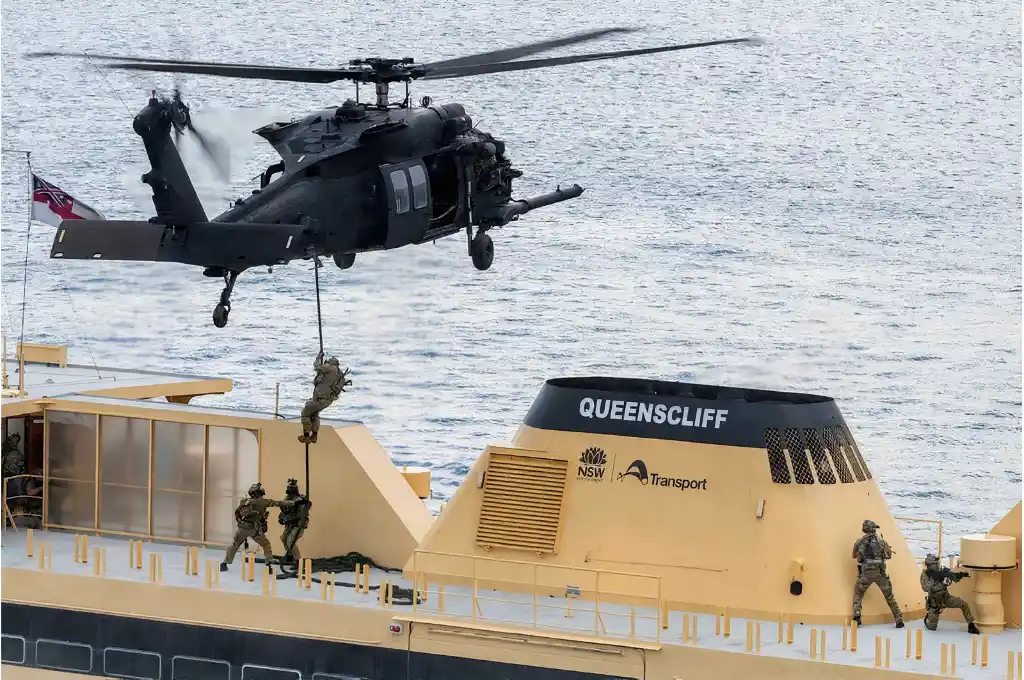
A Dramatic Multinational Ship Recapture
The exercise climaxed with a joint-force recapture of a New South Wales green and yellow ferry, an operation designed to symbolize the defense of critical public assets. UK Royal Marines were supported by U.S. MH-60 Black Hawks and CH-47 Chinooks for airborne insertions, while Australian inflatable raiding craft and U.S. Naval Special Warfare boats provided maritime support. The coordinated assault showcased the seamless integration of air and sea assets, as operators performed synchronized insertions onto a moving target, demonstrating precision in close-quarters battle and vessel-clearing operations under high-pressure conditions.
Responding to Maritime Terrorism in the Indo-Pacific
This training comes against a backdrop of rising maritime terrorism risks in the Indo-Pacific. The region’s vast, complex maritime corridors present opportunities for extremist groups, who have increasingly sought to exploit coastal access and shipping vulnerabilities. Recent Houthi rebel attacks on shipping in the Red Sea and interdictions by forces under Operation Prosperity Guardian have underscored the global nature of maritime security threats.
In the South Pacific and Southeast Asia, transnational groups continue to exploit small boats, remote ports, and commercial vessels for illicit activities, heightening the urgency for enhanced counter-maritime terrorism capabilities. These developments make multinational exercises like Talisman Sabre critical for strengthening the alliance’s readiness to rapidly respond to evolving threats.
A Strategic Shift in Talisman Sabre 2025
With over 30,000 personnel from 15 nations, Talisman Sabre 2025 is the largest iteration of the exercise to date. The prominent role of special operations forces reflects a deliberate strategic shift toward maritime counterterrorism and anti-piracy readiness. By simulating operations in realistic urban maritime environments, the exercise delivered a powerful demonstration of multinational unity and rapid-response capabilities.
The UK’s involvement underlines its commitment to Indo-Pacific security, aligning with the country’s broader strategy of maintaining a forward-deployed presence in the region. By training alongside partners from Australia, the U.S., Japan, and Singapore, British forces have reinforced coalition interoperability, ensuring that allied special operations units can respond decisively to crises across the maritime domain.
Building Multinational Maritime Interdiction Capacity
The exercise’s integrated maritime interdiction operations provide a proving ground for joint forces to refine their tactics, techniques, and procedures. Helicopter insertions, ship-boarding drills, coordinated small-boat maneuvers, and urban port defense all combined to test the adaptability of special operations teams under dynamic, high-risk conditions.
Such exercises also support a broader allied strategy aimed at reinforcing maritime domain awareness and ensuring freedom of navigation across contested waters. U.S.-led operations like Blue Pacific and Kurukuru already play a key role in enforcing maritime law across the South Pacific, but Talisman Sabre adds a critical special operations component to these efforts, making the alliance more capable of countering non-state maritime threats.
A Message of Strength and Preparedness
Talisman Sabre 2025 sends a clear signal: the Indo-Pacific’s key allies are prepared to counter sea-based threats with speed, precision, and multinational coordination. For the UK’s 42 Commando, the exercise also served as a demonstration of high-readiness force projection, showing that the Royal Marines can deploy thousands of miles from home to operate effectively within a complex coalition framework.
The inclusion of these high-visibility maritime counterterrorism drills in such a large-scale exercise reflects a growing recognition among allied nations that maritime security threats require elite, interoperable forces capable of working across domains — air, sea, and land — to neutralize emerging dangers.
As the Indo-Pacific continues to grow in strategic importance, exercises like Talisman Sabre are no longer just rehearsals; they are essential demonstrations of deterrence and operational capability in a region where security challenges are both immediate and evolving.