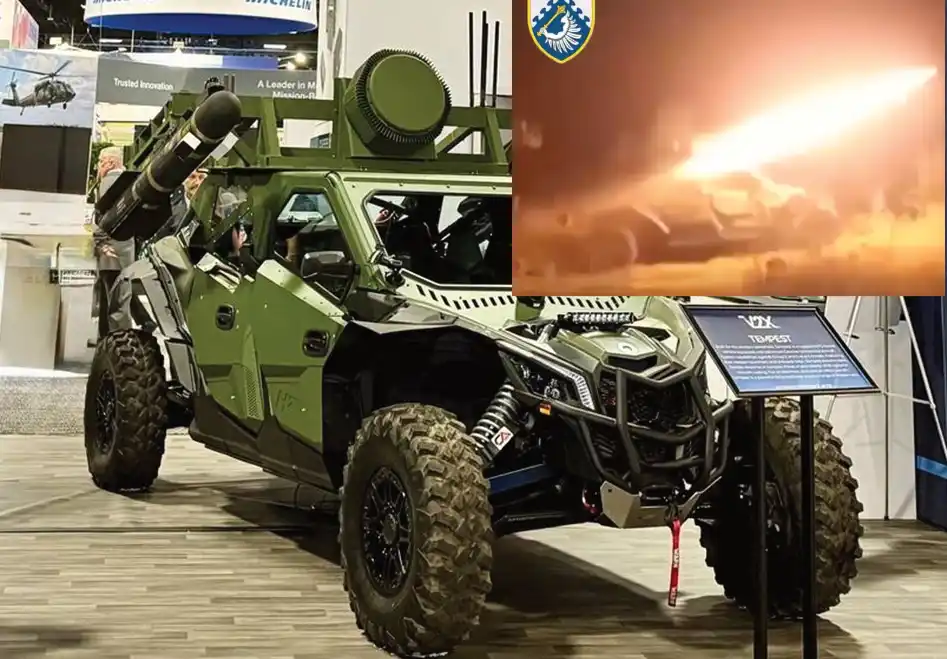
Ukraine has taken another significant step in adapting to the realities of modern aerial warfare with the apparent first combat deployment of the U.S.-made V2X Tempest counter-drone system, a highly mobile interceptor designed specifically for the relentless drone threat shaping the conflict. Footage released by the Ukrainian Air Force at the start of 2026 strongly suggests that the Tempest has already been used to destroy a Russian unmanned aerial vehicle during a nighttime engagement, marking an important milestone for both Ukrainian air defense and U.S. rapid-fielding concepts.
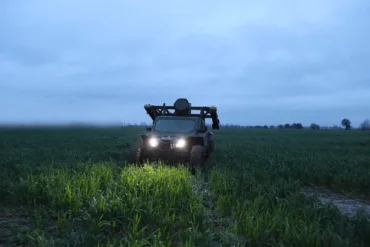
The brief clip, embedded within a New Year video montage published by Ukraine’s Air Command Center, shows a compact, lightly armored vehicle halting briefly before launching a missile into the dark sky. Seconds later, a distant flash consistent with an aerial intercept is visible. Although the system is not officially named in the video, multiple independent defense analysts have identified the vehicle as the V2X Tempest counter-UAS platform, based on its silhouette, launcher configuration, and firing sequence.
This restrained, almost understated introduction aligns with Kyiv’s established pattern for sensitive capabilities: operational use first, formal confirmation later—or not at all. In previous cases involving Western-supplied air defense and strike systems, Ukraine has chosen to demonstrate effectiveness on the battlefield before acknowledging specific platforms, limiting adversary intelligence while reinforcing deterrence through visible results.
The Tempest’s emergence is not merely symbolic. It reflects how Ukraine continues to reshape its layered air defense architecture under constant pressure from Russian drones, loitering munitions, and cruise missiles, while balancing survivability, cost, and speed of response.
A Counter-Drone System Built for Movement, Not Permanence
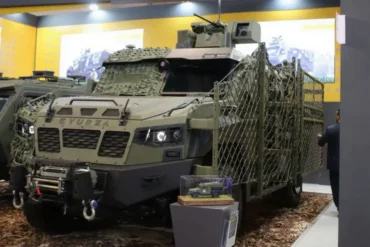
The V2X Tempest was conceived as a “shoot-and-scoot” counter-UAS solution, optimized for environments where lingering in one position invites immediate retaliation. Built on a rugged, commercially derived light vehicle, the system integrates dual missile launchers with an onboard sensor suite capable of detecting, tracking, and engaging Class 2 and Class 3 drones, even under heavy electronic warfare conditions.
Unlike traditional short-range air defense vehicles that rely on continuous radar emissions and extended firing positions, Tempest emphasizes minimal exposure time. Crews halt briefly, engage the target, and relocate almost immediately, reducing vulnerability to counter-battery fire, loitering munitions, or artillery strikes. This operational rhythm mirrors Ukrainian battlefield experience, where static air defense assets are rapidly targeted once detected.
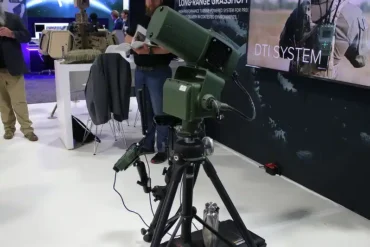
V2X documentation presented during defense exhibitions in 2025 highlighted the system’s ability to operate in GPS-degraded and communications-contested environments, a direct response to Russian jamming tactics. The Tempest’s design philosophy assumes that connectivity may be intermittent and that crews must retain the ability to fight autonomously when cut off from higher command nodes.
The Interceptor Question and Fire-and-Forget Advantage
One of the most closely analyzed aspects of the Tempest system is its missile. While V2X has not publicly disclosed the interceptor’s designation, defense analysts widely assess that the launcher configuration and engagement profile are consistent with the AGM-114L Longbow Hellfire or a closely related variant.
The Longbow’s active millimeter-wave radar seeker is a decisive factor. Unlike laser-guided missiles that require continuous target illumination, the radar-guided Hellfire allows true fire-and-forget engagement, enabling the vehicle to disengage immediately after launch. In a battlespace saturated with counterfire threats, this capability significantly enhances crew survivability.
With a warhead of roughly nine kilograms and a range suited to point defense, Hellfire-class interceptors occupy a crucial middle ground. They are powerful enough to ensure a high probability of kill against medium-sized drones while remaining far less expensive and scarce than strategic air defense missiles used against cruise or ballistic threats.
Filling a Critical Gap in Ukraine’s Air Defense Layer
Ukraine’s air defense challenge is not limited to intercepting high-end missiles. The daily reality involves large numbers of relatively low-cost drones, including Shahed-type one-way attack UAVs and reconnaissance platforms that cue artillery or missile strikes. Engaging these threats with strategic interceptors is economically unsustainable, while machine guns and MANPADS often lack range, accuracy, or all-weather reliability.
The Tempest offers a mid-tier solution, bridging the gap between guns and high-end systems such as Patriot, NASAMS, IRIS-T, and SAMP/T. By assigning mobile Tempest teams to protect airfields, logistics hubs, energy infrastructure, and troop concentrations, Ukraine can preserve its most advanced interceptors for the threats only they can defeat.
Equally important is the reduced collateral risk. Radar-guided interceptors can destroy drones at stand-off distances, lowering the chance that debris falls into populated areas or critical facilities—an increasingly important consideration as Russian strikes continue to target civilian infrastructure.
Networked Defense and Rapid Cueing
Open-source reporting from Tempest’s initial public unveiling suggests the presence of a compact onboard radar, likely optimized for engagement rather than wide-area surveillance. This supports the concept of a networked air defense ecosystem, where larger radars and command centers provide early warning and cue mobile shooters toward likely approach corridors.
In Ukrainian service, such integration would allow Tempest vehicles to remain silent and mobile until needed, activating sensors only for the final detect-to-engage phase. Even if the onboard radar covers a limited sector, this is consistent with Ukrainian tactics that prioritize rapid, localized engagements over persistent emissions.
Strategic Implications for Ukraine and the United States
Neither Kyiv nor Washington has publicly detailed the number of Tempest systems delivered, the timeline of their transfer, or the authority under which they were supplied. The system’s appearance in operational footage nonetheless indicates that at least one unit was integrated and combat-ready by late 2025.
This ambiguity leaves open two possibilities: Tempest may be undergoing operational evaluation in small numbers, or it could represent the leading edge of a broader shift toward rapidly fielded, commercially based counter-UAS solutions. In either case, Ukraine has once again become the world’s most demanding test environment for modern air defense concepts.
For the United States, real-world combat data from Tempest operations against Russian drones would be invaluable. Performance metrics such as engagement success rates, maintenance demands, and survivability under persistent threat cannot be fully replicated in exercises. Ukraine’s battlefield offers unfiltered feedback that could shape future counter-drone doctrine and procurement.
A Glimpse of the Drone War’s Future
The apparent combat debut of the V2X Tempest underscores a broader transformation in air defense thinking. Mobility, autonomy, and speed are becoming as critical as radar range and missile performance. Systems that cannot move quickly or operate under electronic attack are increasingly vulnerable, regardless of their theoretical capabilities.
For Ukraine, the Tempest is not a silver bullet. It is one more tool in a constantly evolving defensive mosaic, tailored to a war where drones are cheap, numerous, and tactically decisive. For observers beyond the conflict, its use offers a rare glimpse into how Western-designed counter-UAS systems perform when theory meets the unforgiving realities of modern combat.